

This is an overreaction of the immune system to harmless substances from the environment, called allergens, leading to symptoms ranging from mild like itching to severe like anaphylaxis.
Although not an immediate life-threatening condition, allergies have long-term effects on children's development and quality of life, and place a significant burden on families.
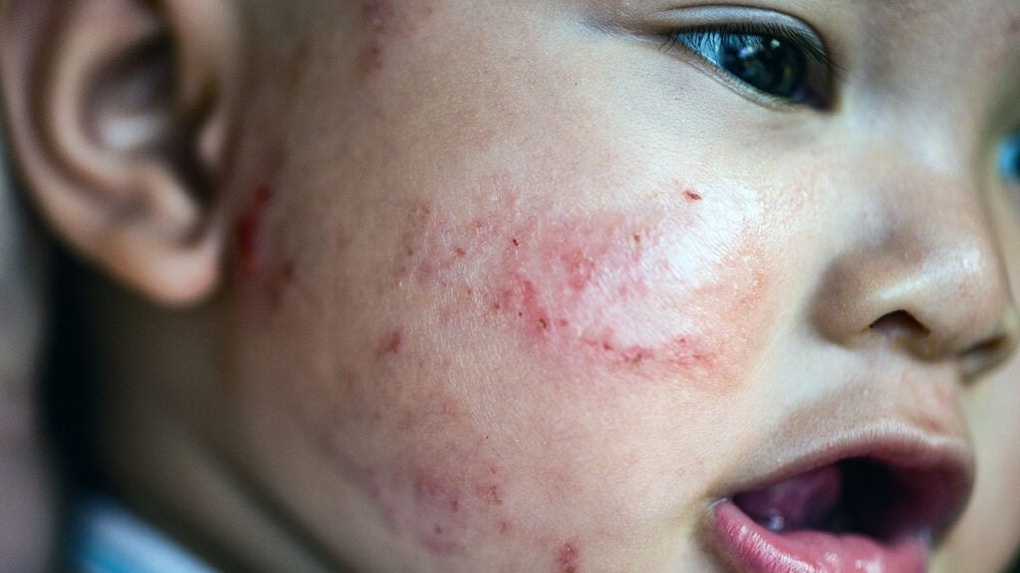
A child with atopic dermatitis (Illustrative image: Getty).
Reporting at the Pediatric Nose and Throat Conference 2025 held on December 12th, Dr. Hoang Quoc Tuong, Lecturer in Pediatrics, School of Medicine, University of Medicine and Pharmacy, Ho Chi Minh City, stated that allergies often manifest through conditions such as atopic dermatitis, food allergies, allergic rhinitis, and asthma.
These conditions don't appear in isolation but are usually part of a continuous, natural progression, known as an "allergic progression." Once an allergic condition develops, children are at risk of developing other conditions over time if they are not well managed.
Why are more and more people developing allergies?
The rate of allergies in children globally has increased rapidly in the past few decades. According to Dr. Hoang Quoc Tuong, while atopic dermatitis was rare 10 years ago, the incidence of this disease in children under 5 years old has now reached 10-20%, depending on the country.

Doctor Hoang Quoc Tuong giving a report at the event (Photo: DL).
The incidence of food allergies has also increased sharply, particularly to eggs, milk, and seafood, while allergic rhinitis accounts for 10-20% of school-aged children. Asthma is not only on the rise but is also projected to remain high until 2050.
"The underlying cause of allergies is damage to the epithelial barrier – the protective layer of the skin, gut, and respiratory tract. This allows allergens to easily penetrate and trigger an immune response."
"This increase is not due to a single cause but a combination of factors including climate change, declining microbial diversity, diet, and environmental pollution," the doctor stated.
Among the contributing factors, climate change is considered the biggest driver of the increase in respiratory allergies.
Rising global temperatures lead to a longer pollen season, higher pollen counts, and wider dispersal times. Extreme weather events such as floods, dust storms, and wildfires also increase the concentration of irritants in the air, causing outbreaks of allergic rhinitis and asthma.
In addition, loss of microbial diversity—a consequence of cesarean section, antibiotic overuse, and premature birth—is another cause of allergies in children.
In particular, cesarean sections prevent babies from being exposed to their mother's natural microbiome as they would be in vaginal deliveries. Premature births don't allow enough time for babies to fully develop their immune system and epithelial barrier. The overuse of antibiotics disrupts the balance of the microbiome, making the body more prone to overreacting to allergens.
Changes in dietary patterns also explain the increasing rate of allergies.
According to Dr. Tuong, a diet high in fast food, saturated fats, refined sugar, and highly processed foods, and lacking in vegetables and fiber, has been shown to increase the risk of allergies in children.
Furthermore, air pollution, vehicle exhaust fumes, fine dust, detergents, preservatives, etc., directly attack the epithelial barrier of the skin and respiratory mucosa. When this barrier is damaged, it increases the likelihood of allergens entering the body.

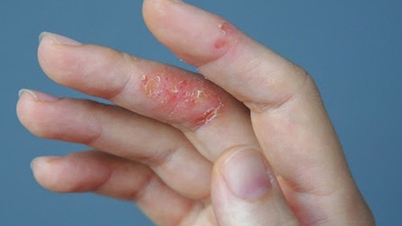
A little girl's arm is covered in allergic rashes (Illustrative image: Getty).
The "domino effect" of allergic diseases and how to prevent them.
The allergic process in children is a natural progression according to age and biological mechanisms, beginning with skin lesions and leading to respiratory diseases. Dr. Hoang Quoc Tuong describes this as a "domino effect," with atopic dermatitis as the first link. If left uncontrolled, it can spread to food allergies, allergic rhinitis, and asthma.
According to the allergic progression, children often develop atopic dermatitis in their early years. As they get older, they may also develop food allergies, most commonly to eggs, peanuts, milk, and seafood. Studies show that children who develop atopic dermatitis early have a six times higher risk of developing food allergies compared to normal children.
During the school-age period, allergies can spread to the respiratory system with conditions such as allergic rhinitis and asthma. These two conditions are closely related: good control of allergic rhinitis helps improve asthma control, and vice versa.
Furthermore, children can suffer from "double allergies," meaning they have multiple allergic conditions simultaneously. If not treated early, the allergic condition will worsen and become more difficult to control later on.
According to Dr. Tuong, completely preventing the progression of allergies is not yet possible. However, some early interventions from the pregnancy stage to when the child is older have been proven effective in reducing risk and limiting the severity of the disease.
Studies show that a Mediterranean diet, or a diet rich in vegetables and fresh foods, helps reduce the risk of allergic rhinitis and asthma in children as young as four years old. Conversely, a Western diet with highly processed or overcooked foods increases the risk of allergies in children.
Therefore, both mother and baby should eat a variety of foods, limit ultra-processed foods, and prioritize home-cooked meals to reduce/limit the risk of allergies.
Babies should be born naturally, exclusively breastfed, and avoid excessive use of antibiotics. They should also be exposed to allergens (pets, food, etc.) to boost their immunity.
Since atopic dermatitis is the initial stage of the allergic process, early skin care, especially in children with a family history, is also significantly effective. Doctors cite several recent studies showing that daily moisturizing from infancy can reduce the risk of atopic dermatitis by 30-50%.
Some studies have also noted that the use of probiotics may reduce the risk of atopic dermatitis, although the evidence is not yet strong enough to make a widespread recommendation.
For children with respiratory allergies, managing both allergic rhinitis and asthma simultaneously is essential. Effectively treating one condition will help improve the other.
Source: https://dantri.com.vn/suc-khoe/ly-do-ngay-cang-nhieu-tre-em-bi-viem-da-co-dia-di-ung-thuc-an-20251212141125406.htm











































































Comment (0)