

Many people only go to the doctor when these symptoms start to significantly affect their daily activities: difficulty walking, standing for a long time or having to stop halfway because numbness spreads down the leg. When recounting the progression, most admit that the pain appears slowly, lingering for many weeks, but they are subjective, thinking that their back is just sore after exercise or from sitting for a long time.
Among them, there is the case of Ms. T. (47 years old) - a person who lost the ability to move due to herniated disc and prolonged spinal stenosis, but was able to walk normally after TLIF surgery. She recounted that she started with dull back pain, sometimes numbness down the legs, but because she was busy with work, she was subjective. Only when the pain spread down both legs, and she had to hold onto the wall to walk, did she go to the hospital. The test results showed that she had a severe lumbar disc herniation with spinal stenosis, and severely compressed nerve roots.
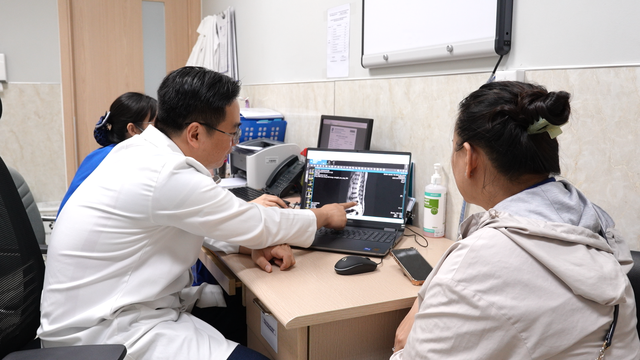
Doctor examines patient
Photo: BVCC
Spinal stenosis: The disease comes from very small changes
Through the patient's story, it is easy to see that the symptoms do not appear suddenly but progress silently. This is the characteristic of spinal stenosis - a condition in which the spinal canal, which is the "shield" protecting the spinal cord and nerve roots, gradually narrows. When this space becomes smaller, the nerves are compressed, causing back pain, numbness and weakness in the limbs and limited mobility.
When diagnosed, many people are surprised because they do not think that the "mild and familiar" pain is related to spinal disease.
Ms. T. was the same! She thought that her back pain was just due to sitting too much. But when she could not stand up by herself, felt numbness and tingling like electricity running down her legs and almost lost the ability to move, she really realized the seriousness of her condition. MRI images showed that the herniated disc had compressed almost the entire spinal canal and nerve roots. If delayed, the risk of complete paralysis was very high.
What causes the spinal canal to narrow?
Based on common cases, spinal stenosis can originate from many causes:
Spinal degeneration : Bones and ligaments enlarge over time, narrowing the spinal canal space.
Herniated disc: The nucleus pulposus escapes and presses directly on the nerve roots or spinal cord.
Spondylolisthesis: The vertebrae are misaligned, creating pressure and narrowing the spinal canal.
Spinal injury: Fracture, fracture or deformity after an accident.
Congenital: Some people are born with a smaller than normal spinal canal.
Post-surgical/traumatic complications: Scar tissue or bone growth over time.
Spinal stenosis is common in middle-aged and elderly people due to degeneration, but in recent years, doctors have recorded a number of younger cases with symptoms, mainly due to prolonged sitting in the wrong posture, lack of exercise or sports injuries. However, this is not a common disease in young people.

The team of doctors operated on the patient
Photo: BVCC
Signs that patients easily confuse
Many patients, when recounted, experienced a similar series of symptoms:
Back pain radiating down the legs, especially when standing for long periods or walking a lot. Numbness and tingling along the legs, feeling of heaviness in the legs or unsteady gait. Reduced sensation in the buttocks and inner thighs. Must stop and rest after walking a short distance before continuing. In more severe cases: urinary and bowel disorders.
These symptoms range from mild to severe, so the early stages are often mistaken for sciatica or common low back pain.
For Ms. T., at first there was only slight numbness in her right leg, then it spread down both legs, the pain increased when standing, and decreased when sitting and bending - a typical sign of spinal stenosis. But because she thought it would "cure itself", she missed many golden opportunities for early treatment.
When to see a doctor?
The common story of many patients is that they only go to the hospital when the pain really hinders movement. However, specialist Dr. Nguyen Hai Tam, Department of Neurosurgery - Spine, South Saigon Hospital said that if the following signs appear, patients should see a doctor soon:
Pain radiating down the leg lasting more than 1-2 weeks. Numbness and weakness in the lower limbs, burning sensation or sharp pain when standing. Difficulty controlling urination or bowel movements. Decreased sensation in the buttocks and inner thighs.
This may be a sign of nerve damage and needs to be evaluated promptly to avoid long-term sequelae.
Spinal stenosis treatment: each patient has a separate regimen
Depending on the degree of compression and symptoms, your doctor may recommend:
- Medical treatment: Pain relievers, muscle relaxants, anti-inflammatory drugs.
- Physical therapy: Helps reduce pressure on the spine and improve mobility.
- Minimally invasive intervention in cases of persistent pain unresponsive to conservative treatment.
- Surgical decompression when signs of weakness or sphincter dysfunction appear.
In Ms. T.'s case, the doctor prescribed TLIF surgery (transverse interbody fusion). During the surgery, the team of the Neurosurgery - Spine Department removed the herniated nucleus pulposus, decompressed the nerve roots, placed a cage and fixed screws to recreate the intervertebral height. After the surgery, the unexpected happened: Ms. T. was able to sit up on the second day, practice walking on the third day and was discharged safely afterward. From almost losing the ability to move, she returned to normal activities - something she herself once thought was impossible.
Source: https://thanhnien.vn/hep-ong-song-bien-chung-cot-song-am-tham-qua-nhung-cau-chuyen-nguoi-benh-185251203141120031.htm


![[Photo] Cat Ba - Green island paradise](/_next/image?url=https%3A%2F%2Fvphoto.vietnam.vn%2Fthumb%2F1200x675%2Fvietnam%2Fresource%2FIMAGE%2F2025%2F12%2F04%2F1764821844074_ndo_br_1-dcbthienduongxanh638-jpg.webp&w=3840&q=75)
















































![[VIMC 40 days of lightning speed] Da Nang Port: Unity - Lightning speed - Breakthrough to the finish line](https://vphoto.vietnam.vn/thumb/402x226/vietnam/resource/IMAGE/2025/12/04/1764833540882_cdn_4-12-25.jpeg)







































Comment (0)