

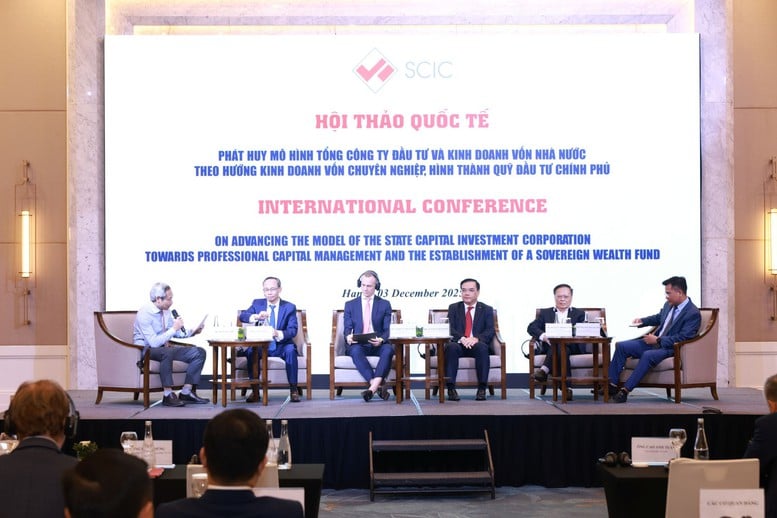
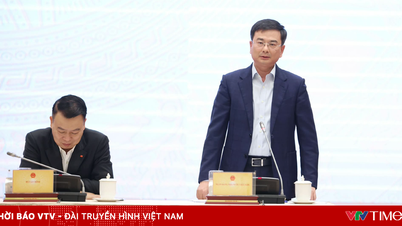
Experts and managers discuss at the workshop "Promoting the model of the State Capital Investment Corporation towards professional capital trading, forming a Government Investment Fund" - Photo: VGP/HT
SCIC affirms the advantages of the capital investment business model
At the international conference on December 3 with the theme "Promoting the State Capital Investment Corporation model towards professional capital trading, forming a Government Investment Fund", Deputy Minister of Finance Cao Anh Tuan highly appreciated SCIC's achievements over nearly 20 years, saying that the capital investment and trading enterprise model has proven to be more effective than the traditional administrative management mechanism.
Since its establishment, SCIC has taken over 120 enterprises, including 18 corporations and general companies, with a total state capital of more than VND 24,746 billion, and handled many major problems at Vinaconex, Vinatex and Seaprodex. Currently, SCIC represents the owner of 112 enterprises, with a total book value of VND 56,284 billion, while implementing solutions to optimize resources and manage state assets in accordance with regulations.
Deputy Minister Cao Anh Tuan emphasized that separating the capital ownership representative function from the state management of ministries, branches and localities is an important step forward, helping to reduce procedures, shorten work processing and make good use of investment opportunities. The capital management model in the direction of investment - business has helped SCIC operate more streamlined and professionally.
Since 2014, SCIC has sold capital in 396 enterprises, collecting nearly 48,000 billion VND, 4.4 times the cost price and accounting for 90% of the value of capital sold since its establishment. At the same time, SCIC has promoted new investments with a total value of more than 55,000 billion VND, including 16,000 billion VND invested in enterprises it has received, 15,000 billion VND invested under the direction of the Government and 10,639 billion VND in key areas such as energy, port infrastructure and finance - banking.
The representative of the Ministry of Finance affirmed that SCIC is increasingly demonstrating its role as an important financial tool in preserving and developing state capital, contributing to promoting economic growth.
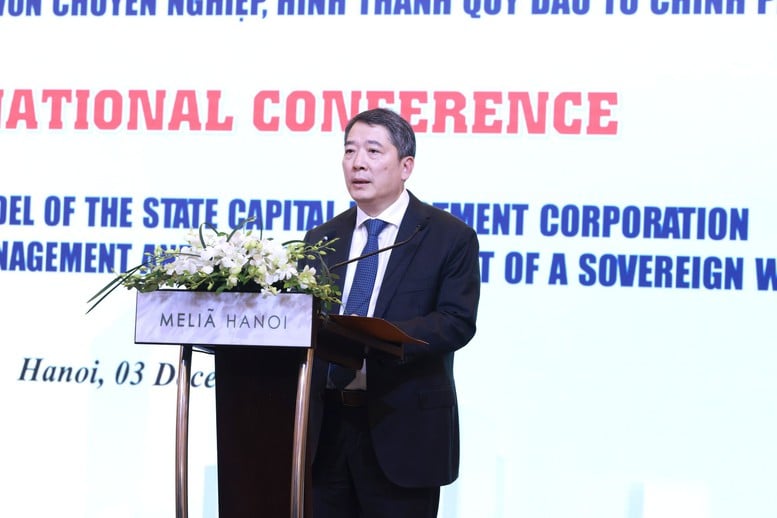
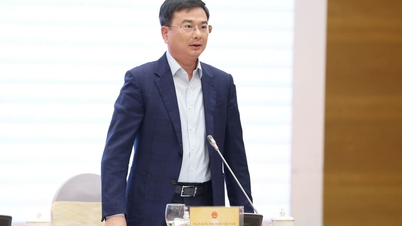
Deputy Minister of Finance Cao Anh Tuan speaks - Photo: VGP/HT
Model transformation - an inevitable development step
Deputy Minister Cao Anh Tuan said that the results achieved by SCIC are still not commensurate with its potential and position. The Deputy Minister said that the National Assembly has passed Law 68/2025/QH15 on management and investment of state capital in enterprises, replacing Law 69/2014, marking a shift from “capital management and use” to “capital management and investment”, creating an important legal foundation to improve the efficiency of state assets.
The Ministry of Finance is finalizing three decrees guiding Law 68/2025/QH15, including: a decree on state capital management and investment; a decree on inspection, supervision and evaluation of enterprise efficiency; and a decree on restructuring state enterprise capital. At the same time, the Ministry is also developing six specific decrees on the operational and financial mechanisms for corporations and groups in key sectors, including a decree on enterprises investing and trading state capital - the legal basis for SCIC to fully promote its role.
The Politburo is directing the development of a State economic development project, focusing on improving the efficiency of the State enterprise sector and restructuring State-owned enterprises towards reducing the number, increasing the scale, and focusing on essential industries.
According to Deputy Minister Cao Anh Tuan, studying international experience on the Government Investment Fund model is necessary. Models such as Temasek, Khazanah or Danatara provide many lessons for Vietnam. “If aiming for the Government Investment Fund model, it is necessary to calculate the financial mechanism, resources and legal framework so that SCIC can truly become an effective financial tool,” he noted.
At the workshop, international experts, financial institutions and consultants shared experiences in reforming state-owned enterprise management, analyzed the Temasek model and evaluated the equitization process as well as the role of SCIC in restructuring state-owned enterprises. Opinions focused on perfecting the organizational structure, operating mechanism, improving transparency and guiding SCIC to operate according to international standards.
Receiving the comments, Mr. Nguyen Chi Thanh - Chairman of the Board of Directors of SCIC said that the proposals at the workshop have high practical value, especially in affirming the need to give SCIC more autonomy in investment, divestment and corporate governance. According to him, when given enough authority and flexible mechanisms, SCIC will invest more professionally, transparently and effectively, gradually developing into a model of a Government Investment Fund with an independent monitoring system and transparent information disclosure.
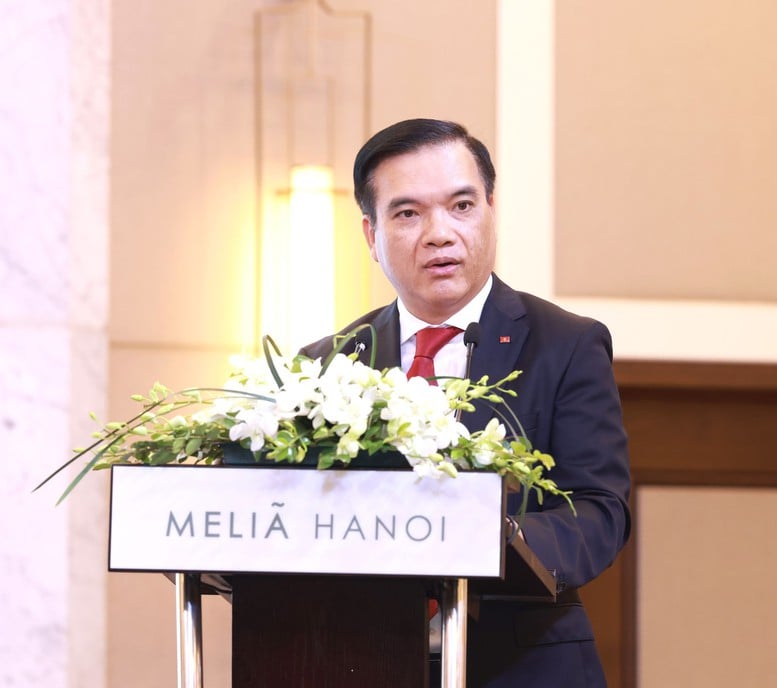
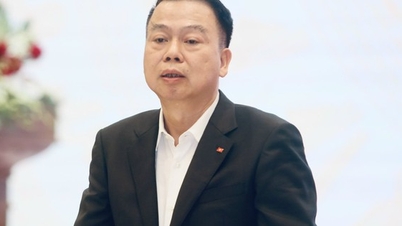
Mr. Nguyen Chi Thanh - Chairman of SCIC Board of Directors - Photo: VGP/HT
Mr. Nguyen Chi Thanh also said that after nearly 20 years of operation, SCIC has basically completed its mission of restructuring state-owned enterprises: "From more than 1,000 enterprises, SCIC now has about 100 enterprises - that is a big step forward."
SCIC leaders emphasized that a clear development strategy is a prerequisite for implementing the long-term vision. The strategy to 2030 and vision to 2035 were approved by the Prime Minister in 2023, creating an important foundation for developing decrees and guidelines for practical implementation.
Regarding the operating mechanism, SCIC proposed to increase the initiative in investment decisions, avoiding bureaucratizing commercial decisions. International experts also said that SCIC's investment activities should be based on the market, similar to the Temasek model.
An important point emphasized is to expand the scale of receiving state capital. Currently, SCIC only manages about 2% of total capital, so it needs to be authorized to receive more, especially through increasing capital at existing enterprises such as Vietnam Airlines, Song Da or Vinaconex, instead of continuing to establish new specialized investment corporations.
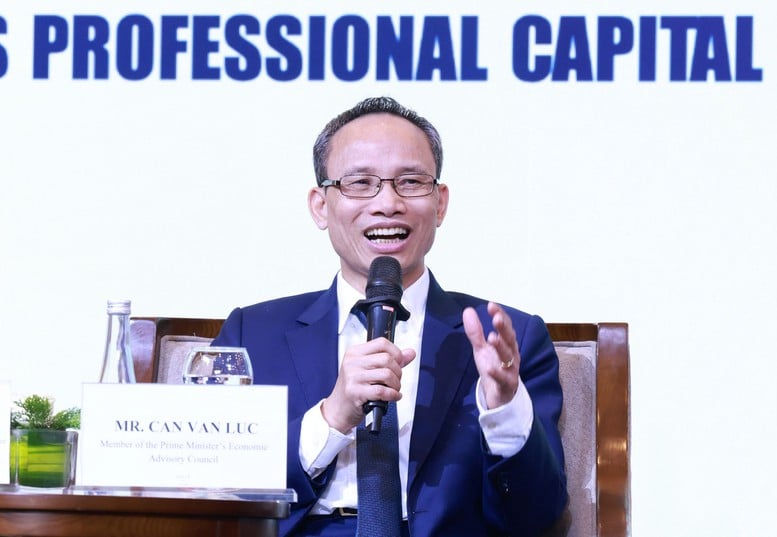
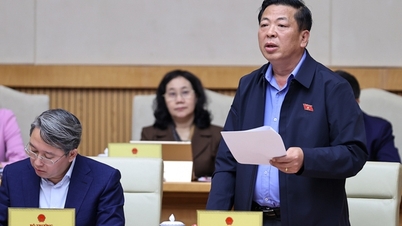
Dr. Can Van Luc, member of the National Financial and Monetary Policy Advisory Council, speaks - Photo: VGP/HT
Regarding financial resources, SCIC proposed to increase charter capital and retain a portion of after-tax profits for reinvestment. Current regulations only allow a maximum of 30% of profits to be allocated to the Development Investment Fund, limiting the ability to expand investment.
Dr. Can Van Luc, member of the National Financial and Monetary Policy Advisory Council, proposed adjusting the "capital preservation" target in the long term and by investment portfolio. "It is impossible to require absolute capital preservation in each project. What is important is the overall efficiency of the investment portfolio in the medium and long term...", he emphasized, at the same time saying that SCIC needs to aim to increase enterprise value, diversify the portfolio and contribute to macroeconomic stability like large government investment funds in the world.
Huy Thang
Source: https://baochinhphu.vn/huong-toi-mo-hinh-quy-dau-tu-chinh-phu-nang-tam-quan-ly-von-nha-nuoc-102251203180430977.htm
![[Photo] 60th Anniversary of the Founding of the Vietnam Association of Photographic Artists](/_next/image?url=https%3A%2F%2Fvphoto.vietnam.vn%2Fthumb%2F1200x675%2Fvietnam%2Fresource%2FIMAGE%2F2025%2F12%2F05%2F1764935864512_a1-bnd-0841-9740-jpg.webp&w=3840&q=75)


![[Photo] National Assembly Chairman Tran Thanh Man attends the VinFuture 2025 Award Ceremony](/_next/image?url=https%3A%2F%2Fvphoto.vietnam.vn%2Fthumb%2F1200x675%2Fvietnam%2Fresource%2FIMAGE%2F2025%2F12%2F05%2F1764951162416_2628509768338816493-6995-jpg.webp&w=3840&q=75)




















































































Comment (0)