


Phu Tho province tax officials guide businesses to install and pay taxes on the eTax Mobile electronic tax application
From lump-sum tax to data-driven management
In the context of digital transformation spreading more and more widely in all fields, Hanoi is taking an important step towards eliminating lump-sum tax, a tax collection method that has existed for many years with individual business households.
According to the plan, from January 1, 2026, all business households in the city will fulfill their tax obligations by declaration method, based on electronic invoices and actual income data. This means that the lump-sum method - which depends heavily on manual estimation and assessment - will officially end.
The Hanoi Tax Department leader said that this change is not simply an adjustment of tax calculation methods but a comprehensive transformation in management methods. The tax industry no longer operates based on estimates and "trust" but on data and digital platforms, in which taxpayers play a central role.
One of the important factors helping Hanoi accelerate the transformation process is the implementation of the Government 's Project 06 on building a national database on population.
According to Deputy Head of Hanoi Tax Nguyen Anh Dung, Hanoi is currently the locality with the highest progress in standardizing personal tax data in the country. To date, more than 7.1 million personal tax codes have been reviewed and matched with the Ministry of Public Security, achieving an accuracy rate of over 99.8%.
Along with population data, the Hanoi tax sector has built a separate database for e-commerce activities. More than 154,700 organizations, enterprises, business households and individuals doing business on digital platforms have been put under monitoring and management.
By 2025, revenue from e-commerce in Hanoi is expected to reach about VND36,300 billion. This figure clearly reflects the effectiveness of "bringing digital business back on track", as tax officials say.
In addition to investing in technology and data, Hanoi is implementing Project 420 to innovate management methods and prevent tax losses in the household business sector.
Since the beginning of the year, the tax authority has added nearly 70,000 business households to its official management. The activities of reviewing cash flow collection and payment, input invoices, data on cash on delivery (COD) and online sales activities are carried out synchronously.
According to statistics, these solutions alone have helped increase budget revenue by more than 1,200 billion VND per year. Of which, the review of the e-commerce sector contributed nearly 890 billion VND.
At the same time, the tax force coordinated with the city police to handle many tax violations in the digital environment, including doing business via social networks and using personal accounts to conceal revenue.
From the end of 2025, Hanoi will launch the campaign "60 peak days of converting from lump-sum tax to declaration" under the direction of the Tax Department.
In this final stage, the tax sector is not only focusing on operations but also shifting to direct support. More than 130 training courses were held in districts with nearly 23,000 business households participating.
In addition, more than 600 Zalo support groups have been established by locality, helping tax officials reach each household and directly answer each problem. Banks and software providers have participated in providing free sales tools, digital signatures and electronic invoices for business households.
According to a representative of Hanoi Tax, the goal is not only to change the tax collection method, but also to help businesses "not lose pace" during the change process.
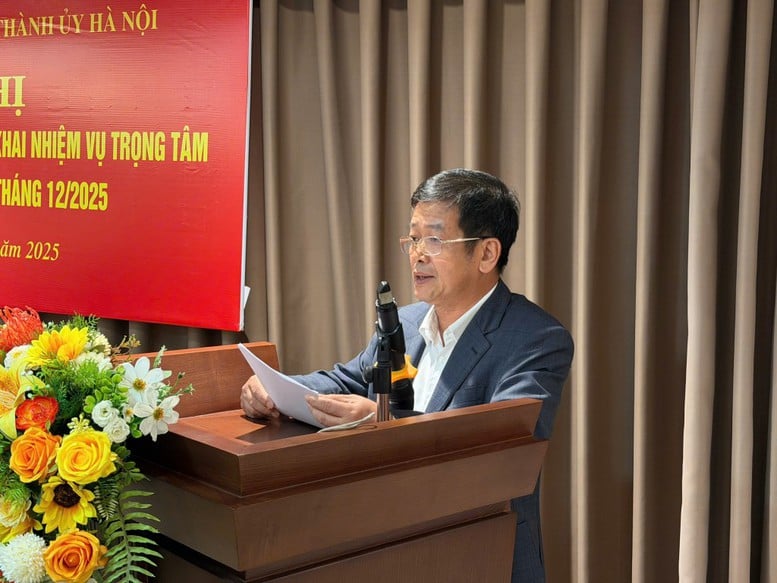
Deputy Head of Taxation of Hanoi City Nguyen Anh Dung shares about management work for business households
Changing the way we think about paying taxes
Not only Hanoi, localities such as Phu Tho and Bac Ninh are also strongly implementing the conversion campaign.
In Phu Tho, the tax department has surveyed more than 77,000 business households, of which more than 3,000 households have used electronic invoices from cash registers, nearly 50,000 households have installed the eTax Mobile application. It is expected that by early 2026, about 65,000 households in this locality will switch to tax declaration.
In Bac Ninh, more than 400 business households have proactively switched to the declaration method, nearly 30 households have converted their model to become enterprises. Tax officers go to markets and stores to directly guide each household to install software and declare taxes electronically.
Resolution 68 of the Politburo sets the target of eliminating lump-sum tax by 2026 at the latest. Resolution 198 of the National Assembly clearly stipulates that lump-sum tax will not be applied from 2026. The Government has also requested the completion of the implementation of electronic invoices from cash registers by 2025.
In October 2025, the Ministry of Finance issued Decision 3389, approving the project to convert tax management methods for business households, creating a complete legal corridor for localities to implement.
According to Hanoi's orientation, the elimination of lump-sum tax does not stop at managing budget revenue but aims at a long-term goal: forming a generation of small businesses from the individual economic sector.
The city aims to add about 40,000 businesses each year in the 2026–2030 period, of which a large portion is expected to come from business households.
To support this process, Hanoi proposed allocating the 2026–2030 budget for declaration software, digital signature subsidies, legal and accounting support, and technology infrastructure. This is considered the “initial investment cost” for business households to enter a professional operating environment.
Mr. Minh
Source: https://baochinhphu.vn/co-quan-thue-cac-dia-phuong-tich-cuc-ho-tro-ho-kinh-doanh-chuyen-doi-thue-102251206111214829.htm


![[Photo] National Assembly Chairman Tran Thanh Man attends the VinFuture 2025 Award Ceremony](/_next/image?url=https%3A%2F%2Fvphoto.vietnam.vn%2Fthumb%2F1200x675%2Fvietnam%2Fresource%2FIMAGE%2F2025%2F12%2F05%2F1764951162416_2628509768338816493-6995-jpg.webp&w=3840&q=75)

![[Photo] 60th Anniversary of the Founding of the Vietnam Association of Photographic Artists](/_next/image?url=https%3A%2F%2Fvphoto.vietnam.vn%2Fthumb%2F1200x675%2Fvietnam%2Fresource%2FIMAGE%2F2025%2F12%2F05%2F1764935864512_a1-bnd-0841-9740-jpg.webp&w=3840&q=75)

























































































Comment (0)