

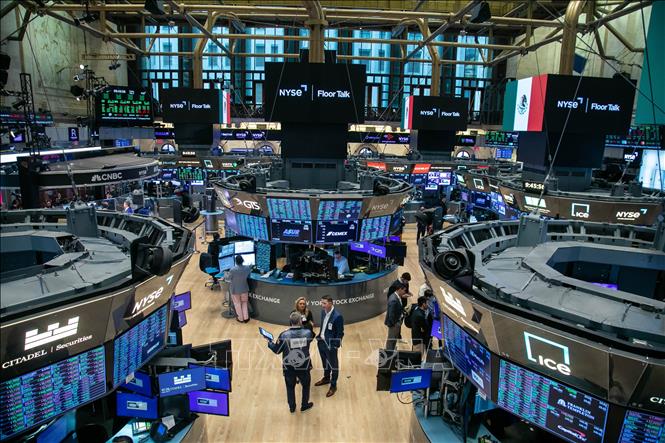
At the end of the trading session on December 5, the Dow Jones Industrial Average rose 104.05 points (0.22%) to 47,954.99 points. Meanwhile, the S&P 500 Composite Index gained 13.28 points (0.19%) to 6,870.40 points and the Nasdaq Composite Technology Index added 72.99 points (0.31%) to 23,578.13 points.
For the week, all three major indexes recorded their second consecutive weekly gain. Specifically, the S&P 500 increased 0.31%, the Nasdaq advanced 0.91% and the Dow Jones added 0.5%.
Main governing factors
The stock market was dominated by two main factors last week: the return of delayed economic data and growing expectations of a round of monetary policy easing from the Fed.
After 43 days of government shutdown, investors finally got some important economic data. The US Commerce Department reported that consumer spending, which accounts for more than two-thirds of economic activity, increased 0.3% in September 2025, in line with expectations. Meanwhile, the Personal Consumption Expenditures (PCE) price index, the Fed's preferred inflation measure, also rose 0.3%, suggesting that US inflation remains under control.
Meanwhile, US labor market data has sent mixed messages. A report from consulting firm ADP showed that the private sector lost 32,000 jobs in November 2025, the largest decline in more than two years. In contrast, the report of weekly jobless claims fell to a three-year low. This contradiction makes investors wait even longer for the November 2025 non -farm payrolls report, scheduled to be released on December 16, to get a clearer view of the US economic situation.
Still, price indexes and a separate report from the University of Michigan showing improved US consumer confidence in early December have strongly reinforced the case for the Fed to act soon.
According to the CME Group's FedWatch tool, the market is now betting on a nearly 90% chance that the Fed will cut interest rates by 0.25 percentage points at next week's meeting. Analysts say the main reason for this belief is that the market believes the Fed does not want to risk a temporary economic weakness turning into a prolonged recession.
Division within the Fed
But while markets are all but certain of a cut, next week’s Fed meeting is expected to be one of the most contentious in years, with at least five of the Fed’s 12 voting members already voicing opposition or skepticism about further easing.
The Fed appears more divided than ever on the path of interest rates, and the market will be interested in the degree of division because it may reveal the Fed's future direction, said Michael Rosen, chief investment officer at asset manager Angeles Investments.
The number of dissenting votes will be an important indicator. The last time the Federal Open Market Committee (FOMC), the Fed's monetary policymaking body, had three or more dissenting votes was in 2019. This shows the complexity of the Fed's balancing act between protecting the labor market and stabilizing inflation.
The Fed’s monetary policy meeting next week is expected to see even more dissent, regardless of the final decision. At the last meeting, there were two votes against a cut: Kansas City Fed President Jeffrey Schmid said high inflation did not warrant easing, while Fed Governor Stephen Miran wanted a bigger cut, by half a percentage point, because he believed inflation was falling faster than previously expected.
Forecast scenario for next week
Next week promises to be a pivotal week for the market, with the two most important events being the Fed meeting on December 9-10 and the November 2025 non-farm payroll report.
All eyes will be on the Fed meeting, said Michael Sheldon, vice president at Washington Trust Wealth Management. With the decision to cut rates almost decided, the question now is what the Fed will say after the meeting about the final interest rate of 2025 and whether it will give any hints about future policy.
Investors will be scrutinizing updated economic forecasts and dot plots for clues. The Fed is likely to take a cautious tone and emphasize waiting for economic data before making a decision, said Tony Roth, chief investment officer at Wilmington Trust.
Meanwhile, the November 2025 jobs report will be the first comprehensive look at the US labor market since the US government shutdown. Current forecasts show a rather weak picture, with only 38,000 jobs created.
Finally, investors are also waiting to see if the Santa Claus rally will happen this year. This is a term that describes the regular phenomenon of the US stock market that usually increases continuously in the last 5 trading sessions of December and the first 2 trading sessions of the new year.
Statistically, this period has typically been positive for the market. Since 1980, this period has reported positive results 73% of the time, with the S&P 500 averaging a 1.1% gain.
Source: https://baotintuc.vn/thi-truong-tien-te/chung-khoan-my-tang-nhe-tuan-qua-khi-tam-diem-huong-ve-fed-20251206130351336.htm
![[Photo] National Assembly Chairman Tran Thanh Man attends the VinFuture 2025 Award Ceremony](/_next/image?url=https%3A%2F%2Fvphoto.vietnam.vn%2Fthumb%2F1200x675%2Fvietnam%2Fresource%2FIMAGE%2F2025%2F12%2F05%2F1764951162416_2628509768338816493-6995-jpg.webp&w=3840&q=75)



![[Photo] 60th Anniversary of the Founding of the Vietnam Association of Photographic Artists](/_next/image?url=https%3A%2F%2Fvphoto.vietnam.vn%2Fthumb%2F1200x675%2Fvietnam%2Fresource%2FIMAGE%2F2025%2F12%2F05%2F1764935864512_a1-bnd-0841-9740-jpg.webp&w=3840&q=75)

































































































Comment (0)