

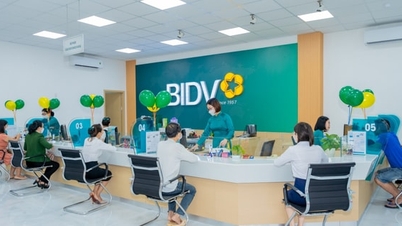
Large-scale joint-stock banks such as VPBank and HDBank recorded NIM exceeding 5%. On the contrary, some small-scale banks only had NIM below 2%. Explaining the reason for the increasingly narrowing NIM, Associate Professor Dr. Dinh Trong Thinh, a financial expert, said that it was mainly because the banking industry was under great pressure to increase deposit interest rates to compete for capital compared to other investment channels, while lending interest rates remained firmly at a low level to support people and businesses, especially at the end of the year and near the Lunar New Year.
Expert Nguyen The Minh, Director of Research and Development of Individual Clients at Yuanta Securities Vietnam, also said that the trend of decreasing net interest margins has been continuous for the past 2-3 years. According to this expert, the biggest reason comes from the urgent request of the Government for the banking industry to maintain low interest rates to support economic recovery, prioritizing growth. In the context that the operator still prioritizes maintaining the current policy, the net interest margins of banks will still be affected in the coming time. Especially for banks with a high rate of income from credit, business operations will certainly be more difficult.

Experts from Dragon Viet Securities Company (VDSC) also shared the view that in the short term, the room for improvement in NIM will be more limited, mainly due to the pressure from capital costs increasing faster than output interest rates. According to VDSC, banks' mobilization costs continue to face many increasing pressures when considering the demand for credit disbursement at the end of the year is often very high and the current gap between mobilization and credit is still significant. However, the liquidity pressure of the system can be partly relieved when the budget expenditure flow, especially disbursement for public investment projects, often increases in the final period of the year.
That is only in the short term, to solve the problem of improving NIM, next year, banks will be forced to increase the CASA ratio, control capital costs well and optimize the loan portfolio, while promoting credit in areas and customer segments with higher lending interest rates. In addition, in the digital era, banks that promote technology investment, digital banking transformation, improve customer experience... will reduce operating costs, increase business efficiency, and contribute to improving NIM.
In the context of deposit interest rates tending to increase again due to year-end liquidity pressure and competition to attract capital, the banking industry's NIM is under clear pressure to narrow. To minimize the impact on business results, experts say that banks need to focus on increasing non-interest income. VIS Rating experts say that strong growth in income from service fees, investments and bad debt recovery is becoming an important "cushion" to help the banking industry's profits remain stable in the context of NIM no longer being as thick as in previous years. In fact, many banks are promoting digital payment services, cards, e-banking and bancassurance, gradually turning non-credit products into a stable source of income. This is an inevitable trend towards sustainable growth, gradually reducing dependence on traditional credit that banks need to identify in their long-term strategies.
Source: https://thoibaonganhang.vn/du-dia-cai-thien-nim-ngay-cang-thu-hep-174689.html
![[Photo] 60th Anniversary of the Founding of the Vietnam Association of Photographic Artists](/_next/image?url=https%3A%2F%2Fvphoto.vietnam.vn%2Fthumb%2F1200x675%2Fvietnam%2Fresource%2FIMAGE%2F2025%2F12%2F05%2F1764935864512_a1-bnd-0841-9740-jpg.webp&w=3840&q=75)



![[Photo] National Assembly Chairman Tran Thanh Man attends the VinFuture 2025 Award Ceremony](/_next/image?url=https%3A%2F%2Fvphoto.vietnam.vn%2Fthumb%2F1200x675%2Fvietnam%2Fresource%2FIMAGE%2F2025%2F12%2F05%2F1764951162416_2628509768338816493-6995-jpg.webp&w=3840&q=75)


































































































Comment (0)