

Huynh Thuc Khang's journalistic career was closely associated with the newspaper Tieng Dan (Voice of the People), a leading example of patriotic journalism in Central Vietnam and throughout the country. Before the August Revolution of 1945, in a context where freedom of speech was suppressed, the patriotic scholar Huynh Thuc Khang courageously chose to "make a revolution openly" on the journalistic front. He declared: "I am an open revolutionary; I fight for the rights of the Vietnamese people openly."
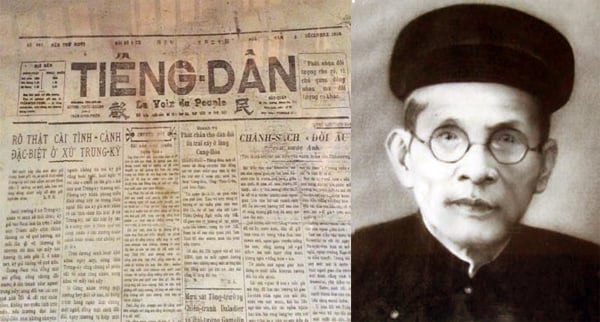 |
| Mr. Huynh Thuc Khang and the newspaper Tieng Dan. |
A dedicated and responsible journalist.
Mr. Huynh Thuc Khang (1876-1947) was born into a poor scholarly family of peasant origin in the mountainous region of Quang Nam. Despite facing numerous hardships, he overcame them with determination and perseverance. He achieved academic success early and gained considerable fame, but instead of pursuing an official career, he nurtured the ambition of modernizing the country.
For nearly 20 years, Huynh Thuc Khang appeared on the journalistic forum, demonstrating himself to be a sharp commentator, a writer with a frank spirit, a journalist with an upright and unwavering ideology in the face of the harsh policies of the colonial regime, with a writing style and reporting method that was "very much Huynh Thuc Khang".
Each of Huynh Thuc Khang's articles demonstrates profound knowledge, sharp insight, and worldly wisdom, exuding a spirit of unwavering courage in the face of hardship and a dedication to journalism for the benefit of society. His name is honored in the history of Vietnamese journalism.
Mr. Huynh's journalistic philosophy was to actively participate in political and social life and to be deeply concerned about the lives of the people. His writing style was full of fighting spirit. He was very aware of the role of the press, "A million soldiers are not worth a single newspaper," and always linked the mission of the press to the destiny of the nation, "The voice of the people is related to the affairs of the nation."
Despite his advanced age, Mr. Huynh devoted himself to serving as Minister of the Interior in Ho Chi Minh's government, and later as Acting President. He excelled in every role, making significant contributions and establishing a distinctly Quang Nam-style work ethic: decisive, swift, resolute, uncompromising, and unwavering.
The pen is a sharp "weapon".
The pen became a sharp weapon in spreading patriotic and revolutionary ideas during the French colonial period. Among them, Mr. Huynh Thuc Khang - a patriotic intellectual - founded the newspaper Tieng Dan (1927-1943); using journalism as a means of struggle, viewing it as a powerful weapon representing the voice of the broad masses, especially the oppressed working people.
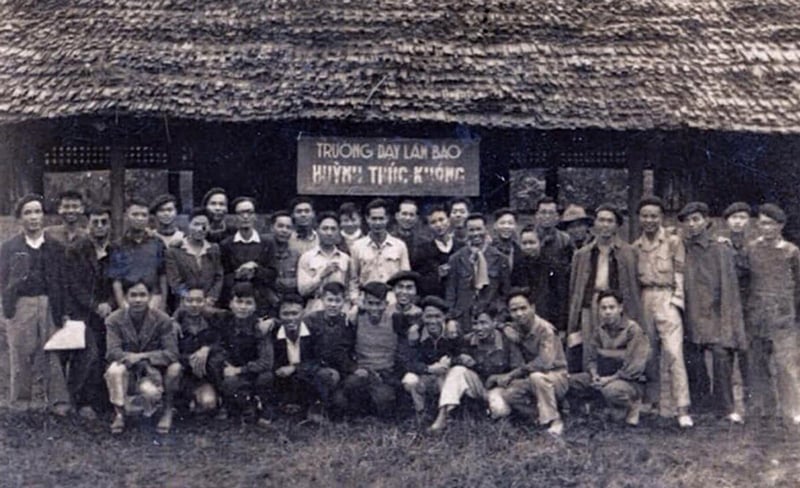 |
| The first students of the Huynh Thuc Khang School of Journalism (Archival photo). |
He believed that a person's greatest achievement lay in whether their words and actions in life benefited society, and whether they accomplished three "immortal" things (things that cannot be destroyed): establishing virtue, achieving merit, and leaving a lasting legacy. As for "mere wealth and luxury, that is not a true achievement" (Tiếng Dân, February 22, 1933).
It was precisely because of this philosophy that, during his time as editor-in-chief of the newspaper Tiếng Dân, even though accepting to publish false advertisements or print official documents that the French Legation in Central Vietnam wanted to entrust to him (while other printing houses had to go through a bidding process) would have increased his income, Huỳnh Thúc Kháng still refused, citing the reason that "the printing house doesn't have enough resources." He firmly believed that journalism was not a place to get rich. His financial independence, not being dependent on the French authorities or any organization, was a crucial factor in helping him lead the newspaper to uphold its principles of speaking the voice of the people and defending their rights…
During its 16 years of operation (1927-1943) with 1,766 issues published, Tiếng Dân was one of the representative newspapers of patriotic revolutionary journalism. The newspaper faithfully reflected the atmosphere and political life in the first half of the 20th century and made significant contributions to the cultural history of Central Vietnam and to Vietnamese journalism in general.
Later, during the nationwide resistance war, in order to promote the role of journalists in "fighting the enemy with their pens and guiding public opinion" and to advance the development of revolutionary Vietnamese journalism, at the end of 1948, President Ho Chi Minh instructed the General Headquarters of the Viet Minh to open a journalism school, considering it one of the urgent tasks. Accordingly, on the morning of April 4, 1949, in Bo Ra hamlet (now part of Tan Thai commune), Dai Tu district, Thai Nguyen province, an important event took place: the opening ceremony of the first course of the Huynh Thuc Khang School of Journalism.
The significance of naming the country's first journalism school after Mr. Huynh Thuc Khang lies in honoring and emulating this patriotic elder, who was also a renowned and long-time journalist; setting an example for students of diligent learning, progressive organizational skills, and unwavering integrity—fundamental qualities for a journalist.
He was one of the pioneers of the newspaper Tiếng Dân (Voice of the People), famously saying: "If I don't have the right to say everything I want to say, at least I can retain the right not to say what I am forced to say." This is the straightforwardness of Mr. Huynh, typical of the people of Quang Nam, and is well worth learning from for today's generation of journalists.
Source: https://baothainguyen.vn/chinh-polit/202502/huynh-thuc-khang-chi-si-noi-len-tieng-dan-de-lam-cach-mang-cong-khai-f930c94/



![[Image] Nearly 125,000 Hanoi students completed the Literature exam for the 10th grade entrance exam.](https://vphoto.vietnam.vn/thumb/1200x675/vietnam/resource/IMAGE/2026/05/30/1780117233041_ndo_br_thiet-ke-chua-co-ten-2-png.webp)












































































Comment (0)