

In 2017, as football superstar Cristiano Ronaldo was preparing to join Juventus, the Italian government launched a bold policy, later dubbed by the financial world after him: the "CR7 law." More than just a tactical move on the pitch, this was a powerful economic leverage: an extremely attractive flat tax regime for wealthy foreign individuals.
Accordingly, anyone who moves to Italy and becomes a resident only needs to pay a fixed fee of 200,000 euros per year (approximately $233,000) to be completely exempt from all income earned outside the country.
The above figure applies to all profits, from financial investments, image rights, capital gains to inheritances. The fee for each accompanying family member is even more favorable, at just 25,000 euros. The policy is valid for up to 15 years, a long enough period for wealthy families to confidently build their new empires.
For the ultra-rich, this is an offer they can't refuse. Matteo Pella, a senior broker at Berkshire Hathaway HomeServices, uses a metaphorical analogy: "For them, that tax is insignificant. It's like coffee: today it's 2 euros, tomorrow it's 4 euros, you wouldn't give it up anyway."
The simplicity and clarity of the "CR7 rule" created a huge pull, turning Italy into a magnet for global wealth.
The Migration of Millionaires
The results of this tax game are coming faster than expected. According to a report by Henley & Partners, a leading investment and immigration consulting firm, Italy has become the number one destination in Europe and the third in the world for millionaire migrants in 2025. An estimated 3,600 millionaires will choose the "boot-shaped country" as their new home, ranking only behind the United Arab Emirates (9,800) and the United States (7,500).
Prominent names in global finance and business have emerged one after another. Egypt's richest billionaire, Nassef Sawiris, co-owner of Aston Villa football club, and Richard Gnodde, Vice President of investment bank Goldman Sachs, are prime examples of this wave of wealthy migration. They bring with them not only personal assets but also networks of connections, investment opportunities, and a luxurious lifestyle.
This migration is taking place against a backdrop of deep divisions in global tax policy. While the UK decided to abolish its 200-year-old non-dominance rule, a move that caused many banks and investment funds to leave London after Brexit, Italy is taking the opposite path.
"People all over the world are asking us: How do we attract British millionaires and billionaires back to their home countries?", says Stuart Wakeling, managing partner at Henley & Partners UK. Italy has its own answer.

Italy is becoming an attractive destination for the super-rich thanks to its unique tax policies (Photo: Getty).
Milan is being reborn as a new financial capital.
At the heart of this shift is Milan, once known as Italy's fashion and industrial capital. Now, Milan is transforming itself into a vibrant international financial hub.
"Milan has changed a lot," commented Anna Cipriani, Director of Membership at the upscale Casa Cipriani Milano club. "No longer just an industrial or fashion city, Milan now attracts creatives, investors, and the international community."
Milan's rise is clearly reflected in its real estate market. Since the new tax policy was introduced in 2017, property prices in Milan have surged by 49%, while the average increase in other major Italian cities was only 10.9%.
According to Knight Frank's forecast, the luxury real estate segment here will continue to grow by another 3.5% in 2025. The heat is not limited to Milan but is also spreading to nearby "holiday paradises" such as Lake Como, the Tuscany region, and the Riviera.
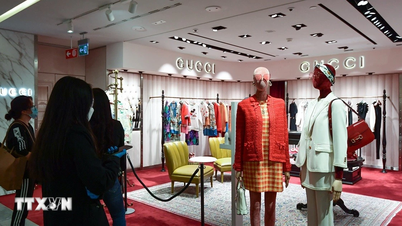
To cater to the new class of residents, a host of luxury services sprang up. Exclusive, private clubs like The Wilde and Casa Cipriani quickly became gathering places for the elite. Investment capital flowed not only into real estate but also stimulated the development of service industries, hotels, restaurants, and finance.
The European comeback game
Italy's strategy becomes even more unique when placed in the broader European context. The continent is witnessing a heated debate about wealth inequality. According to the European Central Bank (ECB), the wealthiest 5% of the eurozone population hold up to 45% of net worth. This is prompting many countries to consider tightening wealth taxes.
Spain not only maintains a progressive net worth tax of up to 3.5% but also imposes a "solidarity tax" on individuals owning over €3 million. France is discussing expanding the tax to real estate with a net worth of €1.3 million or more. Switzerland and Norway are the only two countries remaining that still maintain a tax on total personal net worth.
Meanwhile, a number of other European countries such as Austria, Germany, Denmark, and Sweden abolished property taxes decades ago due to concerns about high administrative costs and the risk of capital flight. Experience shows that when tax rates are too high, the super-rich, with their ability to move freely, can easily transfer assets or settle in other "tax havens."
Italy learned this lesson and decided to play the opposite game: instead of trying to tax a small fraction of the rich's wealth, they invited the rich in, collected a fixed and substantial fee, and expected the economic benefits to spill over.
Of course, Italy's strategy is not without controversy. Critics argue that the 200,000 euro fee from each millionaire is just a drop in the ocean compared to the country's enormous budget deficit.
They fear that this policy will widen the gap between rich and poor, with benefits concentrated only in already prosperous areas like Milan or Lake Como, while ordinary people still face the burden of high taxes. The risk of a "race to the bottom" in taxation, where countries compete by lowering taxes to attract the wealthy, is also a real concern.
However, from a business perspective, this migration wave is creating a positive "economic cycle." Anna Cipriani believes: "When the super-rich move in, hotels spring up, and services grow accordingly. More investors pouring into the city will create more job opportunities for local people."
Source: https://dantri.com.vn/kinh-doanh/italy-va-van-co-nguoc-doi-hut-gioi-sieu-giau-20250930100326389.htm




























































































Comment (0)