

In the middle of the vast sand sea of the Sahara, where the wind and sun burn relentlessly, appears a giant spiral of stone that seems to have been carved by a supernatural hand. From orbit, in the images captured by the European Space Agency's Copernicus Sentinel-2 satellite, the image looks like a giant bull's-eye, an "eye" opening in the middle of the desert: the Richat Structure, also known as the Eye of the Sahara.
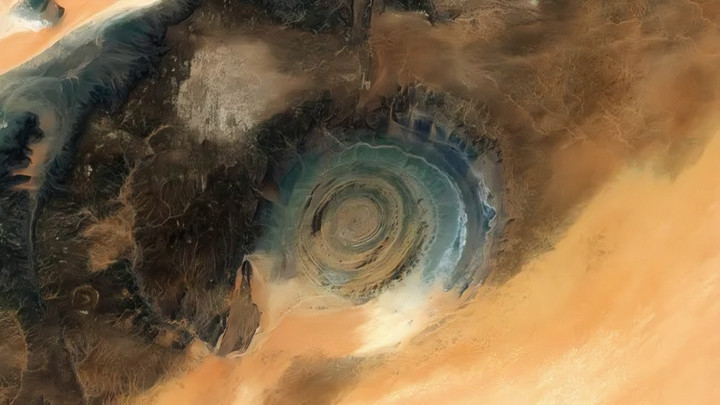
The Richat Structure appears as a giant “eye” in the middle of the Sahara Desert. (Source: Copernicus Sentinel data modified, ESA 2025)
At about 50 kilometers in diameter, the structure is large enough to be a recognizable landmark from space. Yet, from the ground, the circular shape all but disappears, obscured by sand dunes, hot mist, and rugged terrain. Only from above do the concentric rings become apparent, like petrified ripples frozen in time.
The circular perfection of this shape once led scientists to believe it was the remnant of an ancient meteorite impact. A circle in the middle of nowhere—isn’t that a meteorite crater? But when they surveyed the site, they found no trace of shocked quartz or molten rock, the indispensable evidence of a cosmic impact. The mystery gradually revealed itself: This was not a wound from outer space, but a story of deep Earth geology.
Millions of years ago, a giant magma bubble rose from the Earth’s crust, lifting layers of sedimentary rock into a giant dome. Over time, wind, water, and sand—the patient artisans of the Sahara—worn away the soft rock, leaving behind concentric rings of hard rock like quartz sandstone. The result is a natural cross-section of the Earth’s crust, revealing ancient rock layers that are at least 100 million years old.
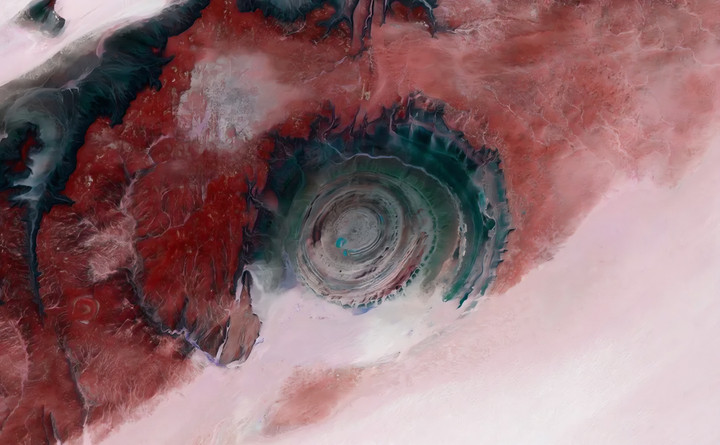
False-color image of the Richat Structure reveals details of its internal chemical composition. (Source: modified Copernicus Sentinel data, ESA 2025)
In false-color images from the Copernicus mission, the landscape becomes even more mysterious. Bands of hard quartz sandstone appear in red and pink hues, defining the outer rings and inner ridges; in between are dark patches of eroded soft rock; and small purple spots in the south show the fragile life—trees and shrubs—clinging along the dry riverbed.
From an orbital perspective, the Eye of the Sahara seems to be watching over humanity, a giant geological circle etched into the desert, silently telling the mysterious history of the Earth in its very layers of rock.
Source: https://vtcnews.vn/kham-pha-bi-an-mat-cua-sahara-cau-truc-ky-vi-giua-bien-cat-menh-mong-ar991372.html
![[Photo] National Assembly Chairman Tran Thanh Man attends the VinFuture 2025 Award Ceremony](/_next/image?url=https%3A%2F%2Fvphoto.vietnam.vn%2Fthumb%2F1200x675%2Fvietnam%2Fresource%2FIMAGE%2F2025%2F12%2F05%2F1764951162416_2628509768338816493-6995-jpg.webp&w=3840&q=75)


![[Photo] 60th Anniversary of the Founding of the Vietnam Association of Photographic Artists](/_next/image?url=https%3A%2F%2Fvphoto.vietnam.vn%2Fthumb%2F1200x675%2Fvietnam%2Fresource%2FIMAGE%2F2025%2F12%2F05%2F1764935864512_a1-bnd-0841-9740-jpg.webp&w=3840&q=75)


























































































Comment (0)