

Sharing his views with VTC News , Mr. Nguyen Van Dinh, a legal expert in the field of real estate investment and business, said that mini-apartments are very popular in large cities because of their moderate size, affordable prices for young families and workers, and convenient locations for living, working, and studying... But this is also a major "problem".
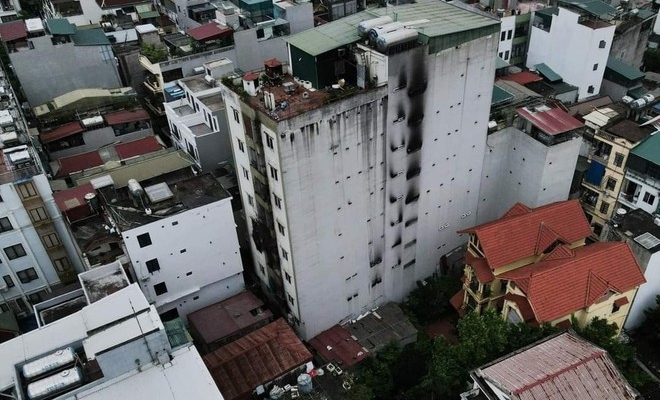
The fire at the mini-apartment building in Khuong Ha (Thanh Xuan district, Hanoi ) on the night of September 12th was horrific because, despite being located in a narrow alley inaccessible to cars, a 10-story mini-apartment building was constructed with a floor area of only 200 m2 and a total floor area of 2,000 m2, housing 45 households with approximately 150 residents.
" People's lives are very fragile because, as mini-apartment buildings are not investment projects, they are not regularly inspected, approved, or checked for safety and fire prevention, " Mr. Dinh emphasized.
However, the draft amended Housing Law proposes "legalizing" this type of housing under the name "multi-story, multi-family housing for households and individuals," meaning that if a household or individual owns a plot of land of a few hundred square meters, they can build a mini-apartment building for sale without having to establish a business or create an investment project to carry out investment procedures according to the Investment Law, the Housing Law, and the Real Estate Business Law.
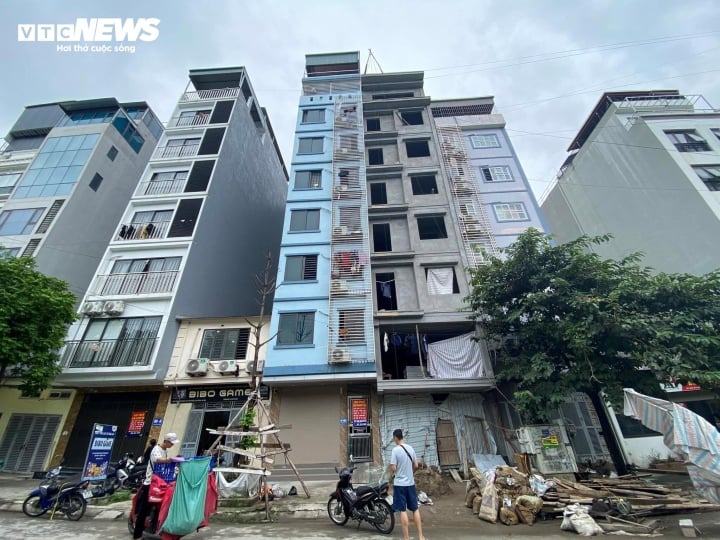
Besides the conveniences they offer, mini-apartments also harbor many unforeseen dangers. (Illustrative image: Cong Hieu).
This means that procedures such as investment policy approval, land allocation/leasing, land valuation and fulfillment of land-related financial obligations, feasibility study/basic design appraisal, fire safety approval, construction permit issuance, fire safety acceptance testing, and acceptance testing of the project as meeting the requirements for operation and exploitation are not required.
Mr. Dinh emphasized that the danger lies in Article 57 of the latest draft of the amended Housing Law (presented to the Specialized Delegates Conference at the end of August 2023), which allows homeowners to choose to have separate ownership certificates ("pink books") for each apartment. If approved, this type of mini-apartment building would be "legalized" and would be no different from regular apartment buildings. This is also reflected in the current Housing Law (Article 46) and previously in Decree 71/2010.
Accordingly, a young family with 700-800 million VND can also buy a 30m2 mini-apartment and receive a "pink certificate" just like buying an apartment in a project.
" If this policy is passed, it will certainly make mini-apartments even more popular, with people rushing to buy them, creating a wave of people searching for adjacent land plots to consolidate and build mini-apartments for sale indiscriminately, instead of encouraging housing development through projects that ensure synchronized infrastructure connections."
"Besides safety and fire prevention issues, addressing technical and social infrastructure (schools, healthcare , administration, services, etc.) for families buying mini-apartments will add to the burden on the authorities of cities like Hanoi, Ho Chi Minh City, and Da Nang if mini-apartments are 'legalized' ," Mr. Dinh warned.
Therefore, Mr. Dinh proposed: Instead of "legalizing" mini-apartments, strict control measures are needed for this type of housing. Specifically, transactions involving the purchase and sale of mini-apartment units should not be recognized, and individual ownership certificates ("pink books") should not be issued for each unit to prevent the proliferation of this type of housing, avoiding safety risks and overloading urban infrastructure.
" If any household or individual has the right to use residential land and wants to build an apartment building, they must establish a business/cooperative and prepare an investment project to carry out investment procedures according to the Investment Law, the Housing Law, and the Real Estate Business Law ," Mr. Dinh stated.
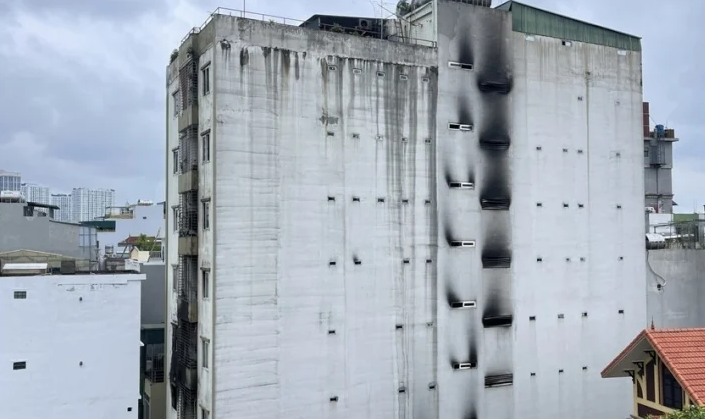
A serious fire recently broke out in a mini-apartment building in Khuong Ha.
Sharing the same view, Mr. Le Hoang Chau - Chairman of the Ho Chi Minh City Real Estate Association (HoREA) also believes that the 2014 Housing Law needs to be amended to eliminate loopholes used to legalize mini-apartment buildings.
Specifically, according to Mr. Chau, Clause 2, Article 46 of the 2014 Housing Law clearly states: Households and individuals in urban areas must carry out the construction and renovation of housing in accordance with the law on construction and are solely responsible for the quality of their housing.
In cases where the construction of a building with two or more floors is permitted, and each floor is designed and built with two or more self-contained apartments, meeting the minimum floor area standards for each apartment according to construction regulations and standards, and having both privately owned and commonly owned areas of the apartment building as stipulated in this law, then the State shall recognize the ownership rights of each apartment in that building.
According to Mr. Chau, this regulation has led to the proliferation of mini-apartment buildings in large cities, disrupting urban development planning. It also detracts from urban aesthetics, compromises fire safety, and lacks essential amenities and services for residents. Therefore, the Association proposes amending Clause 2, Article 46 of the 2014 Housing Law to completely abolish the issuance of land ownership certificates for mini-apartments, only allowing them to be used for rental purposes.
In reality, there has been a recent trend of many developers applying for permits to build ordinary houses but then circumventing the law by altering the original design to construct mini-apartment buildings for commercial purposes. The rampant construction of mini-apartment buildings in large cities disrupts urban development planning, detracts from the aesthetics, and even poses risks to buyers.
This issue has also been pointed out by the Ministry of Construction : In some localities, taking advantage of lax management by functional agencies, households and individuals have arbitrarily constructed multi-story, multi-apartment private houses without complying with legal regulations such as: building without permits, building in violation of permits, building in violation of planning, encroaching on space, subdividing apartments, arbitrarily adding floors... and then freely buying, selling, and transferring them.
The Ministry of Construction also issued a warning: Failure to tighten management will lead to many negative consequences such as violations of fire safety regulations, posing a high risk of fire and explosions in residential areas; overloading of technical and social infrastructure systems; inability to issue ownership certificates to apartment buyers due to violations of design and construction density, leading to disputes and lawsuits between buyers and sellers.
Chau Anh
Source





























































































Comment (0)