

VN-Index rises 38%, Vietnamese stocks regain their position.
The Vietnamese stock market has regained its footing after navigating the 2022 recession, currently trading significantly better than pre-Covid-19 levels. The investment performance of Vietnam's representative indices is now far surpassing comparable markets in the region.
Since the beginning of the year, the VanEck Vietnam ETF (VNM) has recorded an impressive growth of 62%. This fund has also surpassed the 31% increase of the iShares MSCI China ETF (MCHI) from China.
In addition, Vietnamese stocks recorded double the performance of the iShares MSCI Emerging Markets ETF (EEM) for emerging markets, which has an average growth rate of 30%.

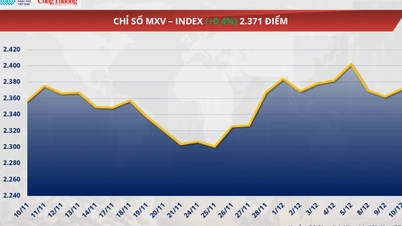
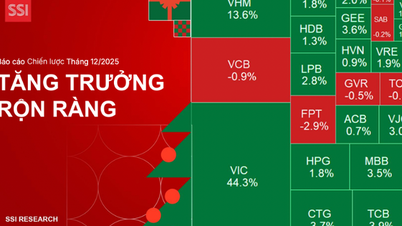
The VN-Index has established strong growth momentum with a cumulative increase of 38% since the beginning of the year. (Illustrative image.)
However, the momentum isn't solely driven by foreign ETFs. The VN-Index has also established strong growth, with a cumulative increase of 38% since the beginning of the year. This reflects investors' firm confidence in the macroeconomic outlook.
Commenting on the market landscape, Thea Jamison, CEO of Change Global, affirmed that Vietnam is separating itself from the general trend of the region to establish an independent position.
Driven primarily by domestic individual investors, the stock market has seen increased liquidity, with average daily trading values reaching $2 billion in 2025. “This market is becoming less dependent on foreign capital flows or fluctuations. It is truly growing based on its own strength and investor base,” Ms. Jamison emphasized.
Investor sentiment was further strengthened following FTSE Russell's strategic announcement in October. Specifically, Vietnam will officially be upgraded from a frontier market to a secondary emerging market, effective September 21, 2026. This is a direct result of efforts to remove the "bottleneck" of pre-trade margin requirements for foreign investors.
Ms. Nguyen Hoai Thu, Managing Director of Securities Investment at VinaCapital, predicts that this upgrade could trigger a capital inflow of approximately $5-6 billion into the domestic market.
“ We are confident that Vietnam will effectively resolve the technical issues so that the upgrade proceeds as planned. However, achieving the title is one thing; the real challenge lies in consolidating and maintaining this position in the long term, ” Ms. Thu stated.
To realize that goal, VinaCapital representatives emphasized the urgent need for in-depth reforms to modernize the capital market. Accordingly, the main pillars include improving access for foreign capital, diversifying the industry structure, and promoting high-quality initial public offerings (IPOs).
Innovation policies create a solid economic foundation.
In parallel with the development of the financial market, the government is resolutely creating a favorable business environment through key reforms.
Accordingly, the focus is on Resolution No. 68-NQ/TW dated May 4, 2025, on developing the private economy by reducing administrative barriers and unlocking capital resources.
Dan Kritenbrink, a partner at The Asia Group and former US Ambassador to Vietnam, sees this as a continuation of a long-term process, beginning with the "Doi Moi" (Renovation) policy in 1986, the normalization of trade relations with the US in 1995, and Vietnam's accession to the WTO in 2007.
The effectiveness of these policies is clearly reflected in the flow of foreign direct investment (FDI). In the first 10 months of 2025, disbursed FDI reached a record high of US$21.3 billion, the highest level in the past five years.
Explaining Vietnam's investment appeal, Mr. Dang Thanh Tung, Director of Operations at Dragon Capital, affirmed that the human factor is a particularly strong competitive advantage.
With a young population, high labor participation rate, and rapid adaptability to technology, the Vietnamese workforce is becoming a crucial link in the global supply chain, especially in the electronics and textile sectors.
“ Agencies are focusing on improving the quality of their personnel through digital and professional skills training. If maintained well, the combination of demographics and a hard-working culture will continue to make a significant difference compared to the region ,” Mr. Tung emphasized.
Furthermore, the strategy of diversifying trade through Free Trade Agreements (FTAs) with Europe, the Middle East, and Asia is helping Vietnam minimize the risk of dependence. In the eyes of international investors, Vietnam's advantages now lie not only in tariffs but also in optimized overall operating costs. This includes competitive minimum wages, reasonable land costs, and stable energy prices.
Entering 2026, the market is expected to operate in a more stable macroeconomic environment. Ms. Nguyen Hoai Thu predicted that corporate profit growth could reach 15%, setting the stage for stock market returns to fluctuate between 15% and 20%.
Source: https://congthuong.vn/chung-khoan-viet-nam-2025-tam-diem-thu-hut-dong-von-ngoai-434257.html





















































































Comment (0)