

However, many patients still carry both their citizen identification card (CCCD) and health insurance card when seeking medical treatment. Many other patients are hesitant and unwilling to use the chip-embedded CCCD.
The habit of carrying health insurance cards
At Tan Phu District Hospital (Ho Chi Minh City), there was a large number of patients waiting (the hospital averages 3,000-4,000 visits per day). When it was her turn, a female patient presented her Citizen Identification Card (CCCD), and less than 30 seconds later, the staff returned the CCCD so she could quickly move to the examination area. She didn't forget to tell the Thanh Nien reporter: "I've known about this (referring to using CCCD for medical examinations - PV) for a long time, thanks to my child telling me."
Another patient was sitting in the waiting area, waiting for her turn to register for a musculoskeletal examination. She had both her Citizen Identification Card (CCCD) and her Health Insurance Card (BHYT) issued in August 2021. When asked if she knew that the chip-embedded CCCD could be used to register for health insurance without needing the BHYT card, she shook her head. "Holding a CCCD is convenient, but I'm worried about it malfunctioning. I've been waiting in line since morning; what if something goes wrong and I have to run back home to get my BHYT card? It's a waste of time and money. It's better to be sure about everything," she expressed.
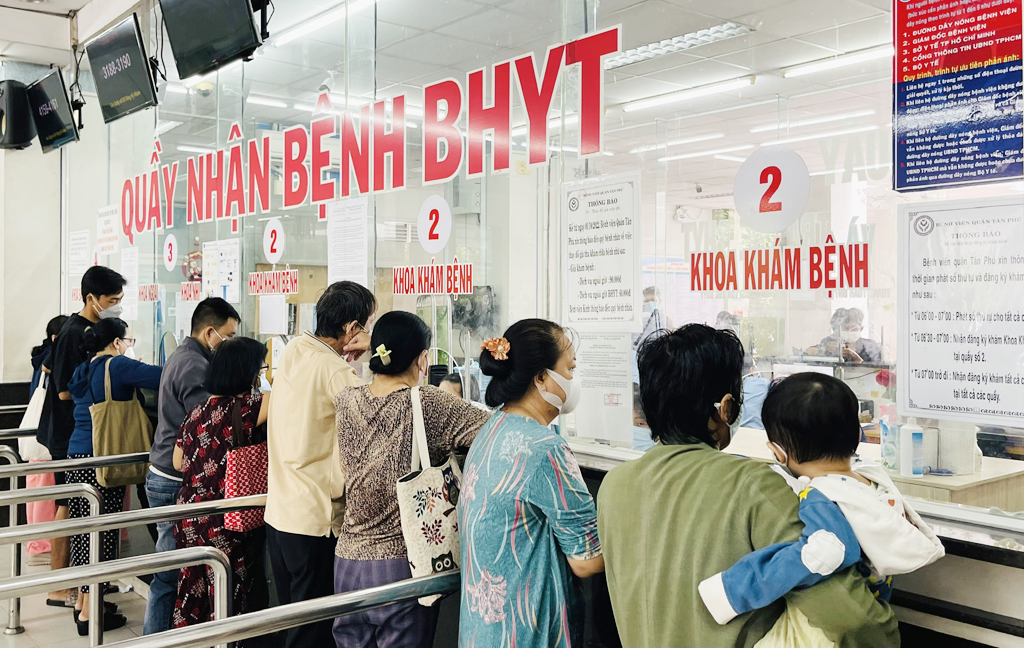
Patients receiving medical treatment covered by health insurance at Tan Phu District Hospital, Ho Chi Minh City.
According to staff at the health insurance reception counter of Tan Phu District Hospital, up to 90% of patients using the Citizen Identification Card (CCCD) come for health insurance-covered medical examinations and treatment, which is very convenient. However, most users of chip-embedded CCCDs also bring their health insurance cards. The remaining cases are those whose CCCDs were issued before the integration of health insurance (from July 2021 onwards); these require verification of information on the health insurance card and the CCCD or driver's license/other photo identification. "Young people and students know that using a chip-embedded CCCD is sufficient. But older people are very meticulous; they bring their health insurance cards as well. When we return their health insurance cards, they ask why their health insurance isn't being accepted," said a staff member at the health insurance reception counter of Tan Phu District Hospital.
Fear of losing the chip-embedded citizen ID card.
Representatives from District 11 Hospital (Ho Chi Minh City) also stated that the hospital has implemented health insurance coverage using chip-embedded citizen identification cards. When receiving patients for health insurance coverage, the hospital advises them to simply bring their chip-embedded citizen identification card next time, but patients say they prefer to carry their health insurance card for examinations.
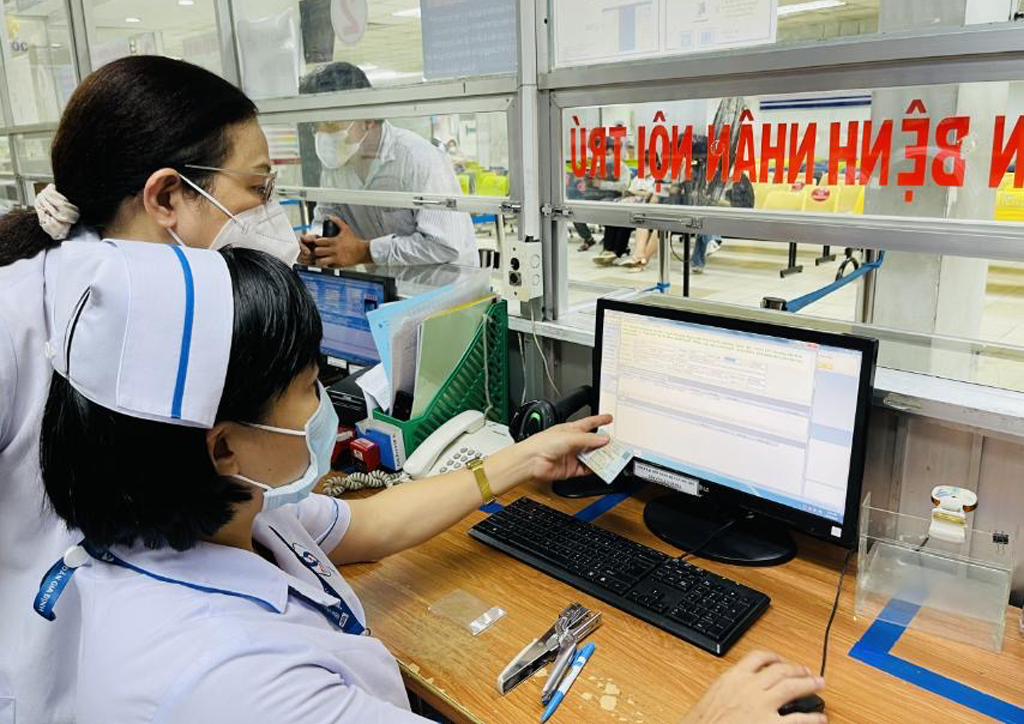
Medical examination and treatment using chip-embedded citizen identification cards at Gia Dinh People's Hospital.
Similarly, according to Dr. Nguyen Thi My Linh, Head of the Outpatient Department at Gia Dinh People's Hospital (Ho Chi Minh City), the hospital has 15 counters for receiving health insurance claims. With just a chip-embedded citizen identification card (CCCD), all health insurance information is clearly displayed and linked to the Social Insurance portal. "The chip-embedded CCCD saves staff time, is quick and efficient; ensures accurate patient identification; and allows for cross-referral (patient's medical history). Checking all information takes only 30 seconds, thus shortening patient waiting times. Currently, the hospital sees an average of 4,000-5,000 patients per day, with health insurance patients accounting for up to 80%," Dr. My Linh stated.
However, according to Dr. My Linh, elderly patients still prefer using paper health insurance cards, and due to fear of losing their chip-based citizen identification cards, they continue to use their old ID cards. "We asked patients to bring their chip-based citizen identification cards for information verification, but some refused, saying 'what if I lose it?' and then presented their old ID cards, keeping their new ones at home," the doctor recounted, adding that if patients don't bring their new citizen identification cards, they need to present their card number, driver's license, or other photo identification.
Provides many benefits
According to Ms. Nguyen Thi Thu Hang, Deputy Director of the Ho Chi Minh City Social Insurance Department, currently 376 out of 391 health insurance medical examination and treatment facilities in the city use citizen identification cards (CCCD), reaching 96.16%. The remaining facilities have not implemented this because they have not generated any patients or health insurance medical examination and treatment costs. As of June 19th, Ho Chi Minh City has had over 4 million medical examination and treatment visits using citizen identification cards, of which over 3.2 million visits used CCCDs with personal information.
Leaders of the Ho Chi Minh City Social Insurance Department assessed that using chip-embedded citizen identification cards for health insurance examinations and treatments has brought many practical benefits to both patients and medical facilities. It also contributes to overcoming limitations in administrative reform, such as shortening procedures and waiting times for patients, eliminating the need to present paper health insurance cards, and avoiding the need to apply for reissues in case of loss, damage, or expiration. This also meets the practical needs of medical facilities in managing patients by ensuring transparency of information and preventing fraud and profiteering in medical examinations and treatments.
However, the leaders of the Ho Chi Minh City Social Insurance agency acknowledge that there are still cases where people search for their Citizen Identification Card (CCCD) but find no information because the synchronization of health insurance data with the National Population Database has not yet reached 100%. Currently, the synchronization of insurance data with the National Population Database under Project 06 in Ho Chi Minh City has reached 89%, with 11% still unsynchronized. The Ho Chi Minh City Social Insurance agency is coordinating with departments and agencies in the city to accelerate the updating of personal identification into the database and synchronization with the insurance database, striving to complete 100% by the end of Q2/2023. They are also intensifying communication efforts to encourage people to use CCCD when seeking medical treatment. At the same time, they are requesting medical facilities to publicly inform health insurance participants that they can use chip-embedded CCCDs or the VNEID application when seeking medical treatment. Prevent situations where medical examinations are refused when citizens provide their Citizen Identification Card (CCCD) information that has been synchronized between the National Insurance Database and the National Population Database.
The Ho Chi Minh City Social Insurance agency advises patients visiting a medical facility for the first time to bring their health insurance card or a smartphone with the VSSID application, along with a photo ID. If a patient has previously received health insurance coverage using their Citizen Identification Card (CCCD) or the VNEID application, they only need to present their CCCD or VNEID for subsequent visits. If the CCCD has not yet been integrated with the health insurance card data, or the health insurance participant has not yet been issued a VNEID account, the hospital must follow the standard health insurance procedures for receiving patients.
The Ho Chi Minh City Department of Health has also directed its affiliated medical facilities to promote the use of chip-embedded citizen identification cards (CCCD) for health insurance medical examinations and treatments, and the VNEID application. According to the Department of Health, as of now, all hospitals providing health insurance medical examinations and treatments in the city have implemented the use of chip-embedded CCCD cards. However, the rate of patient usage remains low. Therefore, the Department of Health requests that units continue to promote information dissemination and awareness campaigns, encouraging medical staff, their families, patients, and their relatives to understand the convenience and benefits of using chip-embedded CCCD cards and the VNEID application when seeking medical treatment under health insurance, instead of paper health insurance cards. Units should proactively ensure the necessary technical infrastructure (upgrading software, installing chip-embedded CCCD readers with integrated biometric modules, etc.) to be ready for the integration and biometric authentication in health insurance medical examinations and treatments using chip-embedded CCCD cards.
The Department of Health requests that heads of units seriously organize and implement the above contents to all staff, striving to ensure that each health insurance medical examination and treatment facility has 80% of patients receiving medical examination and treatment using chip-embedded citizen identification cards or level 2 electronic identification accounts, completing this before June 30th as directed by the People's Committee of Ho Chi Minh City and the Steering Committee of Project 06 of the city.
According to a report from the police department, after nearly a year of implementation, 12,275 out of 13,047 medical facilities nationwide have deployed chip-embedded citizen identification cards (CCCD) integrated with health insurance (reaching 94.08%), with 18.5 million citizens using CCCD for medical examinations and treatment across the country. Thanh Hoa province has the highest number of citizens using CCCD for medical examinations and treatment with over 3 million people (accounting for 16.48%). Meanwhile, Kien Giang has the lowest number with 33,541 citizens (accounting for 0.18%). The implementation of this solution has saved 24.7 billion VND compared to 2021 in printing paper health insurance cards, and has been well received and appreciated by the people.
Source link

![[Photo] Prime Minister Pham Minh Chinh holds a phone call with the CEO of Russia's Rosatom Corporation.](/_next/image?url=https%3A%2F%2Fvphoto.vietnam.vn%2Fthumb%2F1200x675%2Fvietnam%2Fresource%2FIMAGE%2F2025%2F12%2F11%2F1765464552365_dsc-5295-jpg.webp&w=3840&q=75)














































































Comment (0)