

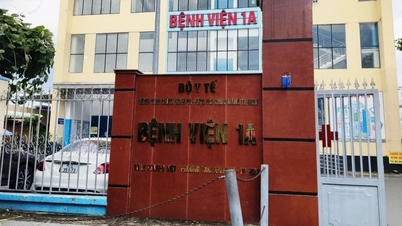
In the early afternoon, sunlight streamed through the window into a small, special classroom tucked away within the grounds of Hospital 1A (Ho Chi Minh City). This is a classroom specifically for children with cerebral palsy, part of the Day Treatment Unit, where more than 10 children attend daily as part-time students. The class begins accepting students at 7:30 AM and continues until around 4:00 PM, when they are picked up by their relatives.
For over a decade, he's been driving his tricycle to take his children to school.
Amidst the scattered parents picking up their children, Ms. Hoai (43 years old, An Lac ward) was already there early to pick up her daughter Ngoc (15 years old) from school. For over 12 years, this mother has persistently driven more than 20km every day to take her daughter to and from school.
“Every day, I take my child to school at exactly 7 a.m. and pick her up at 3 p.m. using my specialized tricycle. Today, the sky looks like it's about to rain, so I had to finish my work and pick her up early,” Ms. Hoai said with a smile.
Ngoc is the eldest daughter of Hoai and her husband. Fifteen years ago, she was pregnant with twins. Their joy was short-lived, however, as they received devastating news: one of their daughters had died in utero at 28 weeks.
At 30 weeks, she gave birth prematurely. Ngoc was born weak and had to stay in an incubator for over a month. Even at over two years old, her body remained stiff, and she couldn't roll over despite starting physical therapy at six months. Around that time, Hoai and her husband decided to have another child for Ngoc, and she began attending this special education class.
Initially, the child cried all day, demanding to go home, crying incessantly. Feeling sorry for her child and hesitant to bother the teacher and other parents, Ms. Hoai decided to give up after a month. But from then on, Ngoc gradually became more well-behaved, and the family felt reassured enough to send her back to school.
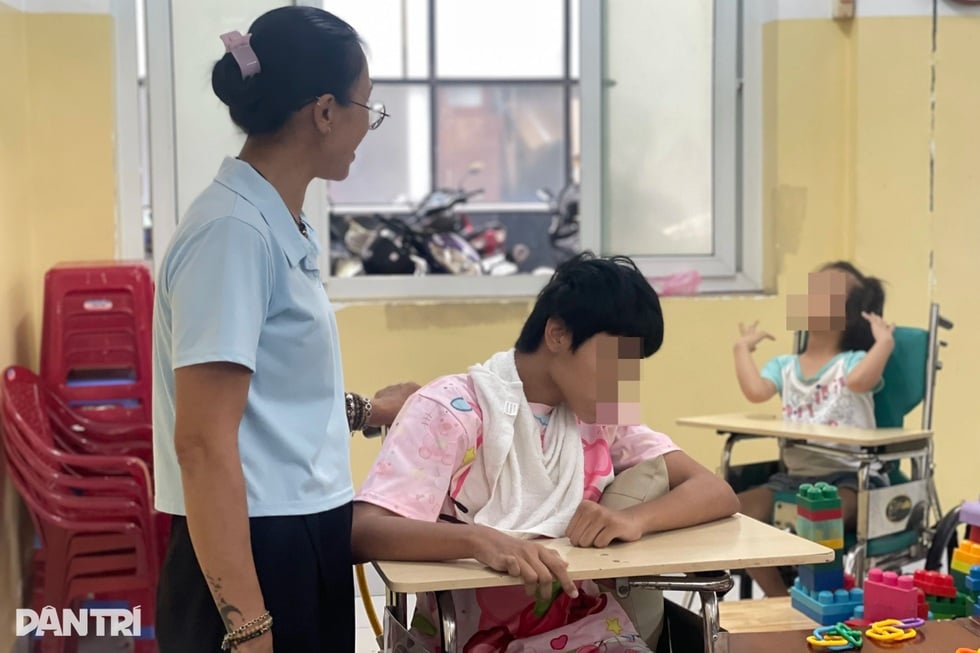
Over the past 12 years, Ngoc has gradually progressed in communication and cognitive development. From a baby who could only stiffen her body, Ngoc gradually learned to roll over, crawl, and then "talk" to people through gestures.
"Now, my child can distinguish letters, find their parents' names in the phone's contact list, and make video calls even though they can't speak. Witnessing each of their developmental milestones, no matter how small, makes me feel much more motivated," the mother shared.
For Ms. Hoai, the class embodies a profound humanitarian spirit, providing children with free physical therapy through health insurance while creating a space for them to interact and integrate outside the family, improving their quality of life. Parents, therefore, also have time to do housework or work to earn extra income.
The class also serves as a place to connect parents, where they can confide in other parents in similar situations, receive support and encouragement, especially for disadvantaged, single-parent, or single-parent families.
"Previously, the class had 20-30 children, but after the Covid-19 pandemic, the number of students decreased significantly, possibly due to economic difficulties or geographical distance. Regardless, I very much hope the class can be maintained to continue supporting the children and their families," she shared.
At the same time, another parent, Mr. Pham Nghia (67 years old), entered the classroom to pick up his granddaughter, Su (8 years old). In the classroom, his granddaughter was smiling broadly. Although she couldn't speak, she waved excitedly at him, her eyes sparkling. The grandfather approached his little granddaughter, giving her a gentle smile, the wrinkles on his face seemingly smoothing out.
Su was born with cerebral palsy. When she was just over a year old, her father left, and her mother took her to live with her maternal grandparents. For the first four years of her life, Su grew up in the care of her grandparents, while her mother worked to earn extra income. Her family sought treatment everywhere, from traditional healers to doctors, but without success.
Four years ago, after being introduced to this class, Su's grandparents decided to enroll her. Since then, she has gradually changed noticeably: she can speak, interact, and smile more and more often.
"Now that she's participating in occupational therapy, receiving guidance from teachers, and interacting with friends, she's able to communicate. She can't speak, but she understands a lot," Mr. Nghia shared, his voice filled with pride.
Every day, the grandparents take turns driving Su from their home in Dong Hung Thuan ward to school at 7:00 AM and picking her up at 2:30 PM, using a three-wheeled vehicle equipped with safety belts.
“For the past ten years, I haven’t worked, rain or shine, my only concern each day is taking my grandchild to and from school. The teachers here are very caring and have professional teaching methods, so my grandchild has made some progress. My wife and I are happy, and we just hope we have the health to continue taking her to and from school,” Mr. Nghia said.
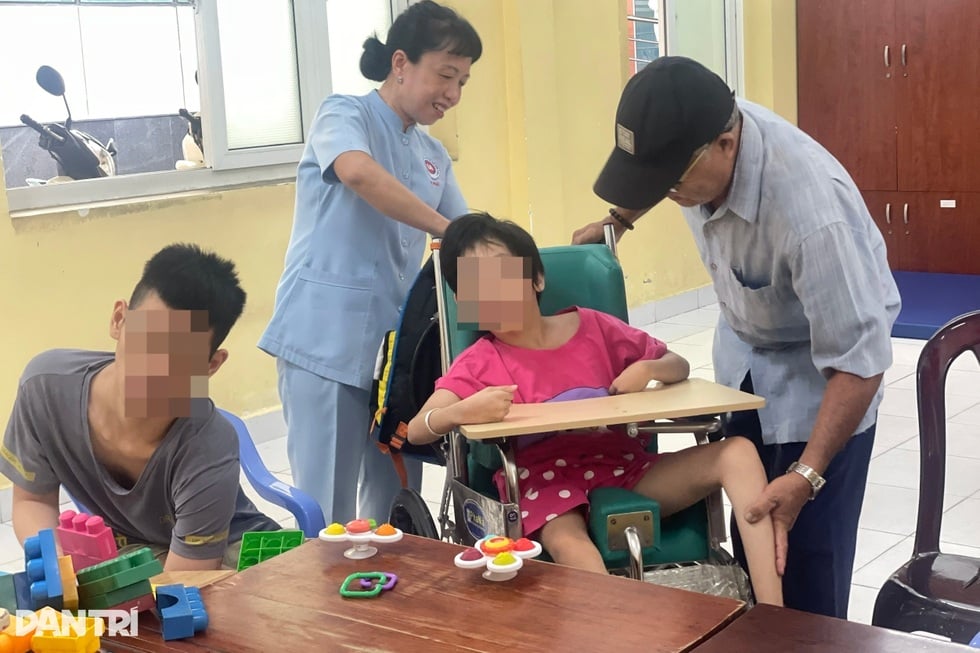
The teachers in the special education class
Having been dedicated to her classroom for the past 26 years, Ms. Tuyet Mai has never forgotten the students who have been with her. Starting as a preschool teacher, she worked various jobs due to difficult circumstances before finding meaning in her life here. Ms. Mai married late and has no children, so she considers the children her source of motivation and happiness every day.
"Caring for a normal child is difficult enough, but caring for a child with cerebral palsy is even more challenging, especially those who have difficulty swallowing or have stiff limbs," she recalled, her voice choked with emotion.
When she first started, Ms. Mai faced considerable pressure. Some children were mischievous, disobedient, and sometimes even dangerous to those around them. Children with cerebral palsy and disabilities often cannot express their emotions, so the teachers here have to be extra patient to understand and help them solve their problems.
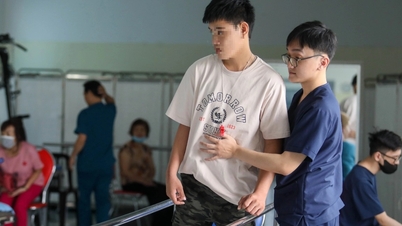
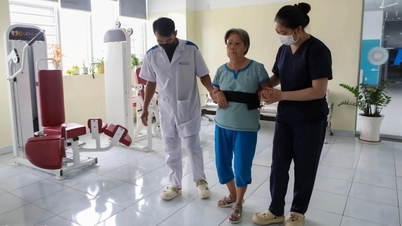
Every day, Ms. Mai arrives at the school early, working alongside specialists and volunteers to teach the children basic self-care skills and provide rehabilitation exercises tailored to each child's abilities.
Ms. Mai has lost count of the faces she has cared for over the past 26 years. Many of the children are now able to care for themselves, attend vocational schools for people with disabilities, and earn an income from simple jobs. This is what has kept her dedicated to the class for such a long time.
According to Ms. Le Thi Thanh Xuan, Head of the Day Treatment Unit at Hospital 1A, the classes for children with motor disabilities and cerebral palsy are one of the hospital's humane policies, supporting children aged 3 and above with motor disabilities or both motor and cognitive disabilities.
Here, children receive free physiotherapy and occupational therapy through health insurance, play with volunteers, and learn self-care skills such as writing, reading, or communicating via telephone.
"Teachers here need a minimum qualification of a nursing diploma (for caregivers) or a university degree (for specialties such as special education, speech therapy, or psychology)."
"Most importantly, it's about having a compassionate heart, love, creativity, and the ability to understand the unique characteristics of each child. Teachers need to accept children's disabilities, teach according to each child's abilities, and thereby help them progress towards social norms, instead of forcing them to become normal," emphasized Master Thanh Xuan.
The small classroom at Hospital 1A is not only a place where disabled children find hope, but also a support system for their families. Ms. Xuan hopes for a future where children receive better support, parents have less burden, and more people participate in this journey.
For her and her colleagues here, every smile from the children is a flame that warms their hearts. Every step forward, however small, is a light in her heart. That classroom is a warm haven, where love and patience open the door to hope, guiding these special souls.
(Character names have been changed)
Photo: Dieu Linh
Source: https://dantri.com.vn/suc-khoe/lop-hoc-dac-biet-giua-long-benh-vien-gieo-hy-vong-cho-tre-em-khiem-khuyet-20251022133519452.htm


![[Photo] Prime Minister Pham Minh Chinh holds a phone call with the CEO of Russia's Rosatom Corporation.](/_next/image?url=https%3A%2F%2Fvphoto.vietnam.vn%2Fthumb%2F1200x675%2Fvietnam%2Fresource%2FIMAGE%2F2025%2F12%2F11%2F1765464552365_dsc-5295-jpg.webp&w=3840&q=75)

























































Comment (0)