

The US says the Iranian drone acted unprofessionally and unsafely by flying just 1.5 km from the aircraft carrier Eisenhower, instead of the required 18.5 km.
Vice Admiral Brad Cooper, commander of U.S. naval forces in the Middle East, accused Iranian drones of approaching the USS Dwight D. Eisenhower aircraft carrier, at times coming within 1.5 kilometers, while the warship was operating in the Persian Gulf.
"Iranian aircraft ignored numerous attempts at communication and warning, violating aviation notices which require aircraft to maintain a minimum distance of 18.5 km from aircraft carriers. Their unsafe, unprofessional, and irresponsible behavior threatened the lives of American and partner soldiers. Iran must immediately cease this," he said.
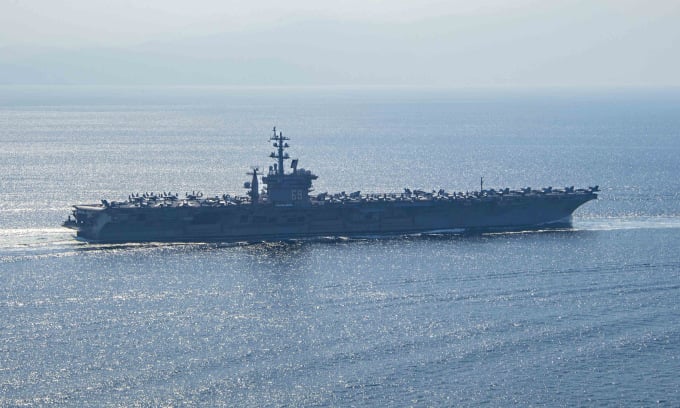
The aircraft carrier USS Dwight D. Eisenhower transited the Strait of Hormuz on November 26. Photo: US Navy
Vice Admiral Cooper affirmed that the U.S. Navy will remain vigilant, continue to operate "wherever international law permits," and promote maritime security in the region.
Iran has not commented on the information.
Iran's Islamic Revolutionary Guard Corps (IRGC) released video on November 28th, recorded by a drone while monitoring the US carrier strike group Dwight D. Eisenhower as it transited the Strait of Hormuz two days earlier.
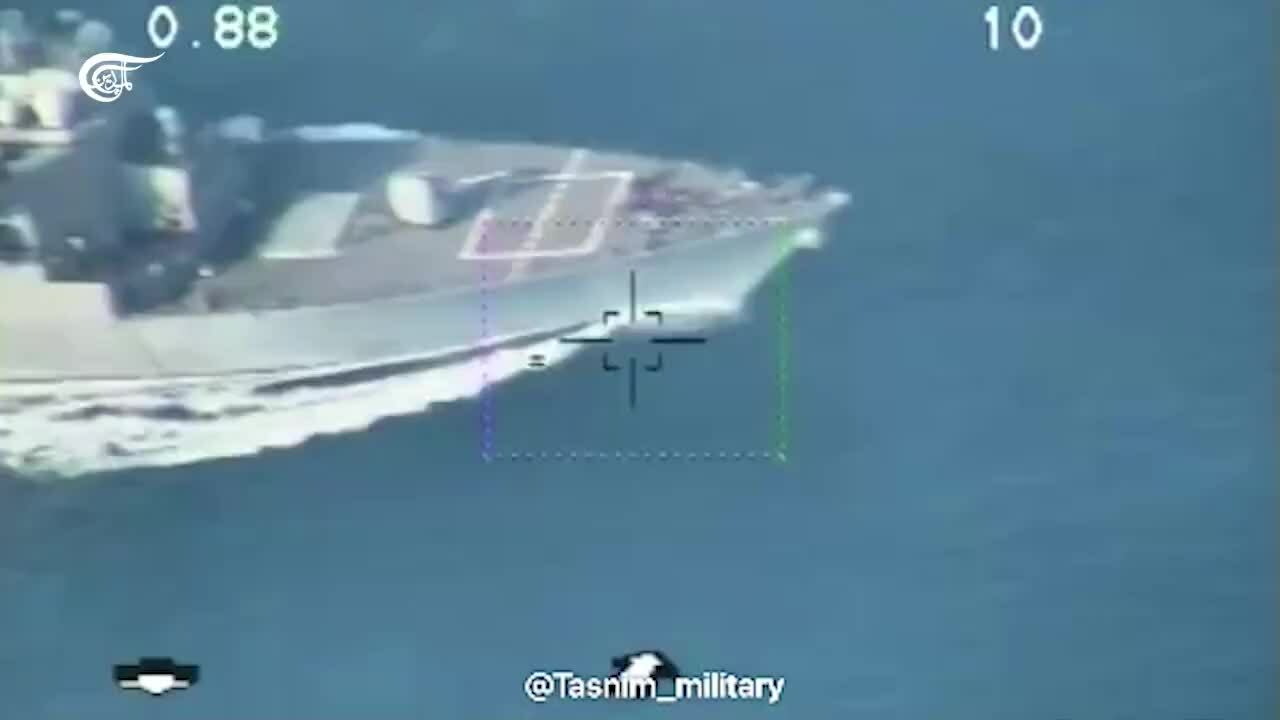
Iranian UAVs tracked a group of US warships in the Strait of Hormuz on November 26. Video: Tasnim
In the video, Iranian UAVs continuously circled above the US naval task force, including the aircraft carrier USS Dwight D. Eisenhower, the cruiser USS Philippine Sea, and the destroyers USS Mason and USS Gravely. The Iranian UAVs also observed aircraft on the flight deck and helicopters landing on the USS Dwight D. Eisenhower.
Brigadier General Alireza Tangsiri, commander of the IRGC's naval forces, said the carrier group "responded to all of Iran's inquiries" before passing through the Strait of Hormuz. "Our UAVs continuously flew overhead and forced the American helicopters to land. They also quickly changed course, moving south toward the Persian Gulf upon detecting the amount of equipment deployed by the IRGC," he said.
Relations between Tehran and Washington have been strained since 2018, when then-US President Donald Trump unilaterally withdrew the US from the nuclear agreement between Iran and world powers, in which Tehran agreed to limit uranium enrichment in exchange for the lifting of economic sanctions.
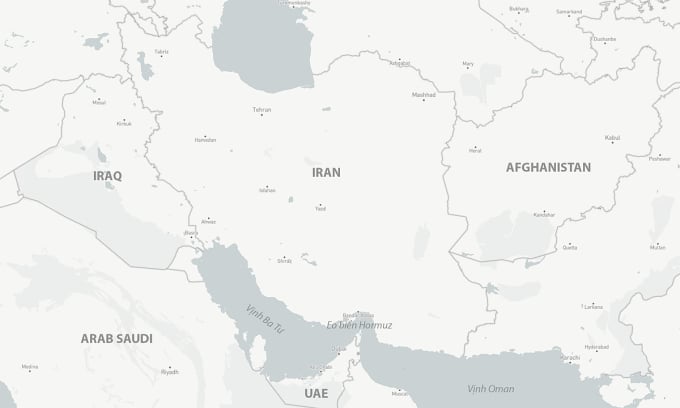
Location of the Persian Gulf and the Strait of Hormuz. Graphic: CSIS
Iranian and US forces have had several encounters at sea. Last month, the Iranian navy claimed to have warned a US reconnaissance aircraft off the Persian Gulf, as well as forcing the nuclear submarine USS Florida to surface while passing through the Strait of Hormuz. In 2019, Tehran shot down a drone worth more than $200 million belonging to Washington, accusing it of violating southern Iranian airspace.
Vu Anh (According to AFP )
Source link
![[Photo] Closing Ceremony of the 10th Session of the 15th National Assembly](/_next/image?url=https%3A%2F%2Fvphoto.vietnam.vn%2Fthumb%2F1200x675%2Fvietnam%2Fresource%2FIMAGE%2F2025%2F12%2F11%2F1765448959967_image-1437-jpg.webp&w=3840&q=75)















































![[OFFICIAL] MISA GROUP ANNOUNCES ITS PIONEERING BRAND POSITIONING IN BUILDING AGENTIC AI FOR BUSINESSES, HOUSEHOLDS, AND THE GOVERNMENT](https://vphoto.vietnam.vn/thumb/402x226/vietnam/resource/IMAGE/2025/12/11/1765444754256_agentic-ai_postfb-scaled.png)

















































Comment (0)