

From the center of Muong Vang commune, following a winding road, we, along with officials from the commune's Culture and Social Affairs Department, ascended to Trai hamlet cave. Situated on the slopes of Khu Trai mountain, the cave's entrance, over 8 meters wide, allows sunlight to penetrate deep into the cave, depicting the pristine living space of prehistoric inhabitants. Behind the protective iron bars is a reconstructed scene of a fireplace and daily life from the Hoa Binh Culture period.
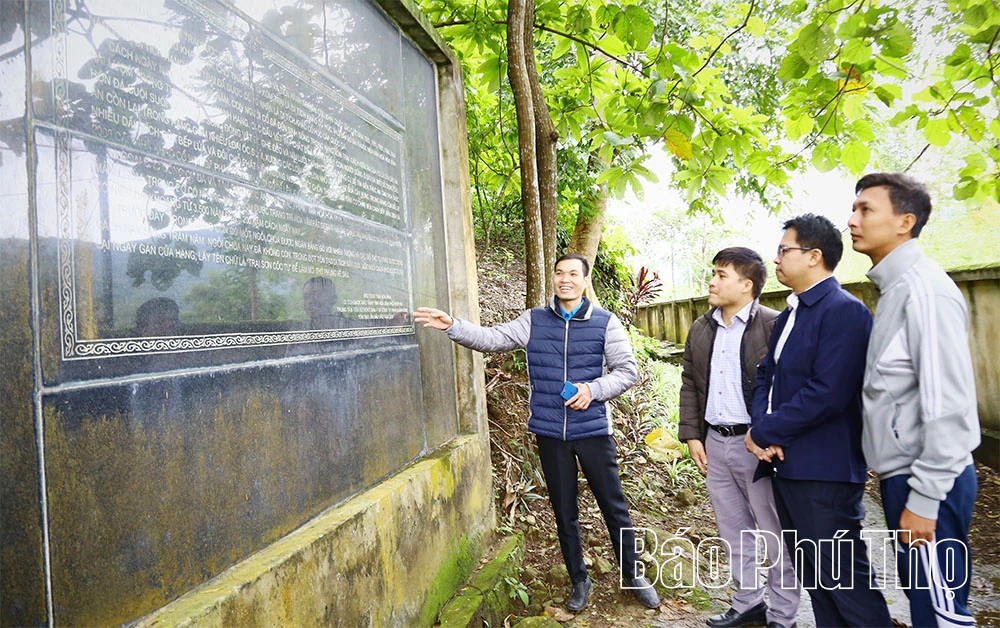
Officials from the Culture and Social Affairs Department of Muong Vang commune introduce the Xom Trai Cave complex.
The Xom Trai cave has a cultural layer nearly 4 meters thick, preserving tens of thousands of cubic meters of shells, animal bones and teeth, hearths, and burial sites – evidence of continuous habitation over tens of thousands of years. According to archaeological documents, since its discovery in 1971 and first excavation in 1981, the Xom Trai cave has provided a unique treasure trove of information about the life of prehistoric inhabitants: layered hearths, chipped and carved tools... Almond-shaped, oval, short axes, long axes... exquisitely chipped and carved from pebbles of the Muong Vang stream show that prehistoric people had mastered advanced crafting techniques. A significant highlight is the burial site discovered in 2008 containing chipped and carved tools and horn-tipped tools. This is valuable material for anthropological research, reflecting the cultural and religious exchange during the Hoa Binh Culture. The Xom Trai cave is not only an archaeological site but also a source of pride for the people of Muong Vang.
Leaving the Trai hamlet cave, we arrived at the Vanh village rock shelter – a site discovered and excavated by the French archaeologist M. Colani since 1929. The large, spacious rock shelter, 64 meters above sea level, reveals a "gigantic sedimentary deposit" with a cultural layer 3.7 meters thick. Here, archaeologists have recorded an exceptionally rich collection of artifacts: chipped and polished stone tools, bone and horn tools including axes, chisels, and pointed tools; dense mollusk shells; animal bones; traces of hearths; and a cluster of polished stone supports showing signs of food processing and toolmaking by prehistoric people.
Along with Xom Trai Cave, the rock shelter of Lang Vanh village became the "core center" of the "Hoa Binh Culture" - preserving the most typical characteristics of tools, hearths, traces of habitation, and burial sites. The Prime Minister's approval of the ranking of the Xom Trai Cave - Lang Vanh rock shelter complex as a Special National Monument not only affirms the stature of the "Hoa Binh Culture" in the archaeological landscape of Southeast Asia, but also creates an important legal foundation for the province to expand investment, preservation, and tourism connectivity.
Accompanying the delegation on a visit to the cave complex belonging to the Special National Monument, Comrade Pham Nga Viet - Deputy Head of the Cultural Heritage Management Department (Department of Culture, Sports and Tourism) assessed: The title of Special National Monument creates favorable conditions for the province to develop a comprehensive conservation plan, promoting its value by linking scientific research with sustainable tourism development. Especially in the context of administrative unit mergers, the replanning of cultural and tourism spaces is even more important, contributing to creating new highlights for the core area of the "Hoa Binh Culture" heritage.
Good news has come to the officials and people of the communes in the Muong Vang region (formerly Lac Son district) with the Prime Minister's Decision No. 2531/QD-TTg, dated November 19, 2025, approving the task of developing a plan for the preservation, restoration, and rehabilitation of the special national archaeological site of Xom Trai Cave and Lang Vanh Rock Shelter in Phu Tho province. Accordingly, the scope of the planning study includes the entire administrative boundaries of eight communes (Ngoc Son, Quyet Thang, Thuong Coc, Lac Son, Dai Dong, Yen Phu, Muong Vang, and Nhan Nghia) with an area of approximately 58,700 hectares. This area surrounds the space where the "Hoa Binh Culture" was formed and developed in Vietnam. The main objective of the plan is to preserve and protect the unique cultural values typical of the inhabitants of the "Hoa Binh Culture". To create a legal and scientific basis for the management, planning, and implementation of conservation and promotion projects for historical sites linked to tourism development. To define the boundaries of protected areas, identify functional zones, organize architectural and landscape spaces, and arrange technical infrastructure in accordance with the conservation phases. To transform the site into a research center on "Hoa Binh Culture" for the region and the world, an attractive tourist destination and experience, contributing to the socio-economic development of the locality. The People's Committee of Phu Tho province is responsible for allocating funds, selecting consulting units, and organizing the planning, while ensuring the collection of opinions from the community, experts, and scientists. The Ministry of Culture, Sports and Tourism is the lead agency responsible for appraisal and submission to the Prime Minister for approval as prescribed.
In the long-term strategy, the goal is to make the Xom Trai Cave - Vanh Village Rock Shelter complex a key highlight of the "Returning to the Cultural Roots of Hoa Binh" tourism route, linked to the Muong Vang identity and connecting spiritual and ecological tourism destinations in the area.
Tens of thousands of years have passed, yet the echoes of prehistoric inhabitants still resonate in the layers of shell sediment, in the chipped stone fragments, and in the ancient hearths. Honoring and enhancing the value of this Special National Monument is not only about preserving the past, but also about affirming the position of a culture that once brought glory to Vietnam – the Hoa Binh Culture. Local officials and residents hope that, with proper investment, this Special National Monument will not only be a site for archaeological research but also a place for traditional education, attracting domestic and international tourists. The heritage preserved today will become an invaluable asset for the future, when cultural resources are invested in and developed sustainably, ensuring the "Hoa Binh Culture" endures forever.
Huong Lan
Source: https://baophutho.vn/nang-tam-gia-tri-di-tich-quoc-gia-dac-biet-243652.htm


![[Image] Pleasant weather helps students enter the 10th grade entrance exam with confidence.](https://vphoto.vietnam.vn/thumb/1200x675/vietnam/resource/IMAGE/2026/05/29/1780034401612_ngay-1-thi-lop-10-minh-duy-8-5009-jpg.webp)
![[Photo] Ba Lang An Lighthouse - the "eye of the sea" amidst the "rock museum" of Quang Ngai province.](https://vphoto.vietnam.vn/thumb/1200x675/vietnam/resource/IMAGE/2026/05/29/1780038698840_anh-man-hinh-2026-05-29-luc-14-10-42.png)

























































































Comment (0)