

Not only is Europe planning to replace the US role as the likelihood of it leaving NATO increases, but it may also be on the verge of a nuclear arms race.
The Financial Times reported on March 20, citing four European officials, that Europe's largest military powers are planning to assume greater responsibility for the continent's defense.
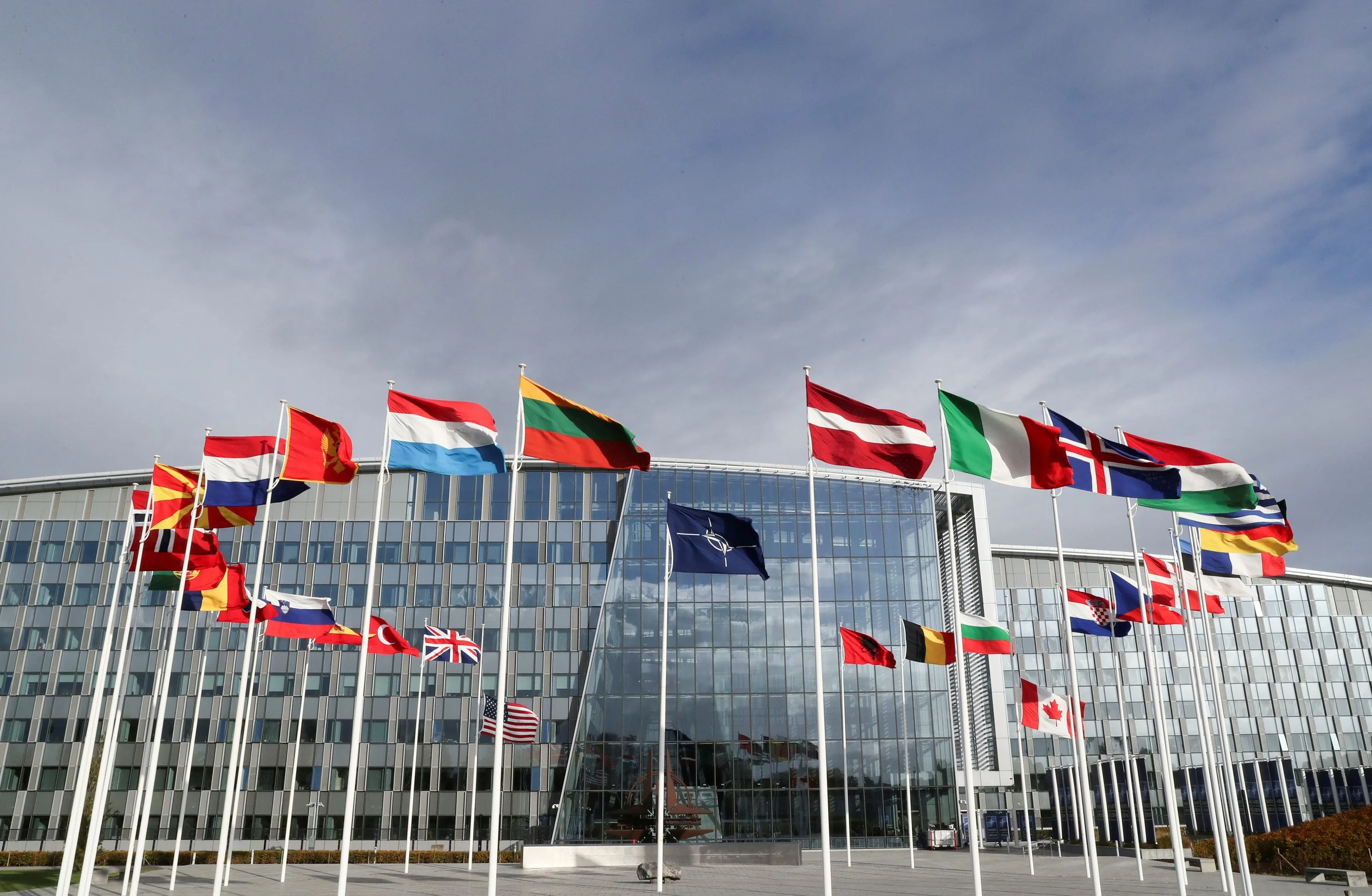
Outside NATO headquarters in Brussels, Belgium
The prospect of separation
Accordingly, Britain, France, Germany, and several other Nordic countries recently held informal discussions on reshaping the security bloc of the North Atlantic Treaty Organization (NATO). These discussions are an effort to avoid potential chaos if the United States unilaterally withdraws from the transatlantic security alliance that has protected Europe for the past 80 years.
Regarding this issue, a few days ago NBC quoted two Pentagon officials as saying that the agency is undertaking a significant restructuring of US military commands. This includes the Pentagon considering abandoning the role of Supreme Allied Commander in Europe (SACEUR) of NATO. For over 70 years, the US has always assigned a general to the position of SACEUR. The current SACEUR is also the head of the US European Command and is currently the primary commander overseeing support for Ukraine in the current conflict.
Recently, right from the first days of his second term, US President Donald Trump has repeatedly demanded that European allies take more responsibility for the security of the continent.
Tensions escalated further after the US pressured Ukraine to negotiate peace in its conflict with Russia. In the process of exerting pressure, Washington temporarily suspended aid to Kyiv, leaving Ukraine solely reliant on Europe.
Moreover, President Trump appeared willing to meet Russian President Vladimir Putin's conditions for achieving peace in Ukraine: addressing the "long-term" and "root causes" that led Moscow to launch its military campaign against Kyiv in February 2022.
In an analysis sent to Thanh Nien newspaper , Eurasia Group (USA), a leading global political risk research and consulting firm, stated that the aforementioned issue is understood to be the same as what Russia had stated in its December 2021 ultimatum to NATO and the US. Notably, this included NATO not admitting Ukraine, withdrawing troops and weapons from member states admitted after May 27, 1997, and refraining from any military operations in Ukraine, Eastern Europe, the South Caucasus, and Central Asia. For the US, there were additional conditions, such as withdrawing medium-range and longer-range missiles from Europe.
Given these developments, the possibility of the US withdrawing from NATO is entirely plausible.
When NATO lacks the US, the risk of a nuclear arms race increases.
Dr. Ian Bremmer, President of the Eurasia Group (USA), commented: "This is a time for action or failure. Europeans feel like they have a gun pointed at them from the East (by the Russians) as a direct national security threat, and now a gun to their head from the West. And that means Europeans now have to act together immediately."
In fact, the EU has officially taken action. According to the Financial Times , discussions about replacing the US role in NATO show that the EU needs to continuously increase its defense spending and capabilities over the next 5-10 years. Bloomberg reports that the five main areas targeted for the coming period are air defense systems, deep fire capabilities, logistics, communications, and ground mobility.
Recently, the European Commission provided details on its proposed budget to support the strengthening of defense capabilities. Specifically, a financial package of up to 800 billion euros (approximately 870 billion USD) could be mobilized over four years. Of course, Europe's efforts also face certain obstacles. Most recently, on March 21st, Italy voiced its opposition to the aforementioned 870 billion USD financial package.
Moreover, the US potentially withdrawing its nuclear umbrella could mean that European countries are even seeking nuclear capabilities for self-defense. For example, in a recent speech to parliament, Polish Prime Minister Donald Tusk called for consideration of "opportunities related to nuclear weapons." "This is a serious race: a race for security, not for war," Tusk emphasized. Friedrich Merz, the soon-to-be German Chancellor, recently expressed a similar view in an interview with German television. He suggested that Germany should discuss a nuclear sharing agreement with France and the UK.
Meanwhile, French President Emmanuel Macron said Paris is ready to consider expanding its nuclear deterrence capabilities to protect European allies. However, France's limited capabilities may leave other countries feeling insecure and prompting them to develop their own nuclear weapons capabilities. This could lead to the risk of a nuclear arms race.
Currently, the US contributes 15.8% to NATO's total annual operating budget of approximately $3.5 billion. The US also deploys 80,000 to 100,000 troops across Europe, along with a range of advanced weaponry. Therefore, Washington is considered to play an indispensable role in European security.
Source: https://thanhnien.vn/nato-truc-vien-canh-tan-dan-xe-nghe-185250321231149603.htm


![[Image] Vietnam's colorful journey of innovation](/_next/image?url=https%3A%2F%2Fvphoto.vietnam.vn%2Fthumb%2F1200x675%2Fvietnam%2Fresource%2FIMAGE%2F2025%2F12%2F14%2F1765703036409_image-1.jpeg&w=3840&q=75)





















































![[Image] Vietnam's colorful journey of innovation](https://vphoto.vietnam.vn/thumb/402x226/vietnam/resource/IMAGE/2025/12/14/1765703036409_image-1.jpeg)
























Comment (0)