

At Ly Tu Trong College in Ho Chi Minh City, Dr. Dinh Van De, acting principal, stated that the school has achieved over 50% of its enrollment target for college-level programs. The school operates on a credit-based system, allowing for year-round enrollment; classes are opened in batches once the required number of students is reached. However, many fields with high demand for manpower, such as suit tailoring technology, garment technology, construction management, communication and computer networking, marine engine repair, and lifting and conveying equipment repair, still have many vacancies, and prospective students can register for these programs.
Notably, in the garment and suit-making industries alone, businesses are placing continuous orders and committing to hiring graduates. However, in reality, the number of applicants is very low. According to Dr. De, one of the main reasons is the lingering fear following the Covid-19 pandemic, when many garment workers were laid off. Furthermore, students are not very interested in this field, despite the abundant job opportunities.
At Hoa Sen Vocational College, Master Nguyen Van Thai, the school's Vice Principal, said that this is not the first year that some professions have a severe labor shortage but a lack of applicants. Typical examples include English, restaurant management (college level), hotel management, and corporate accounting (vocational level).
Meanwhile, at Saigon College of Technology and Tourism , Vice Principal Vo Cong Tri, M.Sc., said that many majors still attract students, such as automotive, tourism, and information technology. However, majors like accounting and business administration are difficult to recruit for, as the development of artificial intelligence has caused job opportunities to stagnate. Nevertheless, the school maintains partnerships with over 200 large and small businesses to ensure students have internship opportunities and guaranteed employment after graduation.
According to Master Lam Van Quan, Chairman of the Ho Chi Minh City Vocational Education Association, this is an alarming paradox. "This is not simply about choosing a school or a major, but more fundamentally, it's a deviation in the national human resource development strategy," Mr. Quan emphasized.

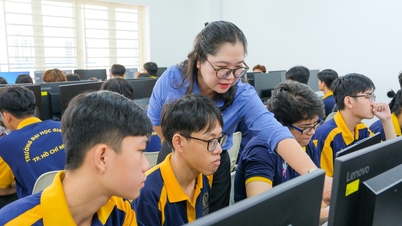
Short study time, extensive practical training, and early graduation are some of the reasons why many students choose vocational training.
IMAGE:
It's not just a psychological issue, it's a systemic problem.
According to Master Lam Van Quan, the situation of "needs certain fields but lacks qualified candidates" stems from many causes, which can be divided into five major groups.
Firstly, there's the societal mentality of prioritizing academic degrees . In the eyes of many parents and students, university is still the path to success, while vocational training is considered a "secondary" option. This mentality is further exacerbated by the trend of choosing fields with "easy jobs and high salaries" such as business administration, banking, and finance, without considering one's own abilities or market demands.
Secondly, there is an inequality in education policy. For many years, budgets, scholarships, and loan mechanisms have been primarily focused on higher education. Vocational education has been left behind, lacking resources and policies to encourage students. Furthermore, the failure to tighten university entrance standards has led to a structural breakdown in post-high school streaming: students with poor academic performance still enter university, while the labor market needs skilled workers but lacks those trained in vocational skills.
Thirdly, there is a lack of accurate labor market information. Currently, students and parents have almost no official data to know which industries are in demand, what the average salary is, and what the career development opportunities are. Therefore, career choices are often vague, easily influenced by popular opinion or word-of-mouth.
Fourth, the career guidance system is weak and lacks scientific tools. Career guidance in schools currently only goes as far as introducing schools, distributing leaflets, or organizing recruitment fairs. Meanwhile, what students need are tools to assess their abilities, test their aptitudes, and experience real-world professions. "When career guidance is wrong, streaming students into different fields will certainly be wrong," said Master Quan.
Fifth, the media coverage lacks depth. Social media still primarily glorifies "top university graduates" instead of successful vocational school graduates. As a result, the image of vocational schools is unappealing and fails to resonate with Generation Z, who are highly sensitive to digital imagery, short videos, TikTok, and YouTube.
Solution: From schools to macro-level policy
According to Master Lam Van Quan, to resolve this paradox, vocational schools and the education system need to take stronger and more coordinated steps.
At the school level, the approach to student recruitment needs to change. Instead of just "recruiting students," schools should provide "career guidance" for students from an early age: organizing career experiences during high school, inviting successful alumni to share their experiences, and maintaining close connections with parents.
Training should be closely linked to businesses. Schools need to strengthen the dual training model, combining learning at school with work experience at businesses, and establishing tripartite contracts to guarantee employment. The clear guarantee of employment for graduates will be the best assurance to attract applicants.
Invest in digital media. Vocational schools need a greater presence on platforms used by young people: short videos, career podcasts, interviews with successful vocational students. A systematic approach is needed to build an image of a modern, dynamic, and "promising" vocational school.
At the policy level, the government needs to take stronger action. First, a national, publicly accessible, and transparent labor market data system should be established to provide students and parents with a basis for choosing careers. Simultaneously, career guidance programs should be standardized and integrated into the curriculum from grade 8, using scientific tools and a team of well-trained experts.
In addition, it is necessary to legalize the mechanism of articulation – lifelong learning – so that vocational students can continue their education at university if they have sufficient ability. The budget for vocational education must also be increased, along with scholarship policies and tuition support for fields that are in high demand but less attractive to society.
Source: https://thanhnien.vn/nganh-nghe-khat-nhan-luc-vi-sao-thi-sinh-van-tho-o-185250910134334822.htm





















































































Comment (0)