

Amidst the mountains and forests of Northwest Vietnam, the stories of local women's livelihoods still revolve around familiar tasks: guiding tourists , weaving, selling souvenirs, and harvesting agricultural products. However, the income these women earn from these activities is relatively low.
Established in 2018 with just 9 members, the Muong Hoa Cooperative in Ta Van village ( Lao Cai province ) initially relied on a few small stalls serving tourists. “Internet was almost non-existent in the village; none of us dared even think about selling online,” recalls Sung Thi Lan, Director of the Muong Hoa Cooperative. Then the pandemic hit, forcing the cooperative to close for three months. “The whole group sat looking at each other, worried about what would happen next.”
The turning point came when the cooperative joined the Economically Efficient Tourism and Agriculture Development Program to Promote Gender Equality (GREAT), funded by Australia. Through the program, Ms. Lan accessed KisStartup's Digital Transformation Ecosystem Enhancement Initiative (IDAP), beginning her journey of transforming her business model.

Ms. Sung Thi Lan, Director of Muong Hoa Cooperative, introduces the handcrafted embroidery products. Photo: Phuong Linh.
From then on, the women participated in training courses on digital transformation, learned how to use Facebook and Zalo to promote products, and built the official fanpage of the Muong Hoa Cooperative. "Initially, we were very confused, but gradually we got used to it. Week by week, month by month, we planned our posts and carefully curated product images. The happiest moment was when we sold our first order online," she smiled.
In addition, Ms. Sung Thi Lan divides the work according to each person's strengths: who is good at dyeing fabric, who is good at embroidery, who is good at sewing, etc. The total number of participants reaches over 300, with the embroidery group being the largest. Hand embroidery requires meticulousness; a small piece can take several months, even a year, to complete, so members usually take advantage of their free time to do it, after cooking meals, taking care of their families, or participating in village activities.
The members regularly guide each other in coordinating, posting content, and finding customers online. Gradually, the cooperative became more stable, generated revenue, attracted more students to help implement online tourism, collect entrance fees, and create funds to maintain operations and pay the members.
Currently, the cooperative's groups are widely distributed across many provinces: the Dao ethnic embroidery group in Lai Chau, the product collection groups in Mu Cang Chai (Yen Bai), Moc Chau (Son La), Ha Giang, Tam Duong (Lai Chau), Dien Bien, etc. Each color and pattern on the products is a combination of different ethnic groups to create a complete product that meets customer needs.
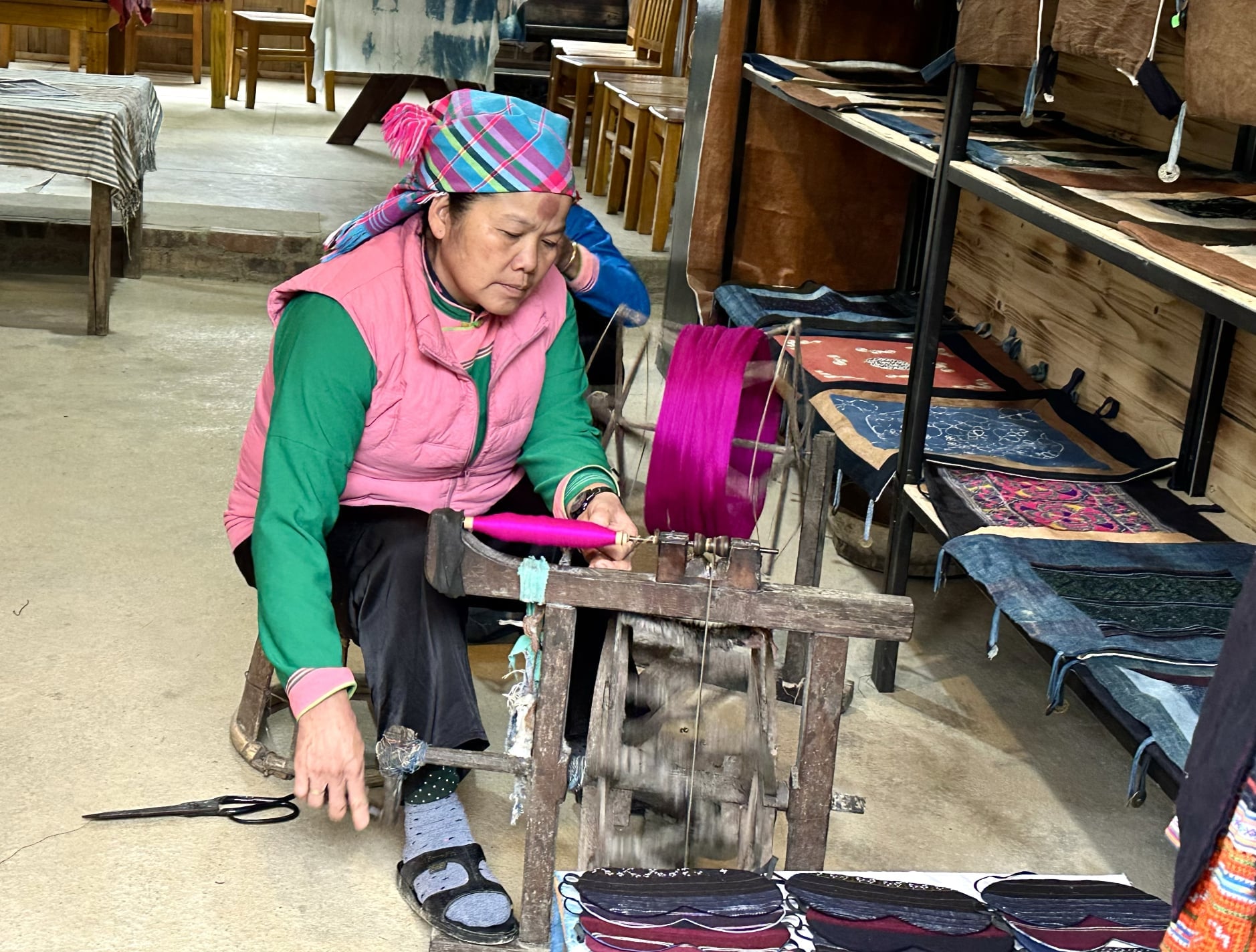
The Muong Hoa Cooperative divides tasks according to each person's strengths. Photo: Phuong Linh.
In terms of personnel, each group has a leader or point of contact to coordinate work, receive materials, distribute products, and process orders. This operational method helps the cooperative maintain its scale and manage effectively, even though its members are scattered in many locations.
At the same time, the Muong Hoa Cooperative is developing additional experiential tourism tours and workshops tailored to customer needs. For example, if a customer wants to learn beeswax painting, there will be a dedicated group; if they want to learn embroidery, there will be an embroidery group; herbal baths, meals, accommodation, and tours are all handled by separate groups. Each group takes on a specific task, ensuring customers have a complete experience while also supporting local people in participating in the work flexibly.
"Not only has it created sustainable livelihoods, but the role of women in the family, especially the role of mother and wife, has undergone positive changes. Previously, according to local culture, men were still considered the main breadwinners. Even if women raised chickens or ducks, they needed the consent of both husband and wife to sell them and ensure a good price."
"But when women have more stable incomes, their roles and voices in the family are significantly enhanced. They become more confident and can participate in important decisions at home," Lan shared.
According to Mr. Vu Hai Phong, representative of KisStartup, the biggest success of the project is the comprehensive transformation in business thinking and business model. Under the guidance of KisStartup, Muong Lan Cooperative has learned how to select products that can promote local cultural values. From there, they have developed tours such as indigo dyeing, beeswax painting, and will soon be developing a small museum model combining the digitization of heritage.
At the same time, the cooperative is gradually utilizing surplus materials for recycling, creating new products, moving towards a green production model, and accessing niche markets for sustainable fashion.
“First, we provide the villagers with basic knowledge and tools through a number of training sessions. Then, we begin to train each member individually, on a case-by-case basis, helping them learn how to apply those tools to their own models.”
In addition, KisStartup mobilized many different experts to support the refinement of its business model. Most of the women studied in the evenings, and the program was very flexible. In some cases, those selling fruit were even guided on how to process spoiled fruit into other products such as dishwashing liquid – creating entirely new value,” he said.
According to Australian Ambassador to Vietnam Gillian Bird, the GREAT program not only empowers ethnic minority women economically in agriculture and tourism, but also contributes to promoting policy changes and the business environment, ensuring that women's economic empowerment is maintained and developed sustainably.
Source: https://nongnghiepmoitruong.vn/nganh-nghe-van-hoa-danh-thuc-khat-vong-thoat-ngheo-d788416.html













































































Comment (0)