

In the context of strong integration and development, administrative reform continues to be one of the key tasks, contributing to building a modern, professional, and transparent administration that better serves the needs of organizations, citizens, and businesses. Implementing Decision No. 494/QD-UBND dated July 15, 2025, of the Quang Tri Provincial People's Committee and Official Letter No. 251/SNV-CCHC of the Department of Internal Affairs, the Department of Health has issued Plan No. 450/KH-SYT on administrative reform for the last six months of 2025 with many comprehensive solutions.
Accordingly, the Department of Health will continue to effectively implement the central and provincial policies on administrative reform, aiming to build an administrative system for the Quang Tri provincial health sector that meets the requirements of the new organizational model and is consistent with practical operations, becoming increasingly modern, professional, and operating smoothly and efficiently. At the same time, it will build a team of qualified and capable officials and employees to better serve citizens, organizations, and businesses, significantly improve the investment and business environment, and contribute to enhancing the province's competitiveness.
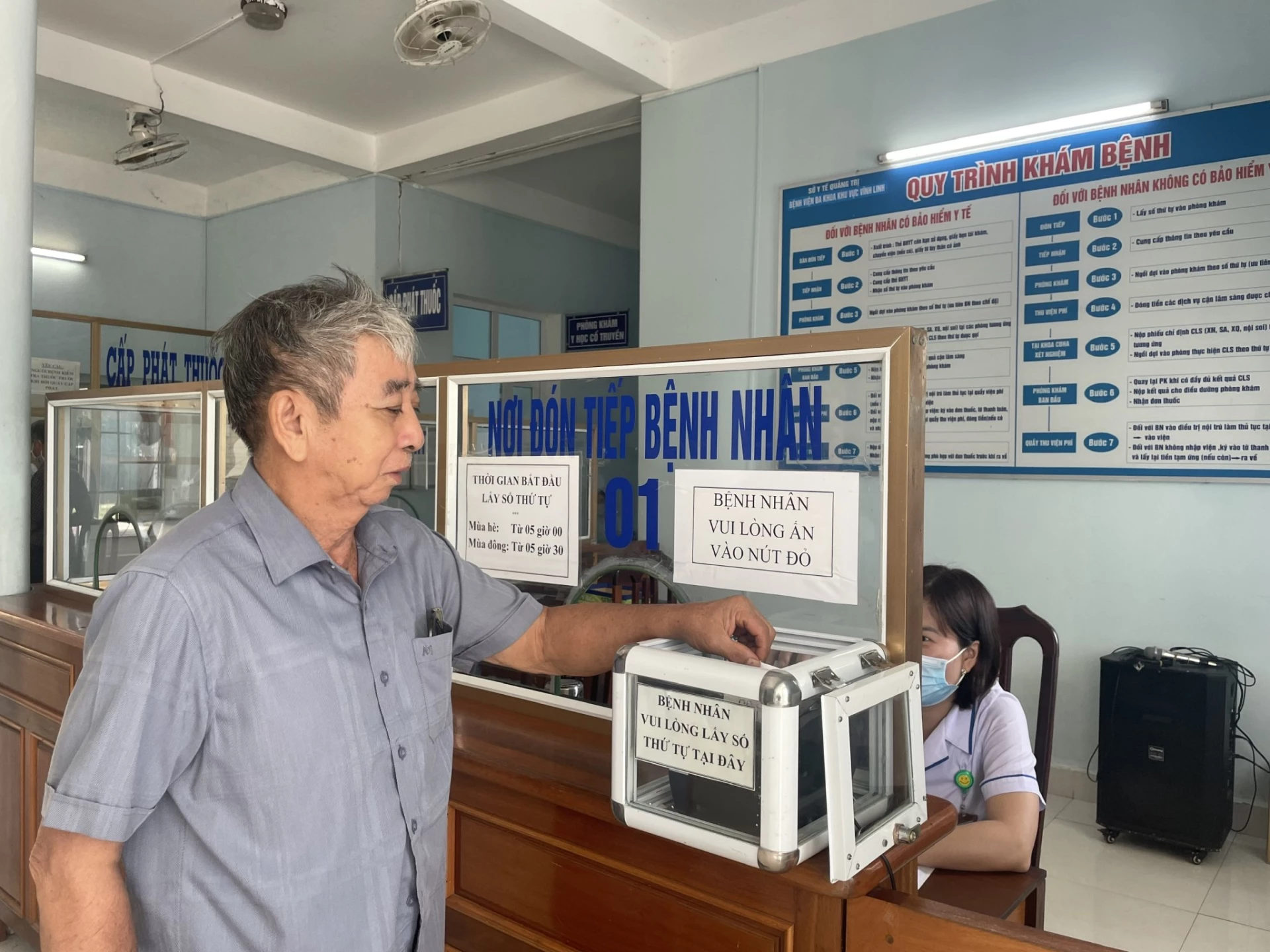 |
| People take numbered tickets to see a doctor at Vinh Linh Regional General Hospital - Photo: HN |
To achieve the set goals, the health sector has identified seven key tasks that need to be implemented in the coming period. These include fully implementing directives from the province and the central government; strengthening the application of information technology in management and operation; promoting administrative reform through online channels, ensuring information reaches every official and citizen; continuing to implement timely and appropriate solutions to improve and enhance the PAR INDEX, PAPI, and SIPAS indicators; strengthening unannounced, surprise inspections on administrative reform, public service inspections, codes of conduct, and the responsibilities of heads of departments; encouraging officials and employees to research and seek models and initiatives to replicate throughout the sector; reviewing and proposing amendments or repeal of outdated documents; organizing the dissemination of laws on anti-corruption, grassroots democracy, social insurance, and emulation and commendation…
Efforts will be made to digitize at least 90% of administrative procedures received and processed; ensuring that 100% of citizens and businesses do not have to re-provide information already available in the database. All administrative procedures will be publicly and transparently displayed on the Department of Health's website and at the Provincial Public Administrative Service Center. Decisions regulating the functions, tasks, and organizational structure of the department and its affiliated units will be finalized; job positions will be arranged and streamlined, and staff reduction will be implemented according to schedule.
Ensure that at least 90% of civil servants and public employees meet the required job title standards; promote training and professional development; and link annual evaluations and rankings to the results of administrative reform implementation.
Promote digital transformation and implement electronic medical records at healthcare facilities. Increase the rate of administrative procedures processed through the entire process according to regulations and digitally signed work files; update information on the website fully and promptly.
In a conversation with us, Deputy Director of the Department of Health Nguyen Xuan Dung stated: “Besides the advantages, the health sector is currently facing some difficulties. Firstly, after the merger of provinces and the operation of the two-tiered local government model, the workload has increased dramatically, especially in administrative procedure reform. The Ministry of Health has delegated and decentralized many administrative procedures in the health sector, so we must urgently review and submit to the Provincial People's Committee for timely publication the sets of procedures and re-decentralize them to localities quickly to ensure that administrative procedures for citizens and businesses are handled smoothly, seamlessly, efficiently, and without interruption. Secondly, in the initial phase, the implementation of digital signatures by various units has not been synchronized, directly affecting the speed of processing documents and digitally signing documents; at the same time, it poses a risk to the sector's administrative reform score – an objective factor. Previously, the health sector's responsibilities were decentralized down to the health station level.” "The number of communes, now that the province has merged, has almost doubled, creating considerable pressure on the entire system."
Although the administrative reform work of the Quang Tri Provincial Health Department is currently facing many difficulties and challenges, with specific and comprehensive tasks and solutions, especially with high determination, close guidance from leaders, the unity of all officials and employees, and close coordination of units, it is believed that the administrative reform work of the provincial health sector in the remaining months of 2025 will achieve high results, contributing to building a transparent and efficient administration, aiming to better serve the people and businesses.
Nguyen Hoai Nam
Source: https://baoquangtri.vn/xa-hoi/202509/nganh-y-te-quang-tri-day-manh-cai-cach-hanh-chinh-6191ec0/


























![[Video] The craft of making Dong Ho folk paintings has been inscribed by UNESCO on the List of Crafts in Need of Urgent Safeguarding.](https://vphoto.vietnam.vn/thumb/402x226/vietnam/resource/IMAGE/2025/12/10/1765350246533_tranh-dong-ho-734-jpg.webp)




























































Comment (0)