

Bring billions of dong back to your hometown to start a business.
In 2001, after getting married, Mr. Thai Doan Tuan (48 years old, residing in Lang Danh village, Lang Thanh commune, Yen Thanh district, Nghe An province) and his wife joined the 6th Youth Volunteer Brigade to build the economy and start a business. In 2010, the Youth Volunteer Brigade was disbanded, and Mr. Tuan and his wife returned to their hometown with over 3 billion VND in compensation.
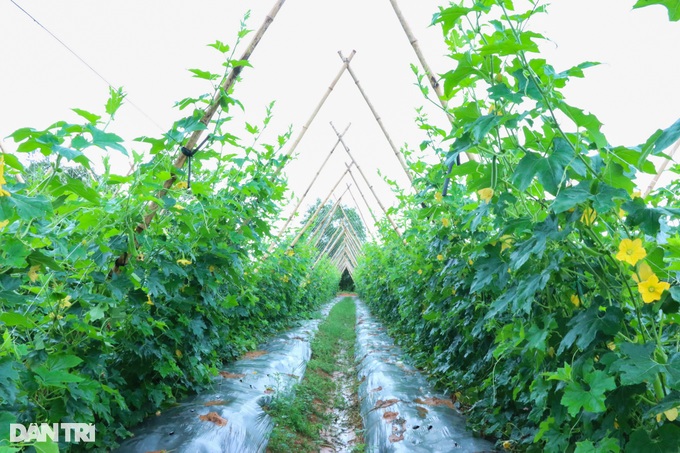
The model of growing green squash on leased land by Mr. and Mrs. Thai Doan Tuan (Photo: Hoang Lam).
Despite having capital and experience in agricultural production, Mr. Tuan was still struggling with the choice of "what crops to grow, what livestock to raise" to start his business.
"I leased 4 hectares of land in Dong Bau, Lang Thanh commune, to grow sugarcane, but during a period of falling sugarcane prices, the factory forced me to accept low prices. After struggling for a while , I had to say goodbye to this crop, even though the sugarcane grew and developed well, was suitable for the soil, and yielded a decent harvest," Mr. Tuan said.
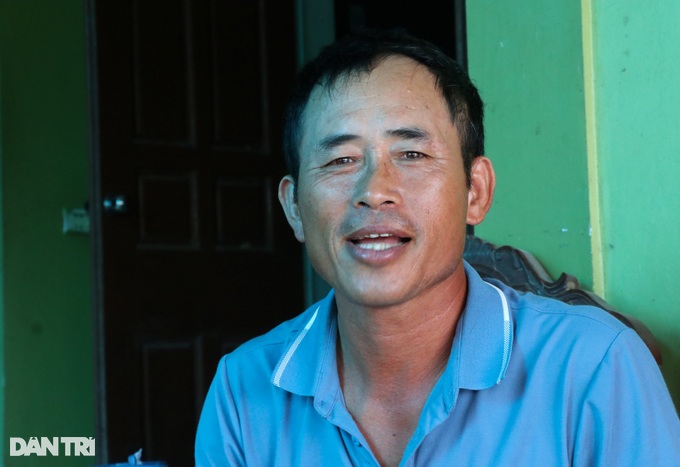
Mr. Thai Doan Tuan shares his experience in growing off-season pumpkins (Photo: Hoang Lam).
After careful consideration, he decided to plant zucchini. Like many other agricultural crops, zucchini is affected by fluctuating market prices. However, the advantage of this fruit is that it can be preserved for a certain period of time to wait for better prices, if harvested when the zucchini is mature enough and under suitable environmental conditions.
Growing off-season green squash, harvesting a wheelbarrow full of it brings in 1.5 million VND ( Video : Hoang Lam).
With the knowledge they accumulated during more than 10 years participating in the Youth Volunteer Brigade, Mr. and Mrs. Tuan transformed the Dong Bau area into a lush green pumpkin garden.
To ensure a sufficient water supply for his garden, without affecting the fruit setting and growth of the pumpkins, there were times when Mr. Tuan had to stay up all night pumping and channeling water from the commune's irrigation system.
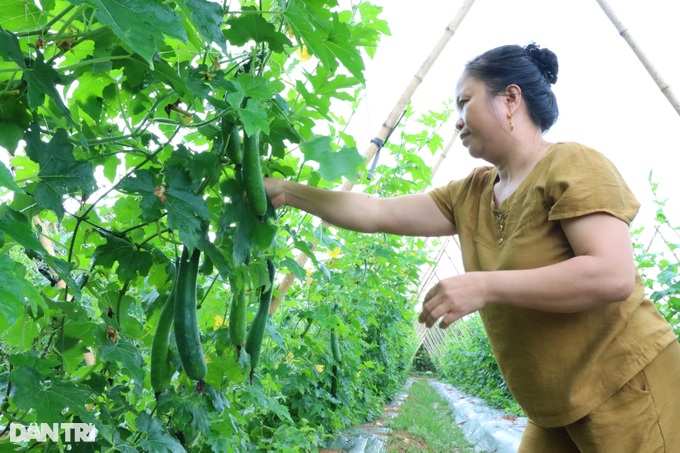
In July, despite the hot weather, the zucchini plants are still growing and developing well, bearing abundant fruit (Photo: Hoang Lam).
The pumpkin plant thrives in well-suited soil, with sufficient water and climate, producing large, uniform fruits that are resistant to pests and diseases, have an attractive appearance, and yield 40 tons/ha.
Defying fate, breaking the curse of "bumper harvest, low prices"
However, as predicted, the vicious cycle of "bumper harvest, low prices; poor harvest, high prices" repeated itself, with pumpkin prices hitting rock bottom at one point, as low as 5,000 VND/kg.
"The price is low, but it's also difficult to sell; traders only choose the big, beautiful ones," said Nguyen Thi Thanh (44 years old, Tuan's wife).
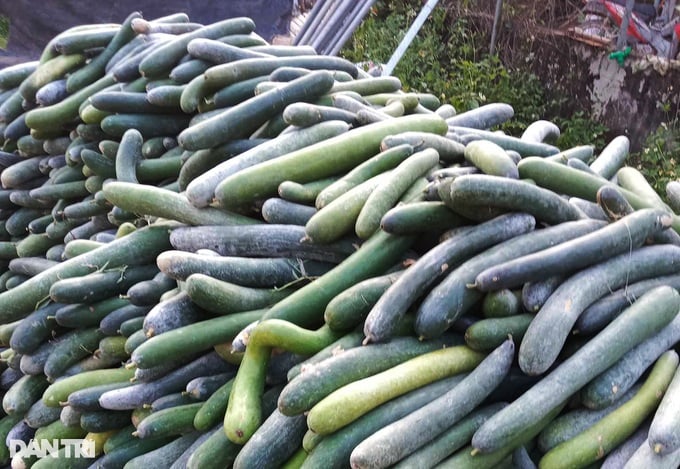
Off-season green squash yields lower productivity, but the selling price can be three times higher than in-season squash, allowing growers to still make a profit (Photo: Hoang Lam).
To avoid dependence on the market, it's necessary to have a reliable supply of goods throughout the year. Starting from a single crop per year, with experience and a bit of daring, Mr. Tuan embarked on growing off-season pumpkins.
Zucchini plants prefer warm weather and high humidity, and are recommended to be planted in January-March and August-September each year, in temperatures between 17-25 degrees Celsius for high yields. However, because they are grown on a large scale, supply often exceeds demand, leading to price manipulation by traders.
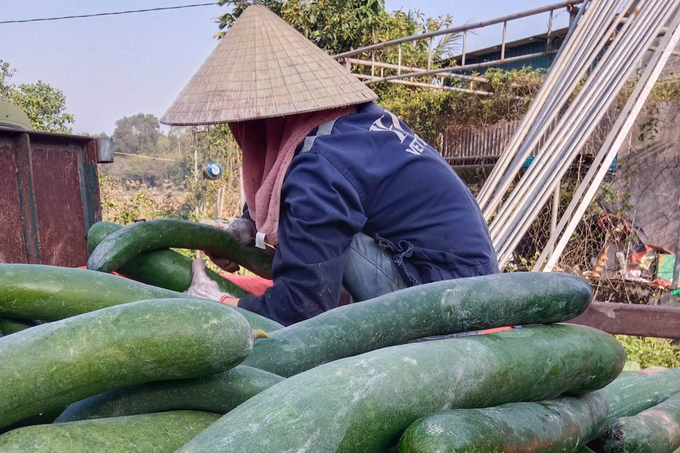
Mr. Tuan's off-season pumpkin production model creates jobs for nearly 15 local workers (Photo: P. Thanh).
Mr. and Mrs. Tuan grow pumpkins three times a year: from April to June, from June to October, and from October through the Lunar New Year. This is a time when the climate in Nghe An is harsh, with intense heat, storms, floods, and freezing temperatures, which are not ideal conditions for pumpkin growth.
Defying nature means accepting risks, but according to Mr. Tuan, farmers can find opportunities in these risks because, like other agricultural products, green squash can also experience crop failures or price increases, especially when grown out of season.
"During the rainy season, we have to use plastic sheeting to protect the plants from the cold or cover the roots to prevent erosion and uprooting. My wife and I invested in a drip irrigation system, which solved the water shortage problem. Of course, pumpkins grown out of season don't yield as much as in the main season, sometimes only half the amount, but the price is three times higher, so we still make a profit," Mr. Tuan said.
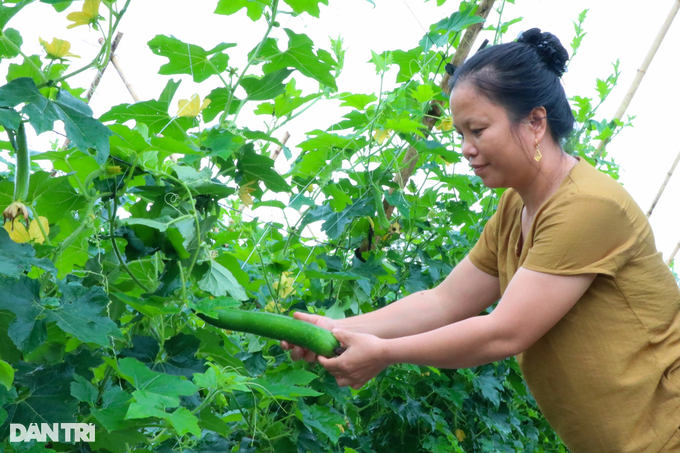
"Off-season pumpkins fetch high prices, and traders aren't too demanding about their appearance or design," Ms. Thanh said (Photo: Hoang Lam).
Normally, pumpkins are bought directly from the fields by traders at prices ranging from 5,000 to 15,000 VND/kg, but for off-season pumpkins, the price can reach 20,000 VND/kg. "During peak season, off-season pumpkins are sold for 22,000-23,000 VND/kg. Harvesting a whole wheelbarrow can bring in 1.5 million VND, and even pumpkins that aren't perfectly uniform are bought up," Ms. Thanh shared.
Besides increasing economic value, growing pumpkins out of season, according to Mr. Tuan, is a solution to the problem of wasted land. However, to prevent disease pathogens from incubating in the soil, he intercrops with corn to control and cut off the source of disease. Currently, 3/4 of the garden area has been reinforced with trellises, replacing bamboo trellises for easier care and to save on long-term investment.
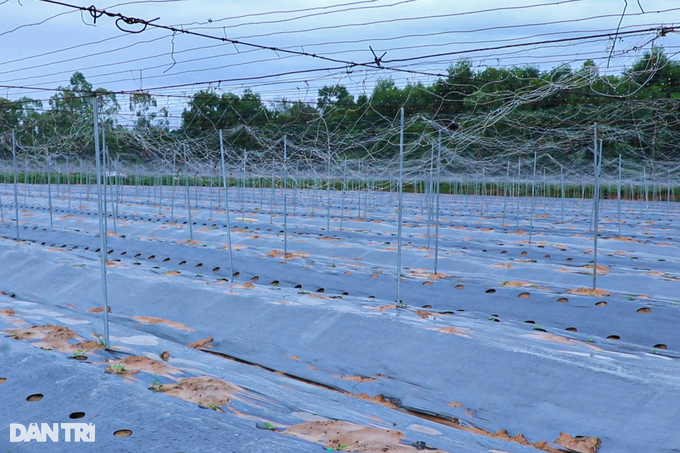
Mr. and Mrs. Tuan invested in a sturdy iron frame and a drip irrigation system for their new pumpkin crop (Photo: Hoang Lam).
With their model of growing three pumpkin crops per year, Mr. and Mrs. Tuan earn approximately 1.2 billion VND. Besides providing regular employment for four local workers responsible for preparing the soil, sowing seeds, planting, and caring for the pumpkins, Mr. and Mrs. Tuan also hire more than 10 seasonal workers during harvest time, paying them 200,000-250,000 VND per person per day.
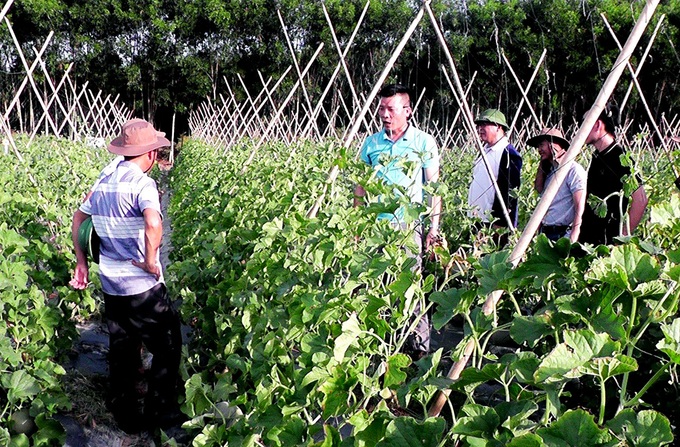
Many locals came to visit the pumpkin farming model of Mr. and Mrs. Tuan (Photo: Doan Canh).
Mr. Nguyen Ho Son, Chairman of the People's Committee of Lang Thanh commune, said: "The model of growing green pumpkins on leased land by Mr. and Mrs. Thai Doan Tuan has initially proven to be economically effective, increasing family income and creating jobs for many local laborers."
According to Mr. Son, this is leased land with a 5-year lease term, which significantly impacts the investment and expansion of production by households. The commune government is studying the draft Land Law to propose a suitable mechanism to create conditions for households to confidently invest in agricultural production and achieve long-term economic efficiency.
Source link






















































































Comment (0)