

Ms. Tran Thi Thanh Xuan, Principal of Phuong Duc Primary School (Thuy Xuan Ward, Hue City), said that for many years, generations of teachers and students at the school have always cherished and contributed to protecting and preserving the Son Xuyen altar of the Nguyen Dynasty.
The school's teachers also contributed funds to build the steps and lay tiles around the worship area to ensure the structure remains neat and clean.

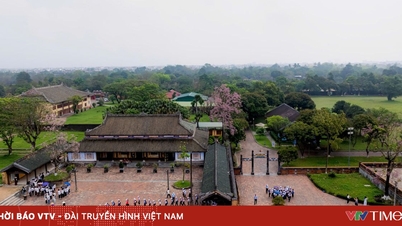
The remains of the Son Xuyen altar from the Nguyen Dynasty are located within the grounds of Phuong Duc Primary School, Hue City (Photo: Vi Thao).
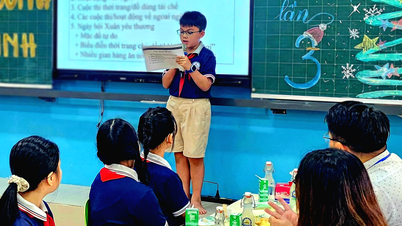
The school has always viewed cultural heritage as a living curriculum, a repository of national memory, identity, and wisdom, thereby educating and nurturing the character, thinking, and pride of the homeland and country in its students.
Mr. Phan Van Chiem (72 years old), a resident of Thuy Xuan ward, said that he had studied at Duong Xuan Thuong School (now Phuong Duc Primary School) before 1967.
During that period, Mr. Chiêm noticed an ancient monument located within the school grounds, often frequented by local people for worship, but he didn't know what kind of structure it was.
Only much later did researchers identify it as the Son Xuyen Altar, an important structure built in 1852 during the reign of Emperor Tu Duc, used to worship famous mountain and river gods, praying for favorable weather, gentle winds, and bountiful harvests.
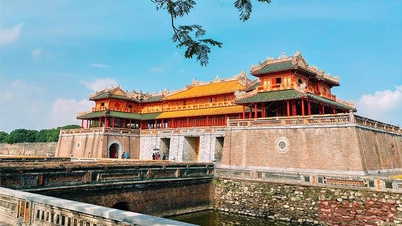
According to historical records, throughout its existence, the Nguyen Dynasty (1802-1945) left Hue with a vast collection of heritage sites, including structures serving the ceremonial activities and spiritual life of the court.

The historical site is protected and preserved by Phuong Duc Primary School (Photo: Vi Thao).
Within the complex of historical relics of the ancient capital of Hue, there are five sacrificial altars, including: Nam Giao, Son Xuyen, Xa Tac, Tien Nong, and Tich Dien.
According to researchers, Son Xuyen was one of 26 sacrificial altars in the provinces across the country at that time. Because this altar was located in the capital city, it played a much more important role than similar structures in other provinces.
Historical records state that, annually, after the imperial court completed its sacrificial ceremonies, the altars in the provinces would be dismantled. The Son Xuyen altar in Hue, however, was solidly constructed in the Bo Hoa Thuong area, in Duong Xuan Thuong commune, Huong Thuy district (now Thuy Xuan ward).
The Son Xuyen altar consists of two square tiers. Each tier is built with bricks and mountain stones, with the center filled with earth and then tightly packed.
The sacrificial ceremonies here were held annually in spring and autumn (February and August according to the lunar calendar) and continued until the reign of King Thành Thái I, in 1889.
Currently, only the top level of the Son Xuyen altar remains, located in the middle of the courtyard of Phuong Duc Primary School. The altars dedicated to the mountain and river gods, the stone steles, and the ancestral tablets have all long since disappeared.

The legacy of a structure that has stood for over 173 years (Photo: Vi Thảo).
Local residents have constructed two concrete altars, a screen, and a place for burning votive offerings in the center of the site for incense burning.
Researchers believe that, although no longer intact as it once was, this is the only remaining altar dedicated to the river and mountain gods in the country, a rare and valuable historical relic.
According to Dr. Phan Thanh Hai, Director of the Department of Culture and Sports of Hue City, in the past, the importance of Son Xuyen Altar was second only to Nam Giao Altar and Xa Tac Altar, national-level sacrificial structures of the Nguyen dynasty in Hue.
However, relics of this type are now almost nonexistent in Vietnam, making it rare. Furthermore, the scale of the Son Xuyen altar is comparable to the Xa Tac altar, making it an even more valuable heritage site for reference, research, and restoration of the Xa Tac altar.
Source: https://dantri.com.vn/giao-duc/dau-tich-giao-trinh-song-hiem-hoi-con-lai-trong-khuon-vien-truong-hoc-20251213100302674.htm
















































































Comment (0)