


At the end of March, Mr. Nguyen Tien Nang, former Deputy Team Leader of Team 34 of the Youth Volunteer Force participating in the Dien Bien Phu Campaign, and former assistant to Prime Minister Pham Van Dong, along with a delegation of former Vietnamese Youth Volunteers, arrived in Dien Bien Phu as part of a journey to revisit their roots and organize social welfare activities. Memories of a difficult time, overcoming bombs and bullets to contribute to the victory at Dien Bien Phu, flooded back to him.
Mr. Nguyen Tien Nang has been involved with the Northwest region since 1953. At that time, he was the Secretary of the Hoang Hoa District Youth Union in Thanh Hoa province. In August and September 1953, following the Central Committee's policy of recruiting Youth Volunteers, thousands of young people from Thanh Hoa, Nghe An, and Ha Tinh provinces volunteered to go. The entire force gathered in Thanh Hoa. Mr. Nang was assigned the important responsibility of Deputy Team Leader of Team 34. After studying the regulations of the Youth Volunteer Corps, Teams 34 and 40 received orders to go to the Northwest, each team consisting of 20 companies with a total of nearly 8,000 people.
Mr. Nang recounted: “At that time, we didn't know what the Northwest region was like, nor did we know what specific mission we would be assigned, but upon receiving the order, we set off with enthusiasm and eagerness. Every young man was ready to go anywhere, do anything for the nation that the Party and President Ho Chi Minh entrusted to us. And so, we traversed the forest, carrying food and supplies, traveling at night and resting during the day. For the first time, I felt overwhelmed by the forest; the further we went, the more dense and cold it became. Forty companies went in stages, scattered along the way, clearing paths as they went, taking several months to reach our destination. During the Tet holiday of 1954, the 40 companies celebrated Tet scattered from Moc Chau to Tuan Giao, along Highway 13 to Ta Khoa ferry, Yen Bai .”

Later, the two Youth Volunteer teams received orders to serve in the Tran Dinh Campaign with many tasks: transporting the wounded, transporting ammunition, protecting food supplies, building warehouses, protecting warehouses... And the main, most important task was ensuring smooth traffic flow to Dien Bien Phu. Mr. Nang recalled: “Honestly, at that time, the team didn't know who Tran Dinh was, or what the campaign was about; we just tried our best to complete the task. When we opened fire to start the campaign, enemy planes bombed fiercely, determined to cut off our supply lines to the front lines, especially the sections: Cheon Pass, Ta Khoa ferry, Pha Din Pass... Particularly the 'throat' of Co Noi intersection - where all vehicles had to pass through to reach the front. They dropped hundreds of tons of bombs of all kinds, including explosive bombs, napalm bombs, butterfly bombs... On some days, the enemy used 69 sorties of B26 and B29 planes to drop up to 300 bombs, and in some periods, the enemy attacked continuously for 2-3 weeks.”
“Initially, we lacked knowledge about different types of bombs, resulting in many injuries and casualties. To minimize losses, bomb disposal teams were established, and each company formed its own bomb disposal unit. The engineering corps trained the Youth Volunteers in bomb disposal. In the Cò Nòi intersection area alone, 5-6 companies were deployed. Everyone was determined to defuse the bombs and ensure the road surface was restored as quickly as possible. So, the entire ‘army,’ armed only with crowbars, hoes, shovels, wheelbarrows, carrying poles, and paving slabs, worked bravely. After each enemy bomb, we would go in to clear the debris and rebuild the road. Usually, it only took 5-6 hours to restore the road to traffic. In March, the French attacked most fiercely, and the rain made the roads muddy and difficult to fill. We had to transport dry soil from afar. Despite the hardships and dangers, the team worked diligently, united and supporting each other to overcome difficulties with the spirit of ‘all for the front lines, all for the cause.’ "Victory" - Mr. Nang proudly recounted those heroic yet tragic days.
Even after the victory of the Tran Dinh Campaign (Dien Bien Phu Campaign), Youth Volunteer Teams 34 and 40 remained to restore bridges and roads. They then continued their march to Lai Chau to build a road to the Ma Lu Thang border for three consecutive years. Therefore, after returning to Dien Bien Phu, despite being exhausted, Mr. Nang and his nephew still took a bus to visit their comrades resting at the Youth Volunteer Martyrs' Cemetery in Chan Nua commune, Sin Ho district, Lai Chau province – the "home" of nearly 100 Youth Volunteers who sacrificed their lives to build the border road.
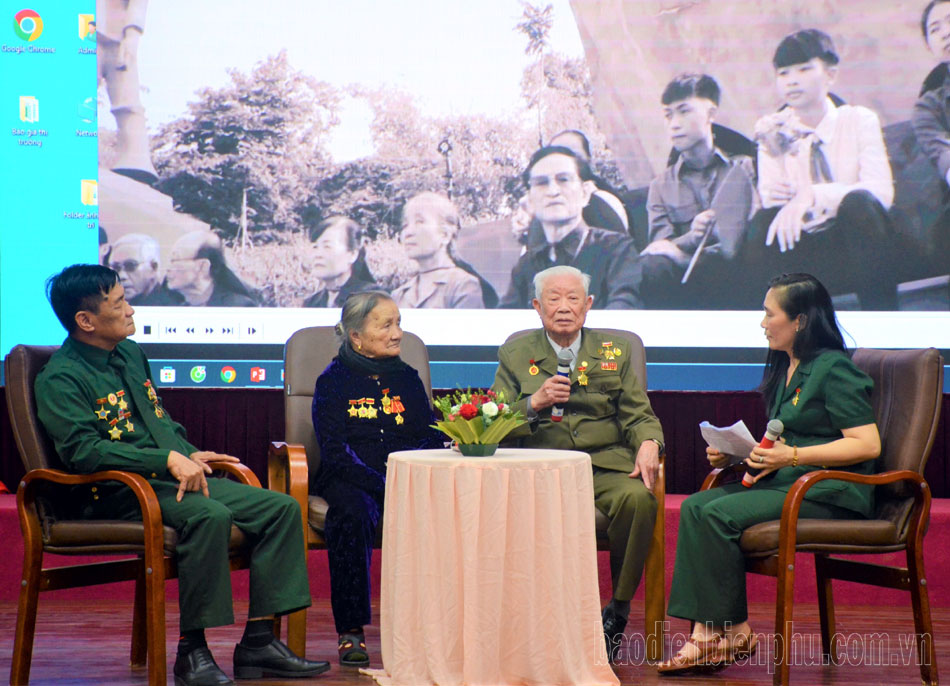
Mr. Nang shared: "For me, returning to Son La, Dien Bien, and Lai Chau is like returning home. So many of my brothers fell for this land. As long as I'm alive and able to travel, I'll come back to visit them. This will probably be the last time, because my health won't allow it anymore."
At this age, he still ponders: "Hundreds of my comrades fell, sacrificing their lives on the land of Son La, Dien Bien, and Lai Chau, contributing to the resounding victory, driving out the invaders, and paving the way to change the lives of the ethnic minorities and develop the local economy and society. Now, I only hope that future generations will understand history and forever remember their contributions. So many comrades sacrificed their lives without their remains found, many graves remain unidentified. I hope that at Co Noi Crossroads, a memorial plaque will be erected bearing the names of the Youth Volunteers who perished there. Similarly, at Pha Din Pass or Tuan Giao Crossroads (Dien Bien), there will be memorial plaques commemorating the historical events and contributions of the Youth Volunteers..."
Source







































































Comment (0)