

Some people believe the Kakhovka Dam collapsed due to structural weakening after decades of operation, but many experts lean towards the possibility that the structure was sabotaged.
Early on the morning of June 6th, the Kakhovka hydroelectric dam, the largest of the six Soviet-era dams on the Dnieper River, unexpectedly broke, releasing billions of cubic meters of water downstream and causing widespread flooding in Kherson.
The dam began to break around 2:50 a.m. on June 6, but for hours afterward, Vladimir Leontiev, the Russian-appointed mayor of the Nova Kakhovka city at the foot of the dam, insisted the situation was "normal" and dismissed reports of any incident at the Kakhovka dam.
But by morning, when videos of the dam breaking began circulating on social media, Leontiev changed his statement, admitting that the dam had indeed broken. Soon after, many pro-Kremlin bloggers and Russian state media put forward the theory that the Kakhovka dam collapsed on its own due to structural weakening over time.
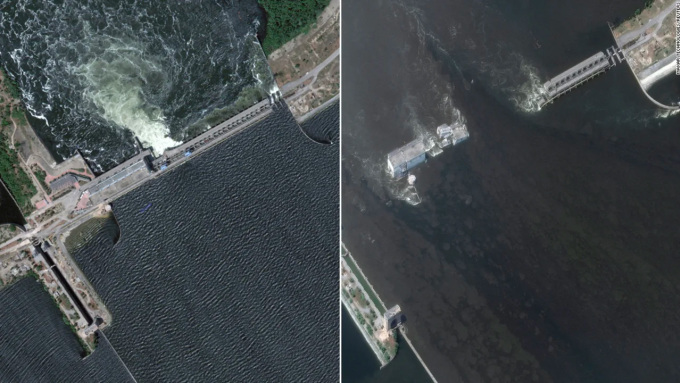
The Kakhovka Dam before (left) and after it broke on June 6. Photo: Reuters
The Kakhovka Dam has been in operation for nearly 70 years, leading some experts to believe that structural weakening, the cause of its collapse, cannot be ruled out.
"Kakhovka is a concrete gravity dam, 35 meters high and 85 meters long. This type of dam is very common worldwide . If designed and built well, and adequately maintained, the likelihood of failure is very low," said Craig Goff, engineering director and head of the dams and reservoirs team at the consulting firm HR Wallingford. "However, it is unclear how the dam was maintained during more than a year of conflict."
The area surrounding the dam has been the scene of intense fighting, and the dam itself has suffered damage before. Several sections on the north side of the dam and some of its spillways were affected by a small explosion last November, when Russia withdrew its troops from the west banks of the Dnieper and Kherson rivers ahead of Ukraine's advance.
Ukraine subsequently recaptured the city of Kherson on the west bank of the Dnieper River, but Russia retained control of the area on the east bank of the river and the Kakhovka Dam.
Satellite imagery from Maxar shows the road above the dam was intact on May 28, but in images taken on June 5, the day before the dam broke, a section of the road had collapsed. It is unclear how the damage to the road above the dam affected the structure of the dam itself.
Data shows that water levels in the Kakhovka dam reservoir also reached record highs last month, according to Hydroweb. Vladimir Rogov, a Russian-appointed official in the Zaporizhzhia province, said on May 5 that the water level in the Kakhovka reservoir had risen by 17 meters, 2.5 meters higher than normal.
However, some experts have expressed skepticism about this hypothesis, because the Kakhovka dam was built very sturdily and evidence suggests that the dam did not break due to natural factors.
"If it were due to excessive water pressure upstream, the dam body would only have broken in one section, and then the hole would have gradually widened. But the images from the scene show the dam body breaking in two sections simultaneously, indicating that this was not a natural occurrence," said Chris Binnie, visiting professor at the University of Exeter and chairman of a tidal energy and environmental company in the UK.
Expert Goff stated that the design of the Kakhovka dam took into account very high water levels, even severe flooding. The structure also has a spillway to allow water to flow through when the water level rises too high.
Andy Hughes, a reservoir engineer in the UK, said that with such a massive structure, it would have to face numerous simultaneous problems to release the 18 billion cubic meters of water. "Gravity dams are designed to withstand very high pressure," he said.
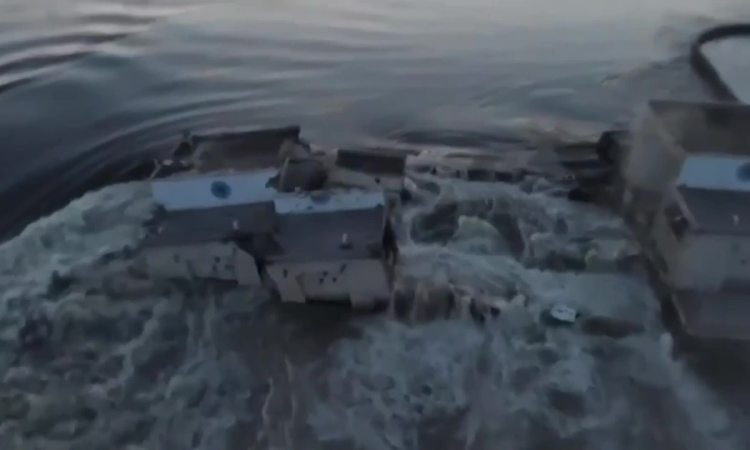
The devastating impact of the Kakhovka dam collapse. Video: RusVesna
The fact that the dam's embankment has been gradually damaged by shelling from both sides over the past few months is unlikely to cause its collapse.
"The Kakhovka Dam was built to withstand a nuclear bomb explosion," said Ihor Syrota, director of Ukrhydroenergo, Ukraine's hydroelectric company. "To destroy the dam from the outside, it would take at least three bombs dropped from aircraft, each weighing 500 kg, all hitting the same spot."
Therefore, Syrota stated that the artillery shells or missiles scattered across the dam's structure were not powerful enough to cause structural failure leading to its collapse.
Peter Mason, a dam and hydroelectric engineer in the UK, also stated that shelling from outside could not have caused such a dam failure.
NOSAR, an independent Norwegian organization that monitors earthquakes and nuclear explosions, recorded strong seismic signals in the Kakhovka dam area at 2:54 a.m. on June 6, very close to the time the dam broke.
"When I saw the news about the dam collapse, I thought I had to check the data to see if it was an explosion or just a structural failure. Then we saw data about an explosion near the dam or right at the dam," said Anne Lycke, executive director of NOSAR.
It is currently unclear whether NOSAR's findings were the cause of the dam's collapse. However, many experts lean towards the hypothesis that explosives were planted inside the dam to sabotage it.
Experts believe the Kakhovka dam began to collapse in the center, near the hydroelectric power plant, before spreading outwards. They argue that completely destroying such a dam would require numerous explosive charges strategically placed by experts at its weakest points.
Gareth Collett, an explosives engineer and former leader of the professional bomb disposal association in the UK, said that when an explosion occurs in a confined space inside the dam body, the full energy of the blast will impact all surrounding structures, causing the greatest destruction.
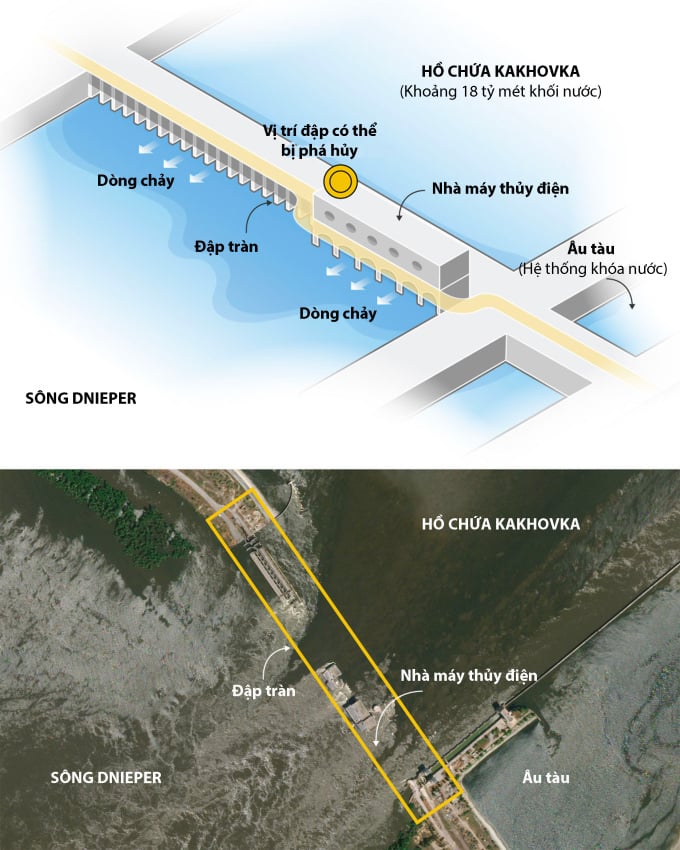
The structure of the Kakhovka Dam before and after its collapse. Graphic: WSJ
According to experts, when explosions occur in the submerged part of the dam, the destructive power is amplified.
"Underwater explosions can significantly amplify the shock waves that hit structures," Collett said.
The central part of the dam may have been targeted by controlled explosions to flood the hydroelectric plant and cause its walls to collapse. This would mean it was a "carefully targeted, deliberate operation."
Theoretically, explosive devices placed inside the hydroelectric plant could rupture the water pipes leading to the turbines, flooding the plant and causing its walls to collapse, before the rest of the structure is destroyed.
"The general consensus at the moment is that it appears someone has vandalized the dam. However, we cannot say for sure at this time," Mason said.
Experts believe that determining the exact cause of the Kherson Dam collapse requires an independent investigation examining all available evidence. However, under the current circumstances, such an investigation is impossible.
On May 30th, a week before the dam collapse, the Russian government passed a law on "ensuring the safety of hydraulic structures" in the four newly annexed provinces of Ukraine. This law prohibits investigations into incidents involving hydroelectric and irrigation structures related to hostilities, sabotage, or terrorism before January 1st, 2028. The law was signed into law by Russian Prime Minister Mikhail Mishustin and came into effect on that date.
Thanh Tam (Based on WSJ, CNN, TASS )
Source link



























![[Photo] Prime Minister Pham Minh Chinh attends the Conference summarizing and implementing tasks of the judicial sector.](/_next/image?url=https%3A%2F%2Fvphoto.vietnam.vn%2Fthumb%2F1200x675%2Fvietnam%2Fresource%2FIMAGE%2F2025%2F12%2F13%2F1765616082148_dsc-5565-jpg.webp&w=3840&q=75)





































































Comment (0)