

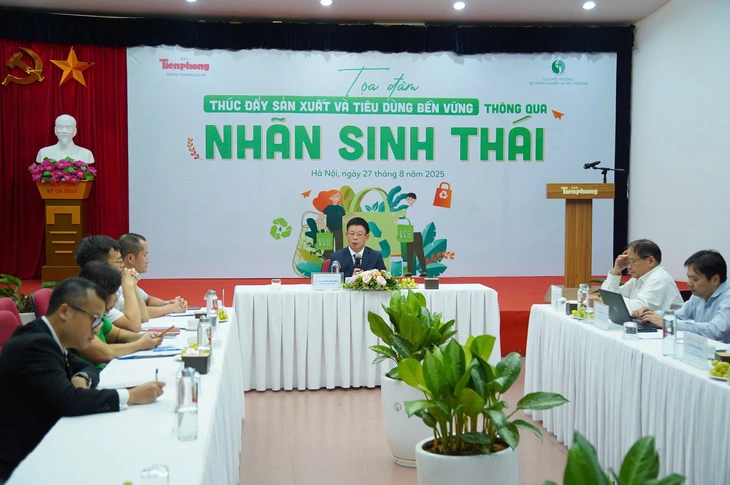
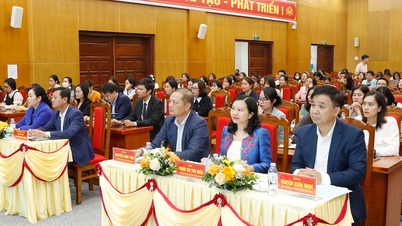
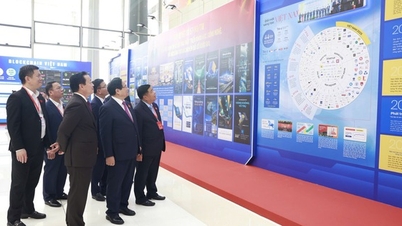
Scene from the seminar - Photo: C. TUỆ
On August 27th, Tien Phong newspaper , in collaboration with the Department of Environment ( Ministry of Agriculture and Environment ), organized a seminar to promote sustainable production and consumption through "eco-labels".
The number of eco-label certifications issued is limited.
According to Mr. Le Hoai Nam, Deputy Director of the Department of Environment, green labels and eco-labels are important environmental policy tools that have been successfully applied by many countries such as South Korea, Japan, China, Thailand, and European countries.
This tool helps businesses transition from polluting products to green products, while also supporting consumers' access to eco-friendly, health-protective goods.
According to Mr. Nam, in 2009, a pilot program on green labels was launched, focusing on two groups of products certified with the Vietnam Green Label: environmentally friendly plastic bags (including biodegradable and recyclable bags).
The ministry has issued specific criteria for these groups, and some businesses have been granted certification, but the number is still limited.
The main reasons are the weak capacity of domestic businesses, lack of resources for technological innovation, unclear incentive policies, and many new regulations remaining at the law level without implementing guidelines.
"For example, the law stipulates an environmental protection tax of 40,000 VND/kg on non-biodegradable plastic bags, aiming to limit production and encourage the use of biodegradable bags. However, in reality, many small businesses still evade the tax and continue to produce this type of bag," he said.
At the seminar, Associate Professor Dr. Nguyen The Chinh - a senior researcher at the Institute of Meteorology , Hydrology and Climate Change - also stated that the implementation of eco-labels still has many aspects that need discussion, even though this issue was raised before the Law on Environmental Protection and the environmental tax and fee policies were enacted.
According to Mr. Chinh, to implement eco-labeling, businesses need to be able to meet the criteria and regulations set by the eco-label. The transition from unlabeled products to labeled products is a long and costly process.
He cited the example of Japanese computer monitors, which, in addition to ISO 9000 certification guaranteeing product quality, also have ISO 14000 certification associated with an eco-label – ensuring both quality and safety for users.
However, upgrading from ISO 9,000 to ISO 14,000 requires significant investment in both cost and technology.

Mr. Le Hoai Nam, Deputy Director of the Department of Environment - Photo: C. TUỆ
The use of single-use plastic and foam products should be limited.
Ms. Trinh Thi Hong Loan, representative of the Vietnam Retailers Association, believes that the legal framework and policies supporting businesses need to be improved to encourage them to produce more eco-labeled products. To achieve this, it is necessary to clarify the product certification process and provide tax reduction support.
Some countries have policies that subsidize 50% of the cost of eco-labeling products. In contrast, in our country, only 13 businesses have participated in eco-labeling within two years, a very small number.
Mr. Vo Thai Son, General Director of Stavian MP Joint Stock Company, said that businesses need to be given favorable access to preferential loan packages and green development funds to invest in clean, energy-saving production technologies.
"In particular, nationwide restrictions on the production, import, and use of disposable plastic and foam products need to be implemented soon to reduce pollution and encourage a green lifestyle," Mr. Son said.
Mr. Nguyen Trung Thang, Deputy Director of the Institute of Agricultural and Environmental Strategy and Policy, suggested that state management agencies need to reform administrative procedures to make it easier for businesses to access support projects, as well as preferential loan sources for green development.
"Simplifying documentation, shortening processing times, and increasing the digitalization of processes will contribute to reducing compliance costs, thereby boosting both supply and demand for eco-labeled products. Consideration should be given to transferring the role of eco-label certification to independent organizations, instead of having state agencies directly carry it out," Mr. Thang said.
WISDOM
Source: https://tuoitre.vn/nhan-sinh-thai-dong-luc-cho-san-xuat-xanh-ben-vung-20250827143609846.htm


























































































Comment (0)