

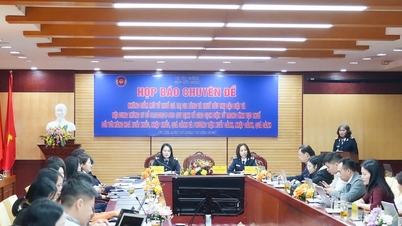
At the press conference, Deputy Head of the Customs Tax Department Mai Thi Van Anh said that in the context of economic fluctuations, tax policies have been adjusted by the Government and the Ministry of Finance to support businesses and improve the business environment.
According to the Customs Department, the VAT Law 48/2024/QH15 and its guiding decrees, which will take effect from July 1, 2025, add many regulations to help businesses more easily fulfill their tax obligations. The group of tax-free goods has been expanded to include: Financial leased goods brought directly into duty-free zones; natural resources and mineral products according to the Government 's list; movable assets within the tax-free limit; goods serving border residents; relics and antiques imported by competent authorities.
The new policy also clearly stipulates the principles of applying tax rates to help businesses easily determine tax obligations and limit disputes. At the same time, a series of changes are applied to tighten management: some items are changed from non-taxable to 5% taxable such as fertilizers and agricultural machinery; some items previously subject to 5% tax are changed to 10% tax such as sugar, sugar by-products, and laboratory research equipment. Businesses that trade in many items but cannot separate them by tax rate must pay the highest tax rate.
The new policy also resolves many practical problems such as guiding a 2% reduction in VAT according to Resolution 204/2025/QH15; unifying the collection of VAT on low-value goods from February 18, 2025 according to the new VAT Law; clarifying the 5% tax rate applicable to veterinary drugs and veterinary vaccines.
Head of the Tax Management Team, Customs Tax Department Nguyen Thi Khanh Huyen said that the VAT Law No. 48/2024/QH15 and the guiding decree have codified many regulations that were previously only guided by official dispatches. The highlight is the expansion of the list of goods not subject to tax, helping businesses reduce legal risks and compliance costs.
Accordingly, imported goods for financial leasing are allowed to be transported directly into duty-free zones without being subject to VAT; exported products belonging to the group of raw or processed resources and minerals according to the Government's List are clearly defined as not subject to tax, in line with the policy of restricting the export of raw resources. The Law also codifies tax exemption cases such as movable assets within the import tax exemption limit, goods exchanged by border residents, relics and antiques imported by competent authorities.
In addition, some non-taxable items such as fertilizers, fishing vessels, and specialized agricultural machinery and equipment are subject to a 5% tax rate. Items previously enjoying a 5% preferential rate have also been adjusted to 10%, including: sugar and sugar production by-products, specialized equipment for teaching, research, and experimentation, semi-processed rosin, and unprocessed forest products.
The Customs Department emphasized that synchronizing regulations from July 1, 2025 will help businesses be proactive in production, import-export planning, while enhancing monitoring capabilities and applying technology in tax management.
In the special consumption tax group, the Special Consumption Tax Law No. 66/2025/QH15 (effective from January 1, 2026) has many notable changes: removing the regulation that air conditioners with a capacity of 24,000 BTU or less are subject to special consumption tax, expanding the scope of goods not subject to tax such as processed export goods, re-imported goods returned by foreign countries, helicopters for rescue and training. The Law also adds cases of tax refund and deduction.
However, some items will be managed more strictly, such as: sugary drinks with more than 5g/100ml are officially subject to special consumption tax; tobacco and alcohol will be subject to a higher tax rate and additional absolute tax will be added according to the roadmap. The new regulations also clarify taxable objects such as airplanes, helicopters, and gliders; and stipulate that votive paper is a taxable commodity, except for votive paper that is children's toys and teaching aids.
New points in VAT and special consumption tax policies, along with the implementation of Circular 51/2025/TT-BTC, demonstrate the strong determination of the Customs sector and the Ministry of Finance in administrative reform, modernizing management and supporting the business community. The new regulations not only create a favorable and transparent business environment but also contribute to increasing the efficiency of State budget collection, in line with the economic development orientation in the current period of strong digital transformation.
Source: https://daibieunhandan.vn/nhieu-diem-moi-ve-thue-gia-tri-gia-tang-thue-tieu-thu-dac-biet-voi-hang-xuat-nhap-khau-10398237.html


![[Photo] Cat Ba - Green island paradise](/_next/image?url=https%3A%2F%2Fvphoto.vietnam.vn%2Fthumb%2F1200x675%2Fvietnam%2Fresource%2FIMAGE%2F2025%2F12%2F04%2F1764821844074_ndo_br_1-dcbthienduongxanh638-jpg.webp&w=3840&q=75)






































![[VIMC 40 days of lightning speed] Da Nang Port: Unity - Lightning speed - Breakthrough to the finish line](https://vphoto.vietnam.vn/thumb/402x226/vietnam/resource/IMAGE/2025/12/04/1764833540882_cdn_4-12-25.jpeg)






































Comment (0)