

According to Mr. Nguyen Duc Kien, Deputy Director of the Vietnam Fine Arts Museum, in the management of artifacts, the Vietnam Fine Arts Museum has been building, exploiting, and managing a database and records of artifacts on an artifact management software system. Since mid-2020, the Vietnam Fine Arts Museum has collaborated with Esoft IT company to develop the museum's artifact management software, and to date, initial results have been achieved, contributing to the development and success of the Vietnam Fine Arts Museum as well as the Ministry of Culture, Sports and Tourism in the overall digital transformation.
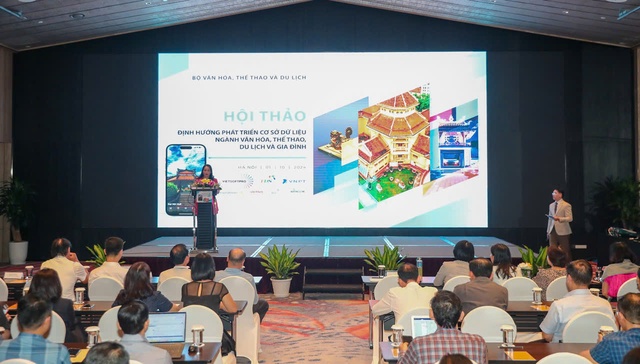
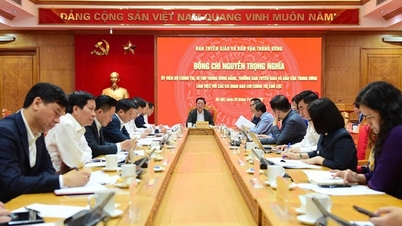
Overview of the Conference
Recognizing that a database of artifacts is the foundation of digitization and the backbone for the effective operation of artifact management software, the professional staff of the Vietnam Fine Arts Museum have collected and built a database of artifacts from records, documents, and artifact registration books that the museum currently holds. This includes: collecting artifact information from the museum's registration system and artifact profiles; documents, texts, and legal papers related to the artifacts; photographs and 3D scans of the artifacts…
After being compiled, this information (data) will be checked, compared, and selected to obtain the most accurate data, and then entered into the artifact management software according to the pre-built information fields in the software, based on the requirements for exploitation, use, and management of artifacts at the Vietnam Fine Arts Museum.
After completing the collection and cleaning of artifact data and the acceptance of the artifact management software, the data entry process begins. This is a very time-consuming and labor-intensive step, requiring high accuracy when entering information from records and registers into the management software. The artifact information entered by the professional staff will be checked, edited, and approved by the department manager before being officially saved to the database for exploitation and utilization.
"After the artifact management software was put into use, its exploitation has yielded many positive results, effectively meeting the requirements in artifact management as well as exploiting and developing the artifact database. The management of nearly 20,000 artifacts is uniformly carried out through the software. Museum artifacts are systematically classified by function/type/material in a scientific manner, making them easy to track, update, and statistically analyze. At the same time, managing artifacts using software also helps museum professionals save a lot of time in various work processes, gradually changing their awareness, improving their knowledge of information technology, and developing working habits in a digital environment," said Mr. Nguyen Duc Kien.
According to Dr. Chu Thu Huong from the Institute of Heritage Conservation, for all industries and fields, data is always a crucial starting point to ensure the scientific accuracy and effectiveness of research.
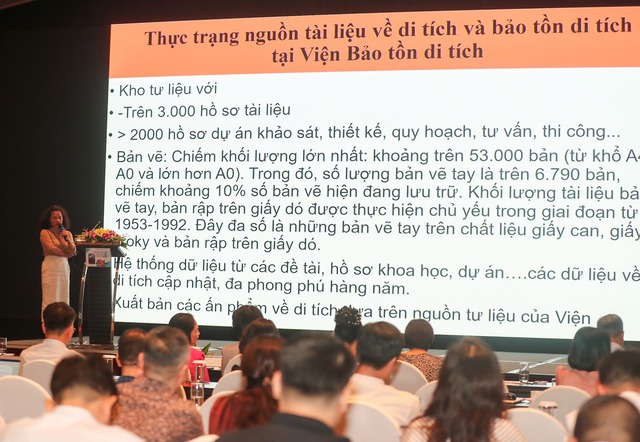
Dr. Chu Thu Huong, from the Institute of Heritage Conservation, shared her insights at the conference.
As a leading research institute in the field of heritage conservation, the Institute always prioritizes documentation and database development for the conservation and restoration of historical sites. The Institute of Heritage Conservation has amassed a considerable collection of documents, contributing significantly to the database of the Ministry of Culture.
The process of digitizing historical sites and heritage has always been implemented comprehensively, from surveying, collecting, and building a database of records for digitization, to building a database of historical sites. The Institute has always carried out this process systematically and according to appropriate standards. In addition, the Institute strives to integrate and share data with relevant parties through the development and updating of the historical site database.
The digital database on historical sites and conservation work in Vietnam, with over 4,000 sites uploaded to the system, has become an important channel for introducing historical sites and conservation work in Vietnam. This is also a significant contribution of the Institute of Conservation of Historical Sites to the development of the cultural sector's database. This database not only provides an overview of Vietnamese historical sites but also offers detailed scientific data on specific sites, technical parameters for restoration, etc. The digital database makes searching and retrieving information about historical sites extremely convenient, diversifies access to data, and contributes to promoting heritage to a wider audience.
However, the implementation of digital transformation in the field of heritage preservation is still quite new. The Institute lacks a skilled workforce proficient in information technology to meet the demands of the job, and the biggest challenge is the funding for implementing digitalization, digital transformation, and integration of new technologies in the field of heritage preservation.

Mr. Pham Minh Truong, M.Sc., from the Vietnam Film Institute, presented his paper at the conference.
According to Mr. Pham Minh Truong, M.Sc., from the Vietnam Film Institute, the Institute's film archive currently holds nearly 80,000 rolls of film. With the aim of preserving and storing these materials long-term, while also widely disseminating them to the public, the Vietnam Film Institute has a plan and roadmap to digitize these valuable materials.
Digitized films make searching simpler and more convenient, increasing the ability to access and search for information anywhere, anytime quickly and easily; facilitating the sharing of information resources; and allowing for editing, reuse, or conversion to other digital data types.
In 2005, the Vietnam Film Institute invested in a modern digital film transfer printing system. On average, the system transfers approximately 1000-1200 rolls of film onto Betacam tapes annually. To ensure continuous film digitization, in line with the development trends of cinema, in 2015, the Film Institute invested in a 2K resolution film digitization system. On average, the Vietnam Film Institute digitizes approximately 600-700 rolls of film in 2K resolution annually.
Similar to film digitization, the Vietnam Film Institute also digitizes secondary documents to ensure the safe and long-term preservation of original materials, minimizing the need to release original documents for public use. Simultaneously, digital storage allows researchers and film enthusiasts to easily access and search for materials. This maximizes the dissemination and promotion of archived materials.
"The construction, exploitation, and effective use of database systems in general is very important, necessary, and requires clear goals and a roadmap. In addition, it is necessary to allocate human resources and strengthen the application of information technology in database construction to improve efficiency in data management and exploitation activities, regularly update data, ensure data is complete, accurate, truthfully reflects reality, and effectively serves the political tasks of agencies and units. At the same time, database construction needs to focus on closely linking with ensuring information security, cybersecurity, national security, and protecting personal information," Mr. Pham Minh Truong shared.
However, according to Mr. Pham Minh Truong, the digitization process at the Institute also faces many difficulties, such as: although equipment has been invested in, most of it is now outdated. Some components of the film scanners are degraded, affecting the quality and progress of the work. Maintenance and repairs require hiring foreign experts, but the cost of this work is very high.

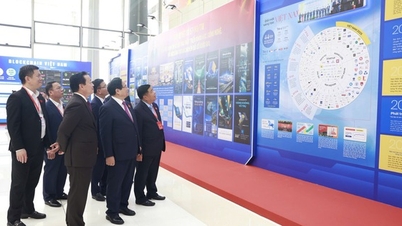
Conference scene
Furthermore, data storage and management remain manual due to the lack of a dedicated data storage system and modern data management software suitable for the specific nature of the work.
The film archive and secondary documentaries continue to be added annually, and while a large number are being digitized, the workforce and equipment are insufficient to meet the demand. The film archive at the Vietnam Film Institute currently holds nearly 80,000 films, while the Institute only digitizes 600-700 films annually. With the current equipment and personnel, digitizing the entire film archive would require an enormous amount of time.
Data security of digitized documents is also a matter that needs to be addressed. Copying, sharing data, and information leaks are entirely possible, even unintentionally, if not strictly controlled.
Based on the practical experience at the Vietnam Film Institute, Mr. Pham Minh Truong believes that building, exploiting, and effectively utilizing a database system in general is very important, necessary, and requires clear goals and a roadmap.
It is necessary to allocate human resources and strengthen the application of information technology in building databases to improve efficiency in data management and exploitation activities, regularly update data, ensure that data is complete, accurate, truthfully reflects reality, and effectively serves the political tasks of agencies and units.
Database development needs to be closely linked to ensuring information security, cybersecurity, national security, and the protection of personal information.
At the same time, we will strengthen exchanges and cooperation with agencies and units both domestically and internationally to share experiences in the work of digitizing, exploiting, sharing, and managing data.
"It is clear that building a database is the central task of digital transformation. Both the government and digital administration consider databases as central. Without a database, digital transformation activities are worthless and cannot develop; digital applications, services, and platforms will 'freeze' or never be created," Mr. Pham Minh Truong shared.
Source: https://toquoc.vn/nhieu-thach-thuc-trong-chuyen-doi-so-va-tich-hop-cac-cong-nghe-moi-doi-voi-nganh-vhttdl-2024100116551151.htm






















































































Comment (0)