

| Increased deep processing: 'Elevating' the value of agricultural products for farmers in the highlands of Bac Ninh : Diversifying agricultural product consumption channels towards modernity and sustainability. |
Strengthening linkages to improve product quality.
Experts believe that, given the growth rate of the past three quarters, the target of $55 billion is entirely achievable, and it is even possible to expect to reach $58-60 billion in 2024.
To meet the demands of the global market, in recent years, many localities and businesses have invested in equipment, worked alongside farmers to improve processing capacity, built brand reputation, and gradually brought agricultural products to stable outlets and official export channels to demanding markets…
 |
| Vietnamese agricultural products conquer the global market with their brand reputation. Photo: Duc Thuy |
The situation in Son La province is typical; currently, the province has 17 factories and 543 agricultural processing facilities. Each enterprise has a different production and business development strategy, but all aim to increase value.
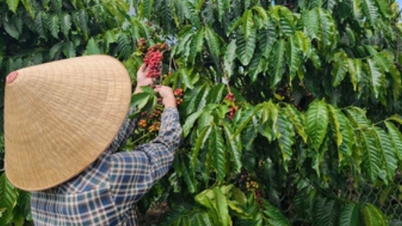
For example, at Phuc Sinh Son La Joint Stock Company, the company is collaborating with over 1,600 households in the communes of Mai Son district and Son La city to cultivate over 2,000 hectares of coffee with RA certification – a sustainable agricultural standard certification. This provides a foundation and ensures the quality of the Blue Son La brand, which is accepted by the global coffee market. In the 2024-2025 crop year, the company plans to purchase 12,500 tons of fresh coffee cherries and produce 3,500 tons of green coffee beans for domestic consumption and export.
As for Ara-tay Coffee Cooperative (Chieng Chung commune, Mai Son district), since its establishment in 2020, its members and more than 300 affiliated farming households have chosen to produce specialty, high-quality coffee. In particular, the cooperative has built its coffee brand using stories and images of the people of Son La and the Northwest region.
Ms. Cam Thi Mon – Director of Ara-tay Coffee Cooperative, introduced: The cooperative chose the name Ara-tay Coffee, "ara" being an abbreviation of Arabica, and "tay" meaning Thai people, the nurturing hand of a woman, or the Northwest region… Nature and climate have been favorable to Son La province, as well as Chieng Chung commune, allowing them to grow this Arabica coffee plant. Now, coffee is the main crop for farmers in Chieng Chung, helping them develop their economy, build decent houses, and send their children to school, eliminating the difficulties they faced before when growing corn or cassava.
Like Son La, Lam Dong is one of the leading provinces in the country in agricultural development, especially high-tech and smart agriculture. In recent years, the province has implemented many solutions to boost the export market for its agricultural products, such as: promoting deep processing to increase product value; participating in domestic and export value chains; linking with cooperatives, production groups, and individual farmers to form stable raw material areas; and establishing centralized post-harvest processing, distribution, and export of the province's agricultural products.
Identifying agricultural development as one of the four breakthroughs, Lam Dong province will focus on removing obstacles in production relations in the coming period, paving the way for production development, especially creating deep cooperation and linkages from production and processing to product consumption markets to create new momentum.
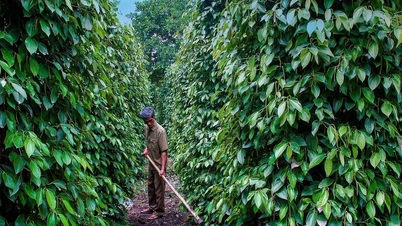
Not only Son La or Lam Dong, but in recent years, many localities across the country have adopted policies to promote the production of clean agricultural products, producing high-quality organic products such as organic rice, organic pepper; medicinal herbs, coffee linked to carbon credits, and some other clean agricultural products; while also calling on businesses to cooperate with farmers, gradually increasing the added value per unit area, helping farmers stabilize their lives on their cultivated land.
Through collaborative production, businesses themselves have realized that accessing customers, selecting markets, and building brands are key to opening up opportunities for exporting agricultural products.
Quality goes hand in hand with transparency of information.
According to economic experts, Vietnam's agricultural, forestry, and fisheries exports have experienced spectacular growth (from US$30 billion in 2015 to US$53 billion in 2023, and reaching over US$46 billion in the first nine months of 2024), ranking among the top 15 agricultural exporting countries in the world. The increasing presence of Vietnamese agricultural products in the international market is proof of the continuous efforts of farmers, businesses, experts, and managers in improving quality, negotiating, and meeting the stringent standards of the international market.
Evaluating Vietnam's agricultural products, economist Vo Tri Thanh commented that, with its advantages in agriculture and natural conditions, Vietnamese agricultural products have certain strengths to compete in the world market and successfully participate in the global value chain.
Sharing her views on this issue, Ms. Trinh Huyen Mai – Deputy Head of the Policy and Trade Promotion Department, Trade Promotion Agency (Ministry of Industry and Trade) – said that in recent times, the quality of Vietnamese agricultural products has improved significantly to meet the increasingly demanding, diverse, and meticulous needs of the market regarding food safety, appearance, design, packaging, and even the quality of service provision.
However, along with quality, product information transparency is also very important. Recently, cooperatives and processing enterprises have been granted planting area codes and traceability codes, and have implemented VietGap and GlobalGap programs for their products.
From a business perspective, many opinions suggest that in order for agricultural products to attract more foreign currency, fruits must first meet food safety and hygiene standards, overcome technical barriers, expand the range of new fruit varieties in markets, and prevent disease outbreaks.
Most importantly, we need to improve the quality of Vietnamese fruit to proactively meet the demands of all markets. When one market fluctuates or other markets emerge, we can immediately switch to offering Vietnamese fruit... Only then can exports go further, penetrate deeper, and achieve sustainable growth.
Experts believe that it's time for Vietnamese agricultural products to conquer the Vietnamese market. Improving quality, positioning, and building a strong brand for Vietnamese agricultural products to gain a firm foothold in the domestic market is not only a prerequisite for facilitating the flow of domestic agricultural consumption, but also helps these products confidently reach the global market.
| Vietnam is currently one of the world's largest exporters of agricultural products. Data from the Department of Quality, Processing and Market Development (Ministry of Agriculture and Rural Development) shows that food safety standards have significantly improved. |


![[Photo] Prime Minister Pham Minh Chinh holds a phone call with the CEO of Russia's Rosatom Corporation.](/_next/image?url=https%3A%2F%2Fvphoto.vietnam.vn%2Fthumb%2F1200x675%2Fvietnam%2Fresource%2FIMAGE%2F2025%2F12%2F11%2F1765464552365_dsc-5295-jpg.webp&w=3840&q=75)

























































Comment (0)