

(NLĐO) - 28 strange objects have been identified as "milinovae" that occurred in previously unknown ways.
According to Space.com, astronomers have just discovered 28 strange objects inside the Large Magellanic Cloud (LMC) and the Small Magellanic Cloud (SMC), two satellite galaxies of the Milky Way, the galaxy containing Earth.
In-depth analysis revealed that these 28 strange objects are actually 28 "milinovae," or "mini-novae," formed by 28 variable stars with peculiar behavior.
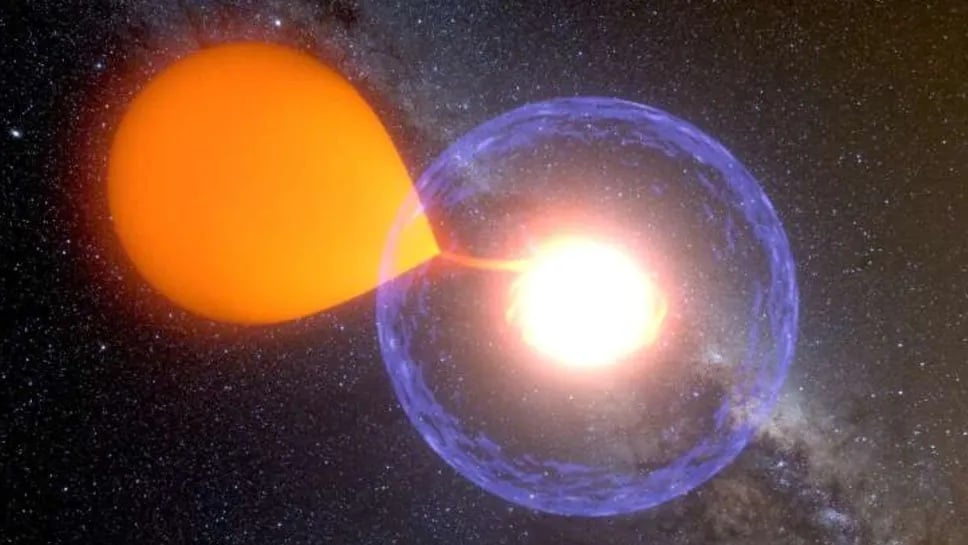
An illustration showing how the "object from the dead"—a white dwarf—is exploding while continuing to devour its companion. (Image: University of Warsaw)
In astronomy, there is a commonly used term called "supernova," which is the brilliant final explosion of a star's life.
Our Sun will eventually become such a supernova.
The newly discovered milinovae are much smaller in size, but are still 100 times brighter than the Sun.
These are not the final deaths of stars, but rather unusual eruptions recorded from stars that exhibit continuous changes in brightness upon observation, known as variable stars.
But the variable stars that have just been recorded are completely unique.
They produce very distinctive triangular symmetrical bursts unlike any previously known variable stars, according to Dr. Przemek Mróz from the University of Warsaw (Poland), a member of the research team.
They believe this is because the variable stars being observed have actually been dead for a long time.
They are white dwarfs, the "zombie" remnants left behind after the final explosion of Sun-like stars. But these distant white dwarfs are not solitary like the Sun; they have a companion, meaning they belong to a binary star system.
Unfortunately, these white dwarf stars become "vampires," sucking matter from their companions. Whenever they become too full, they explode and release the excess energy.
These unusual objects were discovered by chance during the OGLE survey, a 20-year project searching for primordial black holes left over from the Big Bang event that gave birth to the universe.
These unusual variable stars have attracted attention because they brighten 10 to 20 times during bursts, which occur in cycles of several months to several years.
One of them, known as OGLE-mNOVA-11, erupted late last year, allowing the research team to conduct a detailed study of these objects.
Source: https://nld.com.vn/phat-hien-28-vat-the-la-phat-sang-hon-mat-troi-100-lan-196241225111959089.htm
![[Photo] Closing Ceremony of the 10th Session of the 15th National Assembly](/_next/image?url=https%3A%2F%2Fvphoto.vietnam.vn%2Fthumb%2F1200x675%2Fvietnam%2Fresource%2FIMAGE%2F2025%2F12%2F11%2F1765448959967_image-1437-jpg.webp&w=3840&q=75)


















































![[OFFICIAL] MISA GROUP ANNOUNCES ITS PIONEERING BRAND POSITIONING IN BUILDING AGENTIC AI FOR BUSINESSES, HOUSEHOLDS, AND THE GOVERNMENT](https://vphoto.vietnam.vn/thumb/402x226/vietnam/resource/IMAGE/2025/12/11/1765444754256_agentic-ai_postfb-scaled.png)



















































Comment (0)