

Determining the appropriate level of tax increase to ensure the survival and sustainability of revenue streams, thereby strengthening business confidence, especially among FDI enterprises and new investors, is crucial.
Amending the Special Consumption Tax Law: The key is to nurture revenue sources.
Determining the appropriate level of tax increase to ensure the survival and sustainability of revenue streams, thereby strengthening business confidence, especially among FDI enterprises and new investors, is crucial.
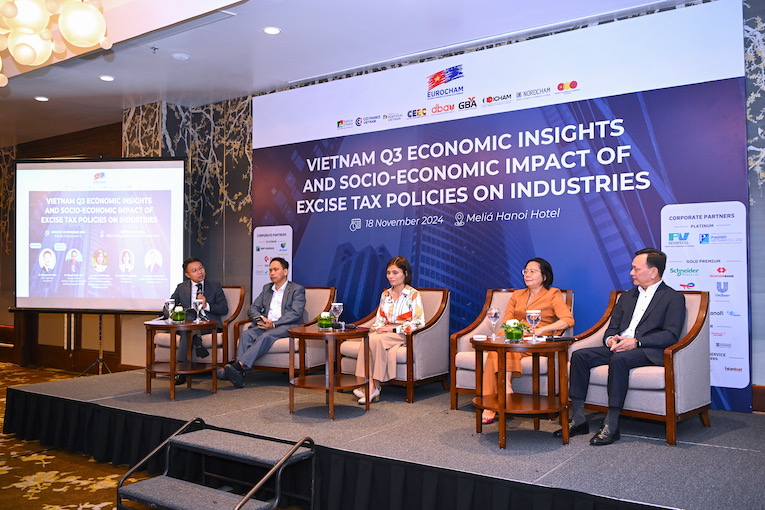 |
| Experts attending the seminar discussed Vietnam's third-quarter economic data and the socio-economic impact of excise tax policies on industrial sectors. |
This opinion was expressed by experts at the seminar: "Economic information for the third quarter and the socio-economic impact of excise tax policies on industrial sectors" organized by the European Chamber of Commerce in Vietnam (Eurocham) on November 18 in Hanoi .
According to the plan, the draft Law on Special Consumption Tax (amended) will be discussed and commented on at the 8th Session of the 15th National Assembly , which is currently underway. This is one of 13 draft laws that are officially being considered during this session.
Dr. Nguyen Minh Thao, Head of the Business Environment and Competitiveness Department at the Central Institute for Economic Management Research (CIEM), analyzed: "Tax policy aims to ensure revenue, but the biggest goal of excise tax is to regulate consumer behavior, followed by regulating the behavior of producers." However, the draft Law on Excise Tax (amended) is prioritizing increasing revenue.
 The Business Confidence Index (BCI) has declined, and in some cases even sharply, since the pandemic, falling below the average (below 50 percentage points). Three years after the pandemic, this index has still not returned to pre-pandemic expectations.
Mr. Nguyen Hai Minh, Vice President of EuroCham

To clarify further, Ms. Thao analyzed: "Increasing taxes leads to higher beer prices, a decrease in production, sales, and profits, which in turn drags down 21 other related industries (agriculture, packaging, transportation, services, hotels and restaurants, etc.)."
Domestic consumption, one of the key drivers of economic growth, is still facing low purchasing power and has not yet recovered to pre-pandemic levels. The beverage industry is also facing a sharp decline in revenue.
"We must regulate appropriately and avoid creating additional burdens for businesses. Therefore, determining the appropriate level of tax increase to ensure the survival and maintenance of revenue sources, thereby strengthening business confidence, especially for FDI enterprises and new investors, is crucial," Ms. Thao analyzed.
Ms. Dinh Thi Quynh Van, Chairwoman of PwC Vietnam, agrees with the trend of increasing taxes on the beer industry, but also recommends that the tax increase should be considered in a way that harmonizes the interests of businesses, the industry, and government revenue.
"Above all, to have a sustainable source of revenue, manufacturing businesses must invest in profitable operations, expand production, and increase revenue. Increasing taxes does not always mean increasing revenue, and reducing taxes does not always mean decreasing revenue," Ms. Van emphasized.
Mr. Nguyen Thanh Phuc, Director of External Relations at Heineken Vietnam, stated that any tax increase should ensure the principles of maintaining stability, harmony, nurturing revenue sources, and aligning with economic scenarios. Simultaneously, it should aim to build a predictable investment environment and public policies to strengthen the confidence of foreign investors.
Given that domestic consumption has not yet recovered to pre-pandemic levels, increasing taxes would severely impact the beer industry, significantly affecting it and 21 related sectors. Increased taxes would force FDI companies like Heineken to reconsider their investments, potentially reducing production, and impacting the income and employment of workers in the industry's production chain.
"Extending the tax increase schedule is most necessary for businesses, as it's a way to support businesses that are still on the path to recovery after the long period of difficulty," Mr. Phuc emphasized.
Therefore, Heineken, businesses, and the Vietnam Beer, Wine and Beverage Association (BVA) propose: “To create a stable environment for the recovery of industries, the beer industry proposes maintaining the current excise tax rate for one year starting from 2026 when the amended law comes into effect, meaning the first tax increase will be in 2027.”
Subsequently, to allow consumers to gradually adapt to the new prices resulting from the increase in excise tax, beer businesses proposed increasing the tax by 5% every two years, up to a maximum of 80% by 2031, and maintaining stability.
Source: https://baodautu.vn/sua-luat-thue-tieu-thu-dac-biet-quan-trong-la-nuoi-duong-duoc-nguon-thu-d230333.html

![[Photo] Prime Minister Pham Minh Chinh holds a phone call with the CEO of Russia's Rosatom Corporation.](/_next/image?url=https%3A%2F%2Fvphoto.vietnam.vn%2Fthumb%2F1200x675%2Fvietnam%2Fresource%2FIMAGE%2F2025%2F12%2F11%2F1765464552365_dsc-5295-jpg.webp&w=3840&q=75)


![[Photo] Closing Ceremony of the 10th Session of the 15th National Assembly](/_next/image?url=https%3A%2F%2Fvphoto.vietnam.vn%2Fthumb%2F1200x675%2Fvietnam%2Fresource%2FIMAGE%2F2025%2F12%2F11%2F1765448959967_image-1437-jpg.webp&w=3840&q=75)










































![[OFFICIAL] MISA GROUP ANNOUNCES ITS PIONEERING BRAND POSITIONING IN BUILDING AGENTIC AI FOR BUSINESSES, HOUSEHOLDS, AND THE GOVERNMENT](https://vphoto.vietnam.vn/thumb/402x226/vietnam/resource/IMAGE/2025/12/11/1765444754256_agentic-ai_postfb-scaled.png)















































Comment (0)