

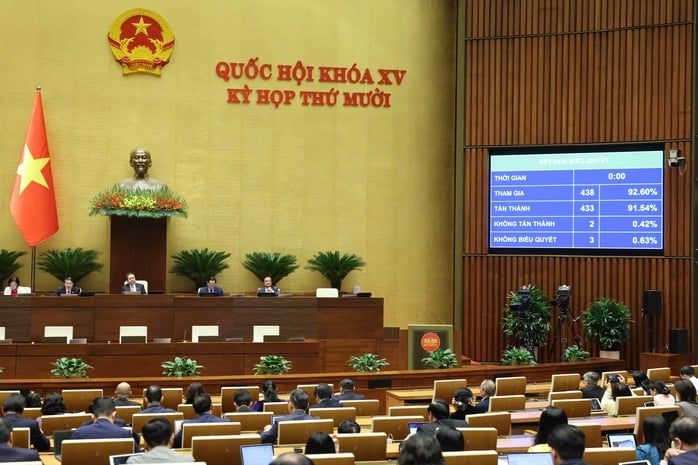
On the morning of December 11th, continuing the program of the 10th session, with 433 out of 438 participating delegates voting in favor, the National Assembly passed a Resolution amending and supplementing a number of articles of Resolution No. 98/2023/QH15 dated June 24, 2023, of the National Assembly on piloting a number of special mechanisms and policies for the development of Ho Chi Minh City. This Resolution will take effect from December 12, 2025.
According to the National Assembly Resolution, Ho Chi Minh City is allowed to pilot a number of unique and unprecedented mechanisms and policies regarding investment management; finance and state budget; urban management, resources, and environment; priority list for attracting strategic investors; establishment and operation of free trade zones; management of science and technology and innovation; and the organization of the government apparatus...
Notably, the resolution allows the Ho Chi Minh City People's Committee to decide on investment in construction combined with housing construction, commercial and service facilities, public works, and other facilities at railway stations, train maintenance and repair depots, and areas adjacent to traffic junctions along the Ring Road 3, which are designated for development under the TOD (Transit-Oriented Development) model.
The People's Committee of Ho Chi Minh City is also authorized to decide on economic and technical indicators and land use indicators for planning that differ from the regulations in the national technical standards on urban and rural planning, but must ensure compliance with technical infrastructure, social infrastructure, and environmental safety regulations for residential areas.
Regarding planning, the Resolution stipulates that Ho Chi Minh City will only have one overall city plan, based on the concretization of national-level and regional planning contents, and the integration and incorporation of provincial and city master planning contents.
The approved master plan for the city replaces the provincial plan and the city's general plan. The city's master plan has the same legal validity as the provincial plan according to planning regulations and the city's general plan according to urban and rural planning regulations.

This approved plan serves as the basis for the preparation, appraisal, and approval of urban and rural plans, and as the basis for assessing the project's suitability according to regulations. The People's Committee of Ho Chi Minh City approves the city's master plan and adjusts the master plan after it is approved by the City People's Council...
Based on the Ho Chi Minh City Master Plan, the City People's Council decides on the list of urban and rural planning projects that will have both zoning plans and detailed plans prepared simultaneously. If the detailed plan is prepared and appraised first, it will be approved first and updated into the zoning plan.
The City People's Council decided to use local budget funds to implement independent public investment projects to carry out compensation, support, and resettlement for investment projects according to separate urban design plans, urban planning of areas surrounding railway stations on railway lines approved by competent authorities, and areas surrounding traffic junctions along the Ring Road 3 within the city's territory. This includes land acquisition, urban renovation and development, resettlement, and creating land funds for auctioning land use rights to implement urban development, commercial, and service investment projects in accordance with the law, or to pay investors implementing railway projects using Build-Transfer (BT) contracts as stipulated by law on investment under the public-private partnership method.
Adding 11 priority project groups to attract strategic investors.
According to the Resolution, the management of revenue sharing and the percentage (%) ratio between the central and local budgets from the exploitation of land in TOD areas is as follows: For local railway projects following the TOD model that use the entire budget of the City or advance capital from the Investor to carry out compensation, support, and resettlement for the land acquired for the railway and TOD area, the City is allowed to retain 100% of the revenue collected from the exploitation of land in the TOD area to prioritize investment in local railway projects and transportation projects along the TOD route.
A key element of the Resolution is the list of priority projects and policies for attracting strategic investors. Specifically, the Resolution adds 11 priority project groups for attracting strategic investors.
Of particular note is the group of investment projects for the construction and operation of integrated entertainment and resort complexes, including accommodation services for tourists meeting at least 5-star standards, high-end resort services, and comprehensive shopping and entertainment services along the Saigon River, Dong Nai River, and coastal corridors, aimed at creating momentum for socio-economic development, with investment capital of 30,000 billion VND or more;
Investment projects for specialized medical clusters, sports complexes, cultural parks, or themed parks with an investment capital of 6,000 billion VND or more;
Projects for renovating and relocating houses on rivers, houses along rivers, houses on canals, and houses along canals have an investment capital of 6,000 billion VND or more;
Infrastructure investment projects in the free trade zone include: Port investment with a capital scale of VND 75,000 billion or more; logistics center investment with a capital scale of VND 25,000 billion or more; industrial, urban, and service functional areas investment with a capital scale of VND 20,000 billion or more...
In addition, the Resolution introduces many unprecedented mechanisms and policies to help Ho Chi Minh City attract strategic investors.
The resolution authorizes the establishment and operation of the Ho Chi Minh City Free Trade Zone. A free trade zone is a geographically defined area established to pilot superior, groundbreaking mechanisms and policies aimed at attracting high-quality investment, finance, trade, and services to promote exports, industry, research and development (R&D), and high-quality human resources.
In addition, it is organized into functional zones including: production zones, port and port logistics zones, logistics centers, commercial and service zones, and other types of functional zones as prescribed by law.
Functional zones within the Free Trade Zone that meet the conditions of a duty-free zone as stipulated by law are guaranteed customs inspection, supervision, and control by the customs authority, as well as state management activities in their respective fields by relevant agencies as prescribed.
Source: https://ttbc-hcm.gov.vn/quoc-hoi-thong-qua-viec-sua-doi-bo-sung-nghi-quyet-98-ban-hanh-hang-loat-co-che-dac-thu-cho-tphcm-1020186.html


![[Image] Close-up of the newly discovered "sacred road" at My Son Sanctuary](/_next/image?url=https%3A%2F%2Fvphoto.vietnam.vn%2Fthumb%2F1200x675%2Fvietnam%2Fresource%2FIMAGE%2F2025%2F12%2F13%2F1765587881240_ndo_br_ms5-jpg.webp&w=3840&q=75)




























































Comment (0)