

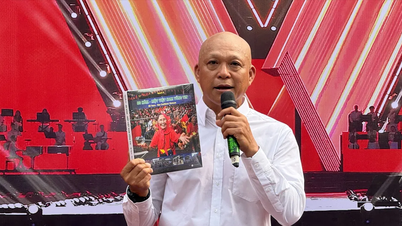
According to author Nguyen The Ky, the novel series "A Thousand Miles of Homeland" will have 5 volumes, with volume 3 recently released to readers, depicting the image of President Ho Chi Minh in 5 important stages of his life and great revolutionary career.
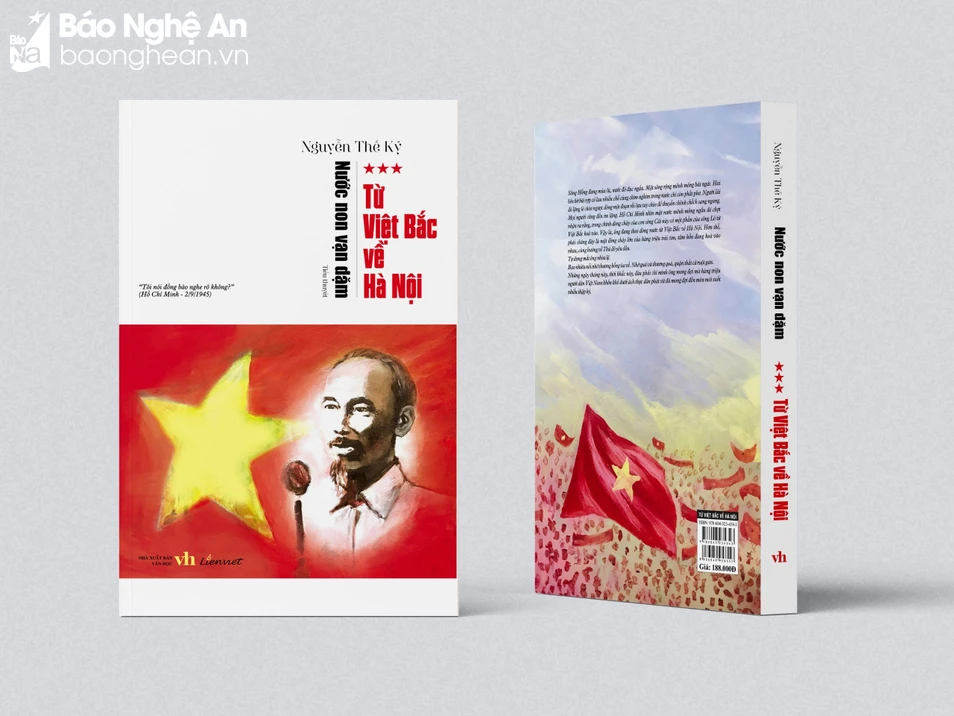
Volume 3, "From Viet Bac to Hanoi" (2024), portrays the image of Nguyen Ai Quoc - Ho Chi Minh from the beginning of 1941 until the success of the August Revolution. On the afternoon of September 2, 1945, President Ho Chi Minh read the Declaration of Independence, giving birth to the Democratic Republic of Vietnam. During those five years, Nguyen Ai Quoc - Ho Chi Minh ignited and fanned the flames of revolution in the northernmost part of the country: "Distant mountains, distant waters / It is not only vastness that is called great / Here is the Lenin stream, there is the Marx mountain / With two hands, we build a nation."
The realistic setting of episode 3 takes place from 1941 to 1945, depicting the Vietnamese revolution, outwardly quiet but inwardly seething, awaiting the opportune moment to erupt into a major storm; the situation in neighboring China and the Chinese Communist Party, and the Nationalist government; the presence of important Soviet and American figures in China; the developments of World War II; and the weak-willed faces of some politicians from the Viet Quoc, Viet Cach, and Vietnam Restoration Army…in exile in China…
The third volume provides readers with further insight into the rich activities and sharp strategic vision of President Ho Chi Minh during his time in Cao Bang, Bac Can, Tuyen Quang, and Thai Nguyen; his frequent cross-border trips between Vietnam and China to establish contact with the Chinese Communist Party and gather information on the Nationalist government; his arrest and imprisonment by Chiang Kai-shek's regime for over a year, and his exile through dozens of prisons; the circumstances surrounding the creation of the poems in his "Prison Diary"; and the affection of the Chinese people for Ho Chi Minh and his comrades.
He returned to the country and continued to lead the national liberation struggle of our people to victory in the August Revolution of 1945... Readers will be fascinated and captivated by the pages about President Ho Chi Minh and the Central Committee of the Party establishing the Vietnam Independence League, abbreviated as Viet Minh; his publication of the Vietnam Independence newspaper; his direction in establishing small guerrilla units and compiling the document "Guerrilla Warfare Techniques"; his early establishment of relations with representatives of the United States in China and later with the American "Deer" group in Tuyen Quang in mid-1945... These details from history have entered literature, giving many pages a fresh and captivating quality.
In the final part of volume 3, writer Nguyen The Ky vividly and heroically portrays the atmosphere of our country before the General Uprising. “Early in the morning of August 22nd, Ho Chi Minh left Tan Trao and headed south to Hanoi. This was the first time in his life he had set foot in the capital of his country. After 30 years of wandering the seas, having traveled through many countries and continents, he finally returned to his beloved land at the northernmost point of the Fatherland. For the next 5 years, mainly through the jungle, he traveled from Cao Bang, through Bac Can, through Tuyen Quang, Thai Nguyen, and then crossed the Red River to Hanoi. For the past few days, his health had not been good; the prolonged illness coincided with a time when many important and difficult tasks were arising...”
“As we approached Hanoi, the floods were raging fiercely. Many fields were submerged in vast expanses of water. Seeing the water engulfing houses, trees, and rice paddies, his heart ached with an indescribable sorrow. Independence was close at hand, but he never forgot the words of Lenin—his great teacher: 'Gaining power is difficult, but maintaining power is even more difficult.' Gaining and maintaining power meant solving the famine, illiteracy, improving the backward and dark way of life, and moreover, dealing with foreign powers plotting to usurp power and invade…” (Volume 3, page 181, From Viet Bac to Hanoi).
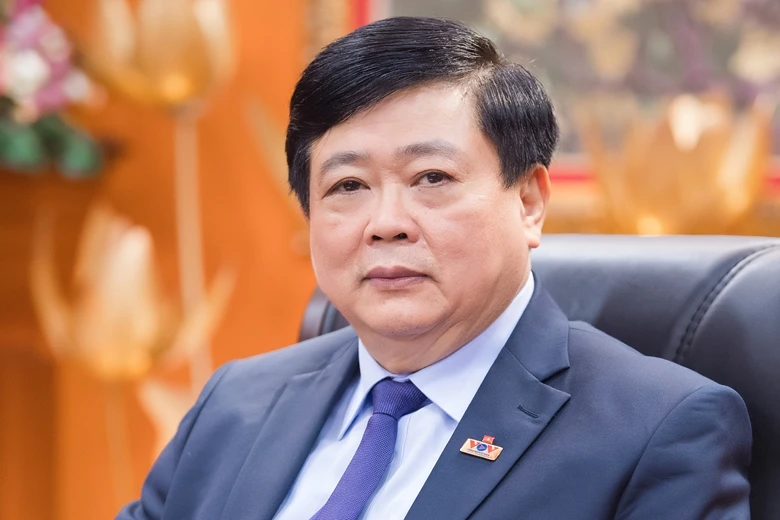
Previously, author Nguyen The Ky released Volumes 1 and 2 of the book series.
Volume 1, titled "Debt to the Nation" (2022) , portrays the image of Nguyen Sinh Cung - Nguyen Tat Thanh growing up with the heartfelt lullabies of his grandmother and mother from the moment he was born: "My son, remember this saying / Take care of your studies as much as you care for your food and clothing / Be a person who is clean even when hungry and honorable in rags / Fame and fortune are a debt to the nation that must be repaid." At over 5 years old, Cung, along with his parents and older brother Khiem, had to leave his grandmother and sister Thanh to go to the capital city of Hue, where they stayed for nearly 6 years (1895 - 1901); after his mother, Hoang Thi Loan, passed away at the age of 33 in a cramped rented house in Hue, the three of them, father and sons Nguyen Sinh Sac, returned to Nam Dan, Nghe An.
The second trip to Hue (1906-1909) was followed by a journey south for father and son Nguyen Sinh Sac and Nguyen Tat Thanh. They had a sorrowful and poignant farewell in Binh Khe, Binh Dinh, with his father's parting words: "If the country is lost, where will the home be? If the country is lost, you must focus on finding the country, don't waste your time looking for your father" (Volume 1, pp. 180-181, NNN). Nguyen Tat Thanh worked as a teacher at Duc Thanh School in Phan Thiet for a short time before going to Saigon. On June 5, 1911, he left the Saigon trading port and sailed across the sea to find a way to save the country.
Volume 2, titled "Drifting on the Four Seas" (2023) , depicts Nguyen Tat Thanh, under the new name Nguyen Van Ba, boarding the ship named Admiral Latouche Tresville to the West, as he later recounted, "I want to go abroad to see France and other countries. After observing how they do things, I will return to help my compatriots." In France, Van Ba - Nguyen Ai Quoc, along with Phan Chau Trinh, Phan Van Truong, and a number of Vietnamese patriots, sent the "Demands of the Annamese People" to the Versailles Conference (1919); On December 29, 1920, along with an overwhelming majority of delegates attending the 18th Congress of the French Socialist Party in Tours, Nguyen Ai Quoc voted in favor of the Third International, and he was one of the founding members of the French Communist Party. In 1922, the founder of the newspaper "Le Pariah" (The Pariah), in his very first article, affirmed the newspaper's mission as "the liberation of humanity."
In the West, while toiling to earn a living and yearning to find a way to save the country and its people, Nguyen Ai Quoc recognized a sad and resentful truth: capitalism and the imperialist colonialists were the ones who caused all the oppression, exploitation, and suffering for workers, farmers, and other classes in the colonies and even in the mother country.
Later, he recounted: “Initially, it was patriotism, not communism, that led me to believe in Lenin and the Third International.” Through his patriotic activities and his search for a path forward for the nation, he understood that “only socialism and communism can liberate oppressed nations and working people around the world from the yoke of slavery.” From patriotism, he embraced Marxism-Leninism, absorbing Lenin’s draft Theses on the National and Colonial Questions. In 1925, he published “The Indictment of the French Colonial Regime.”
For 30 years, he traveled from East to West, and from West back to East, through France, England, America, Africa, Australia, the Soviet Union, China, Thailand… culminating in the event on February 3, 1930, in Hong Kong, China, where he, representing the Communist International, convened a conference to unify three domestic communist organizations into a single political party, the Communist Party of Vietnam. He adopted the Party's Brief Political Program and Brief Strategy, both drafted by himself, ushering the Vietnamese revolution into a new chapter in history. His return to his homeland on January 28, 1941, marked a glorious milestone.
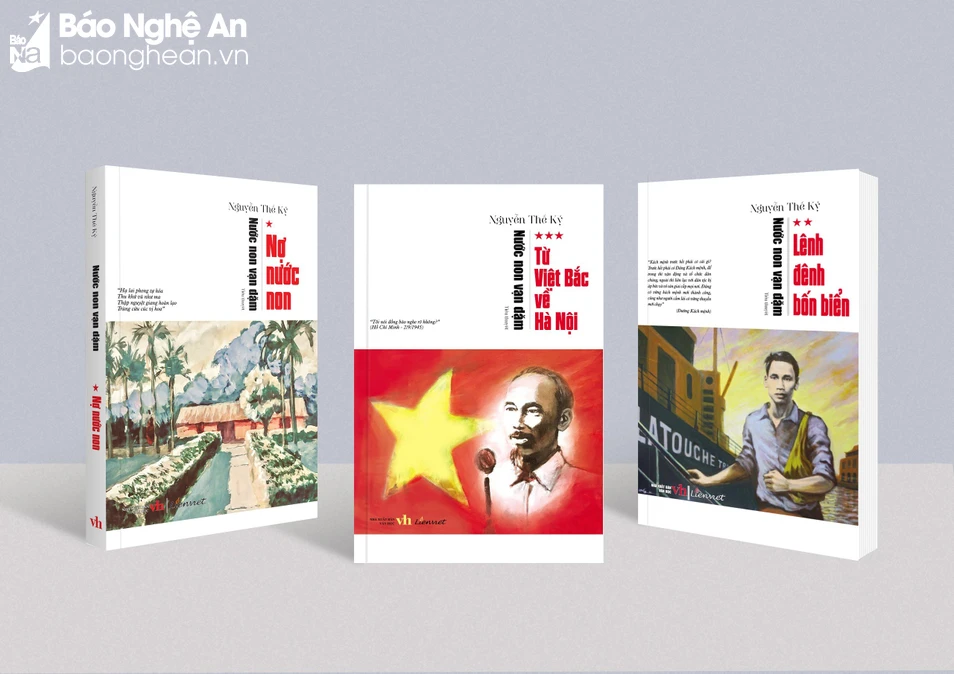
According to the author's plan, volume 4 will be released before September 2, 2024, and volume 5 before May 19, 2025. The novel series "A Thousand Miles of Homeland" is considered a contemporary Vietnamese literary work that fully, profoundly, and vividly reflects the life and career of President Ho Chi Minh, especially the image of Ho Chi Minh, the person of Ho Chi Minh, the revolutionary path of Ho Chi Minh, and the era of Ho Chi Minh.
Source


![[Image] Vietnam's colorful journey of innovation](/_next/image?url=https%3A%2F%2Fvphoto.vietnam.vn%2Fthumb%2F1200x675%2Fvietnam%2Fresource%2FIMAGE%2F2025%2F12%2F14%2F1765703036409_image-1.jpeg&w=3840&q=75)

















































![[Image] Vietnam's colorful journey of innovation](https://vphoto.vietnam.vn/thumb/402x226/vietnam/resource/IMAGE/2025/12/14/1765703036409_image-1.jpeg)














![[Infographic] Portrait of the Standing Committee of the Dong Nai Provincial Farmers' Association for the 2025-2030 term](https://vphoto.vietnam.vn/thumb/402x226/vietnam/resource/IMAGE/2025/12/14/1765708210139_thumbnail_ban_thuong_vu_sua_20251214164836.jpeg)












Comment (0)