

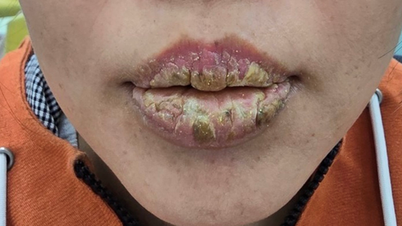
On October 25th, the Ho Chi Minh City Dermatology Hospital announced that it has recently received a significant number of cases of generalized psoriasis due to the use of topical and oral medications purchased on social media, resulting in dangerous flare-ups of psoriasis causing widespread redness of the skin.
The first case involves an 18-year-old male patient who presented with generalized redness and scaling of the skin. He reported having psoriasis for about a year. He saw an advertisement on social media for an oral medication and topical cream that claimed to completely cure psoriasis. He ordered a 3-box treatment for 600,000 VND. After completing the first course of treatment, his psoriasis improved significantly, but after stopping the medication for 5 days, the redness and scaling worsened and spread throughout his body, accompanied by itching, tightness, pain, fatigue, fever, and chills. As a result, he was admitted to the Dermatology Hospital.
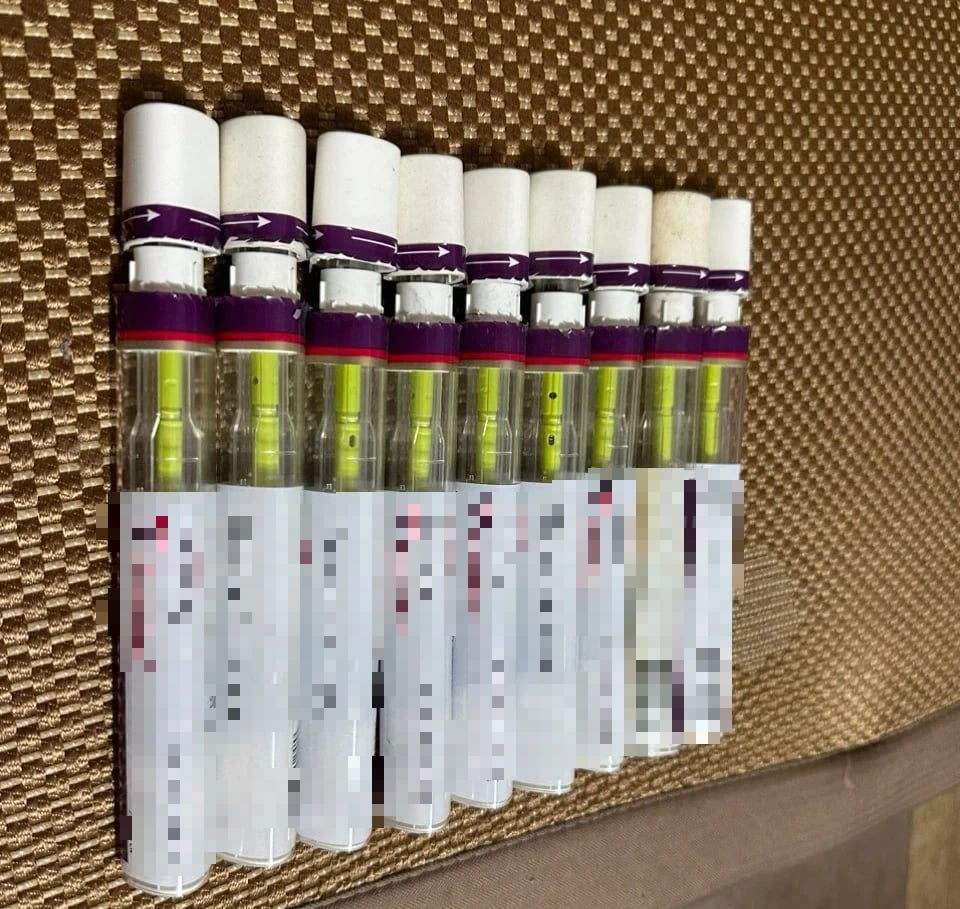
Many people with psoriasis even buy expensive, unproven biological drugs to treat their condition.
In another case, a 49-year-old male patient had suffered from psoriasis for the past 18 years but had not received consistent examination and treatment.
Recently, the patient learned about Mr. H., a specialist in treating psoriasis, through social media and contacted him to schedule an appointment . For two years, the patient received topical and oral medication from him, the type of which was unclear. Initially, the skin lesions became less red and the scaling decreased significantly; however, the patient noticed thinner skin and increased swelling on the face and abdomen. When the medication was stopped, the redness and scaling worsened and spread throughout the body, prompting the patient to seek treatment at a Dermatology Hospital.
Dr. Nguyen Vu Hoang, Head of Clinical Department 2 at the Dermatology Hospital, said that the two patients had generalized erythrodermic psoriasis. They were treated with acitretin, cyclosporin, antibiotics, antihistamines, and local care. After four days of treatment, their condition has stabilized, swelling has decreased, and the psoriatic lesions are less red and less scaly.
According to Dr. Hoang, generalized erythrodermic psoriasis is the most severe form of psoriasis, often resulting from a lack of treatment or improper treatment, causing the psoriatic lesions to gradually spread and become generalized erythrodermic. If this condition persists, it can lead to dangerous complications such as sepsis, pneumonia, or heart failure, which can ultimately be fatal.
Dr. Hoang further explained that while there are many medical treatments for psoriasis currently available, there is still no cure. To treat psoriasis, patients need to visit medical facilities with dermatology specialists and use medication as prescribed by a doctor. They should not self-medicate, especially with drugs of unknown origin, as this can worsen psoriasis and potentially lead to generalized erythrodermic psoriasis.
To mark World Psoriasis Day on October 29th, the Ho Chi Minh City Dermatology Hospital is organizing a psoriasis patient club meeting. The program will take place from 7:30 AM to 11:00 AM on October 29th at the Dermatology Hospital.
By participating in the program, psoriasis patients will receive free consultations from doctors, hear from leading experts on how to care for their skin, how to detect and prevent psoriatic arthritis early, and receive advice from psychologists on how to manage stress to avoid psoriasis flare-ups.
Source link
























































































Comment (0)