

 |
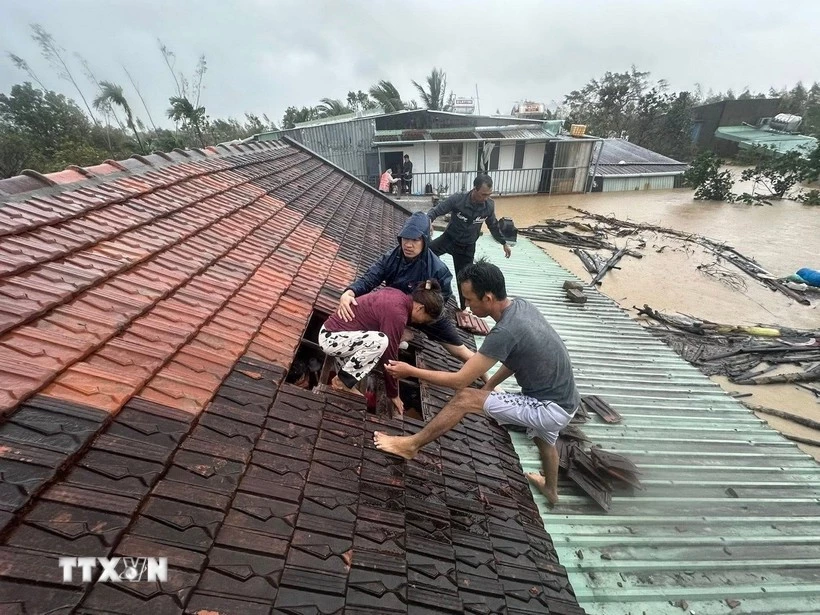
| Floods rose, people had to break roofs to climb up to avoid danger in Gia Lai . (Photo: VNA) |
At the regular Government Press Conference on the afternoon of December 6, Minister and Head of the Government Office Tran Van Son, Government Spokesperson, said that on the same morning, Prime Minister Pham Minh Chinh chaired the regular Government meeting in November 2025 to discuss many important contents.
In particular, the Prime Minister especially emphasized the need to focus on overcoming the consequences of natural disasters, completing the repair of more than 34,000 houses of people damaged by natural disasters before December 31, 2025; and building 1,628 new houses for people who lost their homes due to natural disasters before January 30, 2026, so that during the Lunar New Year, everyone has a home, every family has Tet, every child has joy, and no one is left behind. Along with that, it is necessary to restore production, business, create jobs, and livelihoods for people...
House models are designed to ensure safety.
Sharing about the implementation plan, Chief of Office, Spokesperson of the Ministry of Construction Nguyen Tri Duc said that regarding the flood-proof house model, in 2014, the Prime Minister issued Decision No. 48/2014/QD-TTg on policies to support poor households in building houses to prevent and avoid storms and floods in the Central region. The scope of application is in 13 provinces and cities in the North Central region and the Central Coast.
Then, on October 23, 2014, the Ministry of Construction issued Circular 16/2014/TT-BXD, which requested localities to study and design at least 3 typical storm and flood shelter house models, ensuring minimum criteria on area and quality, ensuring storm and flood prevention, organizing the introduction of design models for people to refer to and choose, not requiring households to build according to the model design.
“In addition to sample designs, localities have specific instructions for cases of renovation and raising floors to make floors to prevent storms and floods,” Mr. Duc emphasized.
To implement the above regulations, Mr. Duc said that all localities design and publish at least 3 models, some localities up to 6-8 models (Hue, Thanh Hoa). These housing models are all posted on the Information Portal of the local Department of Construction.
At the same time, the Ministry of Construction is researching and implementing a system of safe housing designs for natural disaster prevention and control in the period 2007-2023 and published on the National Institute of Architecture's Information Portal, including 176 models that can be used immediately for localities, including models: Typical houses in natural disaster areas; houses resistant to storms, flash floods, landslides; rural houses by region; houses adapting to climate change and rising sea levels.
The above house models are built on the basis of research on natural conditions, cultural practices, and natural disaster characteristics in the affected areas; ensuring compliance with current technical standards and regulations that are eligible for application. Many localities have put these design models into use as the main reference document, serving as guidance on house design, renovation, and building programs to support houses to prevent storms and floods (Dak Lak, Ha Tinh, Quang Tri, Phu Yen before the merger).
In addition, there are 6 localities (before the merger including Thanh Hoa, Quang Binh, Thua Thien Hue, Quang Nam, Quang Ngai, Ca Mau) participating in the Project Component 1 - Support for building storm and flood resistant houses under the Project "Enhancing resilience to climate change impacts for vulnerable coastal communities in Vietnam" funded by the Green Climate Fund GCF through the United Nations Development Program UNDP, integrating funding to add storm resistance features for poor households eligible for support under Decision No. 48/2014/QD-TTg dated August 28, 2014 of the Prime Minister.
“Through practical implementation, houses following the above sample designs are all safe and can withstand storms and floods,” Mr. Duc emphasized.
However, Mr. Duc also noted that in recent years, storms and floods have occurred in most localities nationwide with more complex and dangerous levels, so there is a need for new storm and flood prevention housing designs that are suitable for the actual situation. Therefore, the Ministry of Construction requested the People's Committees of the provinces to direct the Departments of Construction and relevant agencies to coordinate with the National Institute of Architecture (Ministry of Construction) to review the terrain characteristics of each region to apply and select and apply design models according to the instructions in Official Dispatch 234/CD-TTg dated November 30, 2025 of the Prime Minister.
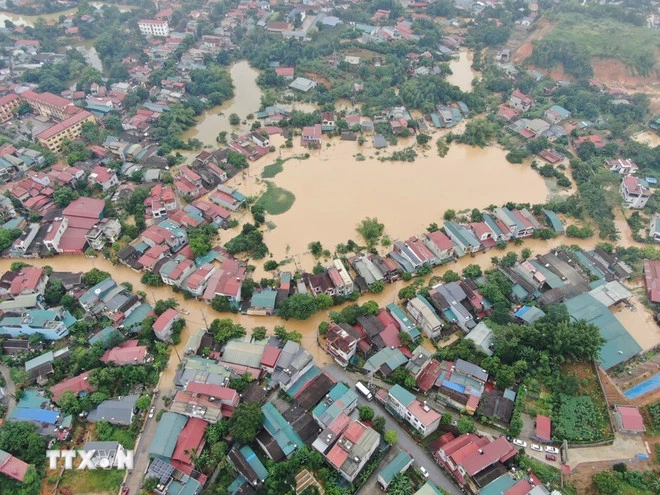 |
| Floods cause heavy damage. (Source: VNA) |
In particular, implementation needs to be closely linked with construction planning, rural planning, regional planning, ensuring long-term safety, not just immediate handling.
Accordingly, materials such as cement and steel will be prioritized to ensure progress, from agencies, organizations, businesses, localities and the entire political system to implement the Prime Minister's direction in Official Dispatch 234/CD-TTg, ensuring that all people have housing and enjoy the Lunar New Year.
Urgent troubleshooting and infrastructure restoration
Regarding the content of building infrastructure works for the Central region to respond to increasingly severe and unusual natural disasters like today, the Chief of Office, Spokesperson of the Ministry of Construction said that in 2021, the Ministry of Transport (now the Ministry of Construction) has deployed the organization of synchronous national sector planning for 5 transport sectors (road; maritime, inland waterway; railway; aviation) to ensure maintaining the advantages of each mode of transport in maximizing the efficiency of exploitation of the entire transport system of the whole country.
“The climate change and sea level rise scenarios of the Ministry of Natural Resources and Environment at that time were also updated in the planning,” Mr. Nguyen Tri Duc informed.
According to the 5 approved plans, the Central and Central Highlands regions are planned as follows: For roads, there are 11 expressways with a length of nearly 1,500 km, 24 main national highways with a length of over 4,400 km to help connect important economic corridors. For aviation, the Central and Central Highlands regions are planned with 14 airports. For maritime, 14 seaports are planned including 89 wharf areas, ports with 208 wharves with a total length of 36,923 m.
For inland waterways, 27 waterway transport routes with a length of 1,263 km are planned; for railways, 1,332 km belong to the North-South railway route.
Regarding investment, Mr. Duc said that the process of putting into operation investment projects to build traffic works has been effective, showing that technical solutions based on assessment and analysis of hydrological, oceanographic and climate data series are basically reasonable. Most projects have long-term operation time to ensure the sustainability of the infrastructure system and promote investment efficiency.
However, due to abnormal changes in weather, especially the Central region, which has had to continuously endure many strong storms, heavy rains, and floods, incidents have occurred in some locations, such as some road sections being flooded due to flood peaks exceeding historical levels, or landslides affecting transport and rescue work.
In the face of the above situation, Mr. Duc said that the Ministry of Construction has proactively carried out urgent tasks to overcome the incident, promptly repair and restore infrastructure to ensure continuous and smooth traffic. The Ministry has also actively coordinated with relevant ministries, branches and localities in rescue work, supporting people to return to normal life soon after natural disasters, contributing to ensuring social security.
For more information, Minister and Head of the Government Office Tran Van Son emphasized that there are two milestones for housing for people to celebrate Tet. First, for houses repaired over 34,000 units, the milestone is December 31 and for new construction over 1,600 units, the milestone is before January 31, 2026.
“This morning, the Government discussed very carefully and the Prime Minister assigned tasks to all ministries, localities, socio-political organizations, including businesses to be able to implement those two milestones,” Mr. Son said.
According to Vietnam+
Source: https://baoquangtri.vn/xa-hoi/202512/san-sang-hoan-thanh-xay-dung-hon-1600-can-nha-moi-cho-nguoi-dan-truoc-tet-nguyen-dan-d5d36ea/

![[Photo] National Assembly Chairman Tran Thanh Man attends the VinFuture 2025 Award Ceremony](/_next/image?url=https%3A%2F%2Fvphoto.vietnam.vn%2Fthumb%2F1200x675%2Fvietnam%2Fresource%2FIMAGE%2F2025%2F12%2F05%2F1764951162416_2628509768338816493-6995-jpg.webp&w=3840&q=75)


![[Photo] 60th Anniversary of the Founding of the Vietnam Association of Photographic Artists](/_next/image?url=https%3A%2F%2Fvphoto.vietnam.vn%2Fthumb%2F1200x675%2Fvietnam%2Fresource%2FIMAGE%2F2025%2F12%2F05%2F1764935864512_a1-bnd-0841-9740-jpg.webp&w=3840&q=75)



















































































Comment (0)