

Built on a total area of 40,000 m2 and with an investment of 20 million Turkish Lira, the solar farm on the roof of the Nef Stadium at the Ali Sami Yen Sports Complex (Turkey) has achieved a Guinness World Record for solar power capacity in the sports sector.
Following a performance-based business model, the stadium will generate its own electricity and become a model for energy efficiency. Over 10,000 solar panels are installed on the stadium's roof, capable of producing 4,650 MWh of electricity, equivalent to the consumption of approximately 2,000 households for a year. Energy from the roof-mounted solar panels provides 63-65% of the stadium's electricity, with the remainder supplying power to the city.
According to Ali Çelikkıran, the stadium director, the energy saved by the solar panels is equivalent to the energy needs of 2,000 homes and reduces carbon emissions by 3,250 tons per year. In natural terms, he estimates this is equivalent to saving approximately 200,000 trees over 25 years.
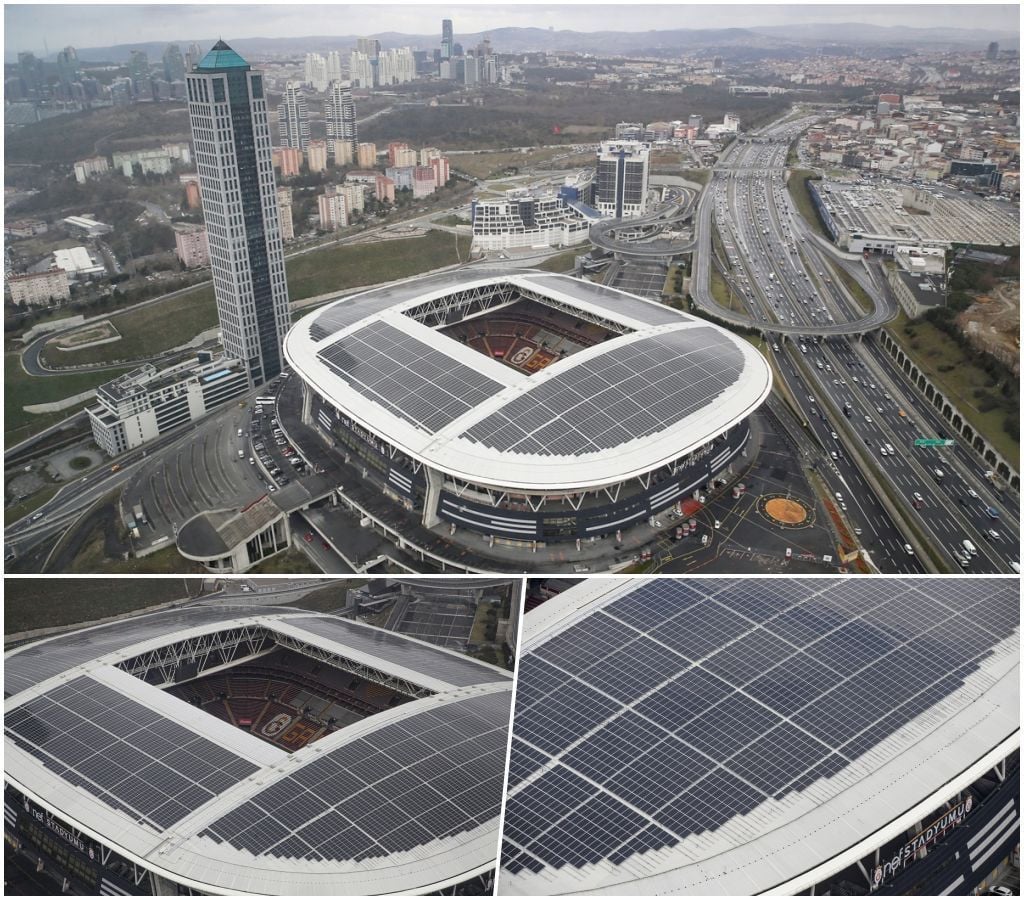
In reality, football clubs spend huge sums of money on players but invest little in energy systems. Stadium managers have had to find ways to cut costs. "These days, whether you like it or not, a large company has a responsibility to the environment because energy is getting more and more expensive," he said.
Türkiye is heavily reliant on foreign energy sources, with 45% of its gas purchased from Russia. Rising energy prices, coupled with inflation, mean the club has saved a considerable amount of money.
Burak Elmas, president of Galatasaray Sports Club, said this is the world's largest solar power project installed on the roof of a sports stadium. It is also the first project in Turkey to be implemented on a stadium roof with a performance-based business model.
The club's leaders recognize the importance of consuming energy from domestic and renewable resources. These efforts aim to reduce dependence on imported energy and have implications for future generations.
In nine years, Galatasaray's contract as the contractor will expire, and full control will belong to the club. From then on, the club will not have to pay for electricity from anyone else, while continuing to earn money from selling surplus electricity.
(According to DS)

Source: https://vietnamnet.vn/san-van-dong-lap-dat-hang-nghin-tam-pin-mat-troi-tren-mai-2307299.html





















![[Video] The craft of making Dong Ho folk paintings has been inscribed by UNESCO on the List of Crafts in Need of Urgent Safeguarding.](https://vphoto.vietnam.vn/thumb/402x226/vietnam/resource/IMAGE/2025/12/10/1765350246533_tranh-dong-ho-734-jpg.webp)





















































Comment (0)