

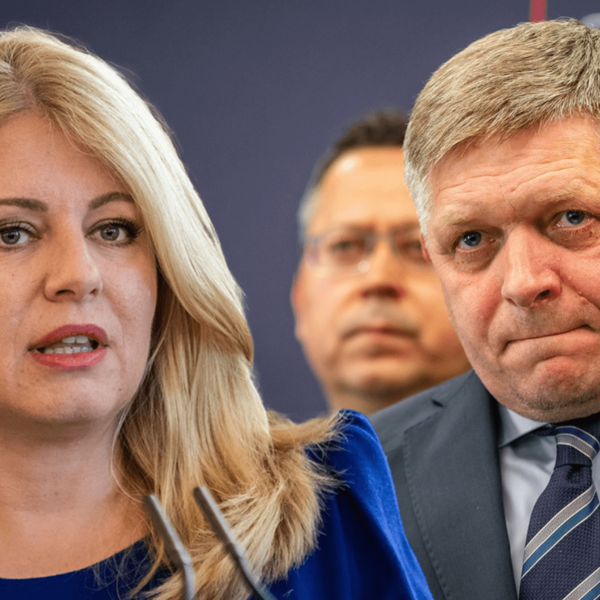
Citizens of Slovakia, a NATO and EU member state, will vote on March 23rd to elect their country's leader for the next five years. The winner of the election will replace incumbent President Zuzana Caputova, who has announced she will not seek re-election.
The vote will likely be a showdown between representatives of the ruling coalition led by Prime Minister Robert Fico – who has a pro-Russian stance and opposes aid to Ukraine – and independent candidates closer to the radical opposition.
Slovak Parliament Speaker Peter Pellegrini announced earlier last week that the presidential election in the Central European country will take place on March 23, with a second round (runoff) to be held on April 6 if no candidate wins an absolute majority in the first round. The runoff round will be a race between the two candidates with the highest number of votes in the first round.
Mr. Pellegrini, who is also the leader of the center-left Hlas (Voice) party in the ruling coalition of populist Prime Minister Robert Fico, has announced his candidacy. If Mr. Pellegrini, 48, wins the race, the coalition's power will be significantly consolidated.
"If the party leadership agrees to nominate me and all requirements are met, I will announce my candidacy on January 19," Pellegrini said after announcing the election date at a press conference.
Besides the left-wing candidate Pellegrini, several potential main rivals have emerged for the race. First is Ivan Korcok, 59, who previously served as Foreign Minister in the previous government . Korcok is likely to attract strong support from opposition parties, including the liberal and pro-Western Slovak Progressive Party (PS).
The PS party, which had assumed Pellegrini would be its presidential candidate, declared that the upcoming Slovak presidential election was crucial for the country, arguing that the current ruling coalition should not occupy all the top political positions in the country.
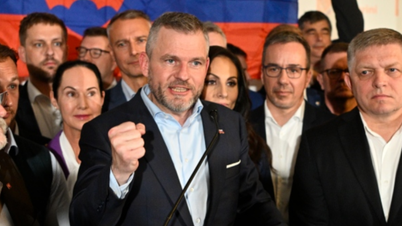
Peter Pellegrini (Hlas Party), Robert Fico (SMER Party), and Andrej Danko (SNS Party) at the signing ceremony to form the Slovakian ruling coalition, October 16, 2023. Photo: AP/Toronto City News
The second candidate is Jan Kubis, 71, an international diplomat who previously served as Foreign Minister in the government led by Prime Minister Fico.
Furthermore, the leader of Slovakia's far-right SNS party, Andrej Danko, has expressed his intention to run in the upcoming presidential election. In a political debate on public television channel RTVS on January 15th, Danko, 50, also stated that if he doesn't have enough support, he will join forces with another nationalist candidate, referring to former Supreme Court judge Stefan Harabin, who has already announced his intention to run.
Danko's SNS party is also part of the ruling coalition led by Fico's populist left-wing Social Democratic Party (SMER). The SMER and Hlas together hold only 69 seats in the 150-seat Slovak Parliament, and therefore rely on the SNS's 10 seats to pass the extensive legislative measures introduced since last November.
According to a poll conducted last December, Pellegrini, himself a former Prime Minister, was considered the most trusted political leader in Slovakia, and he was highly likely to win if he ran for election.
In Slovakia, the President does not hold much power in the day-to-day running of the country, but the Head of State can slow down the law-making process by using the veto power or by referring the matter to the Constitutional Court to question the constitutionality of laws already passed.
This is a tactic that President Caputova has used to restrain previous and current governments. The President of Slovakia is elected for a five-year term and can run for two consecutive terms. However, last June, Ms. Caputova announced that she would not seek re-election.
In Slovakia, a country with a population of 5.5 million, a presidential candidate needs the support of at least 15 lawmakers or to collect the signatures of at least 15,000 citizens, as Korcok and Kubis did, to enter the race .
Minh Duc (According to bne IntelliNews, Reuters, Balkan Insight)
Source





















































































Comment (0)