

Canvus, a startup in Ohio, recycles decommissioned wind turbine blades into products that are both useful and aesthetically pleasing.
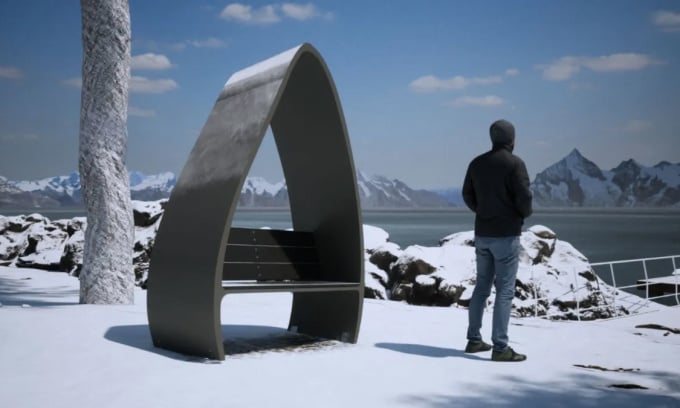
Chair made from recycled wind turbine blades. Photo: Canvus
According to estimates by WindEurope, by 2025, Europe will have up to 25,000 tons of wind turbine blades discarded annually, equivalent to more than 6,000 Hummer SUVs. This highlights the urgent need to find environmentally friendly solutions for disposing of these massive turbine blades, Interesting Engineering reported on November 26th.
Canvus, founded in 2021 and headquartered in Rocky River, Ohio, aims to address this problem. Canvus transforms decommissioned wind turbine blades into useful, attractively designed products such as benches, picnic tables, and planters. These have been used in various locations, creating sustainable spaces.
Wind turbine blades coated with epoxy resin and made primarily from fiberglass present a significant challenge when it comes to recycling due to their high durability and low recyclability. "We're giving these materials a second life," said Parker Kowalski, co-founder of Canvus.
The recycling process involves breaking the turbine blades down into smaller pieces at Canvus' 10,200-square-meter factory in Avon, Ohio. There, more than 30 skilled workers then craft them into durable and environmentally friendly products.
Canvus isn't the only company recycling wind turbine blades, but it has a unique business model. Unlike other companies, Canvus primarily serves corporate clients who want to donate reusable products to public spaces. Each product acts as a marketing tool for the business, featuring a nameplate and a QR code leading to the company's website. Canvus's products are priced between $3,500 and $9,500, while renting a billboard in the US costs at least $250 per month, according to Kowalski. Therefore, it's an affordable and quite effective solution for businesses to both promote themselves and contribute to sustainability.
Canvus not only utilizes old wind turbine blades but also incorporates other recycled materials such as rubber tires, shoes, and plastic waste into its products. However, experts are conducting a comprehensive assessment of the product's lifecycle, including the energy used to transport and handle the wind turbine blades.
Thu Thao (According to Interesting Engineering )
Source link



![[Photo] Closing Ceremony of the 10th Session of the 15th National Assembly](/_next/image?url=https%3A%2F%2Fvphoto.vietnam.vn%2Fthumb%2F1200x675%2Fvietnam%2Fresource%2FIMAGE%2F2025%2F12%2F11%2F1765448959967_image-1437-jpg.webp&w=3840&q=75)
![[Photo] Prime Minister Pham Minh Chinh holds a phone call with the CEO of Russia's Rosatom Corporation.](/_next/image?url=https%3A%2F%2Fvphoto.vietnam.vn%2Fthumb%2F1200x675%2Fvietnam%2Fresource%2FIMAGE%2F2025%2F12%2F11%2F1765464552365_dsc-5295-jpg.webp&w=3840&q=75)










































![[OFFICIAL] MISA GROUP ANNOUNCES ITS PIONEERING BRAND POSITIONING IN BUILDING AGENTIC AI FOR BUSINESSES, HOUSEHOLDS, AND THE GOVERNMENT](https://vphoto.vietnam.vn/thumb/402x226/vietnam/resource/IMAGE/2025/12/11/1765444754256_agentic-ai_postfb-scaled.png)

















































Comment (0)