

Early warning signs of dementia
Dr. Tran Cong Thang, Head of the Dementia Unit, Department of Neurology, University Medical Center of Ho Chi Minh City (UMC Hospital), shared: "According to the Alzheimer's Association of Canada, the 10 warning signs of dementia include: memory loss affecting daily life, difficulty completing familiar tasks, disorientation in time and space, impaired judgment, impaired abstract thinking ability, misplacement of objects, mood and behavior changes, personality changes, and becoming passive."
To diagnose dementia, doctors will conduct a detailed medical history interview to determine which cognitive impairments are present. Next, clinical tests will be performed to assess the patient's neurological deficits. A set of tests will then be conducted to evaluate memory and cognitive function. Finally, blood tests and a brain MRI will be ordered to investigate brain damage… thereby determining the cause of dementia and developing an appropriate treatment plan.
Early detection and treatment of dementia.
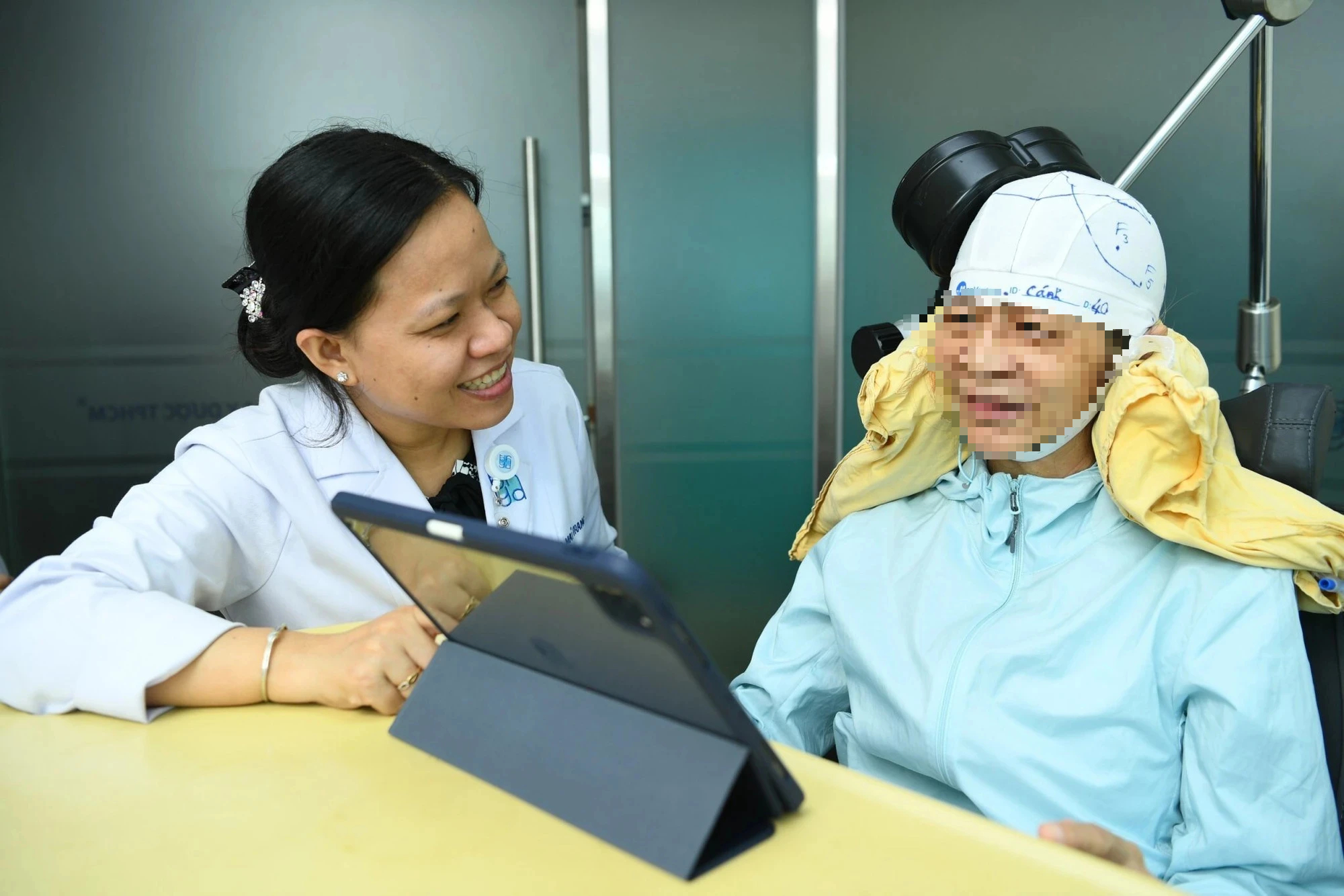
Dr. Tong Mai Trang, Specialist II, converses with a patient undergoing treatment for dementia using deep brain stimulation.
According to Dr. Tong Mai Trang (Department of Neurology, University Medical Center of Ho Chi Minh City), early detection of dementia is difficult because the disease often progresses silently and requires special attention to be recognized. However, we can seize the golden time for early detection of dementia by identifying the disease at the mild cognitive decline stage – an intermediate stage between normal cognitive function and dementia. To detect this condition, patients need regular health check-ups. At this stage, brain cells have not yet suffered widespread damage, so it is entirely possible to intervene to slow disease progression and prolong independent life for patients.
At the University Medical Center of Ho Chi Minh City, patients experiencing memory problems can directly visit the Dementia Unit for in-depth examination. There, patients will have their medical history taken in detail and undergo a neuropsychological test. Based on the results regarding the severity of the condition and the cognitive impairment, the doctor will prescribe medication combined with cognitive training.
Specifically, at the University Medical Center of Ho Chi Minh City, the group therapy program is tailored to different levels of severity (mild, moderate, and severe) to allow patients to interact, share experiences, and avoid feelings of inferiority. In addition, the University Medical Center of Ho Chi Minh City has implemented transcranial magnetic stimulation (TMS) for patients in the early stages. With this method, the patient's brain receives dual stimulation using a magnetic field machine and accompanying cognitive exercises during the machine's operation.

To raise community awareness about the early diagnosis and treatment of dementia, the Communication Center, in collaboration with the Department of Neurology, University Medical Center of Ho Chi Minh City, and EISAI Vietnam Co., Ltd., is implementing the "Healthy Living - Sharing" consultation program with the theme: Why is early recognition and treatment of dementia important?, follow along at: https://bit.ly/dieutrisasuttritue
Source link

![[Photo] First session of the 14th Congress of the Vietnam Trade Union](https://vphoto.vietnam.vn/thumb/1200x675/vietnam/resource/IMAGE/2026/06/03/1780465947883_ndo_br_img-3852-jpg.webp)
![[Photo] Secretary of the National Assembly Party Committee, Chairman of the National Assembly presides over the meeting of the Standing Committee and Executive Committee of the National Assembly Party Committee.](https://vphoto.vietnam.vn/thumb/1200x675/vietnam/resource/IMAGE/2026/06/03/1780480353201_ndo_br_bnd-2585-jpg.webp)

![[Photo] General Secretary and President To Lam presides over a meeting with the Central Organizing Committee.](https://vphoto.vietnam.vn/thumb/1200x675/vietnam/resource/IMAGE/2026/06/03/1780482764658_a1-bnd-4741-3342-jpg.webp)




















































![[Video] Sunset at Lap An Lagoon – Where the sun sets over the fishing nets](https://vphoto.vietnam.vn/thumb/1200x675/vietnam/resource/IMAGE/2026/05/31/1780192137701_beach-landscape-sea-water-nature-grass-745871-pxhere-com.jpeg)







































Comment (0)