

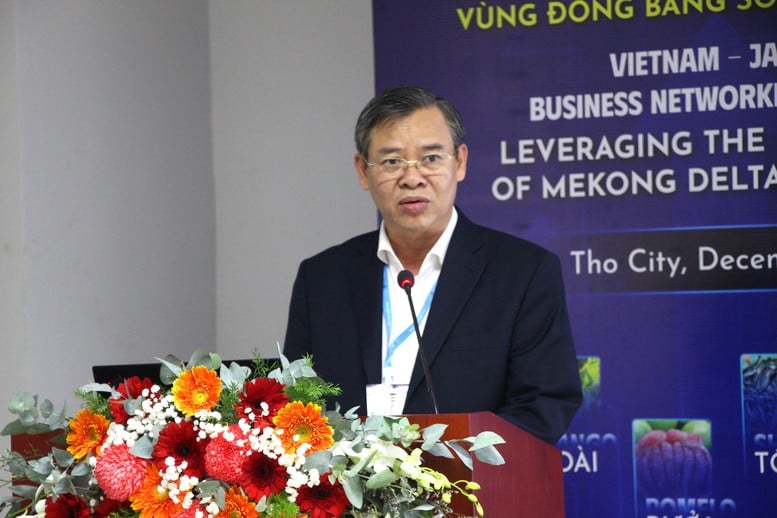
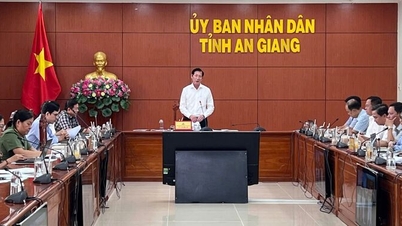
Chairman of Can Tho City People's Committee Truong Canh Tuyen delivered the opening speech at the Forum - Photo: VGP/LS
Large raw material area but not yet fully exploited
The event was attended by Chairman of Can Tho City People's Committee Truong Canh Tuyen, representatives of JICA, JETRO, leaders of Can Tho University, CT Group and many experts, scientists and businesses of the two countries.
In his opening speech, Mr. Truong Canh Tuyen emphasized that the forum is a direct bridge for businesses of the two countries to exchange, learn, and promote cooperation in exploiting the rich, high-quality goods source of the Mekong Delta, aiming to bring Vietnamese products further into the international market, especially Japan.
According to the Chairman of the People's Committee of Can Tho City, Japan has always maintained its position as one of the countries with large foreign direct investment (FDI) in the city, mainly in the fields of processing, industry and trade. This is also a market with the most stringent standards, where many key agricultural products of the Mekong Delta such as mango, longan, dragon fruit and high-quality seafood products have successfully conquered.
The Mekong Delta plays a key role in the country’s food security and exports, while Can Tho acts as the regional hub and gateway connecting the region and the world. With an increasingly upgraded transportation and logistics system, goods from the Mekong Delta have great potential to meet Japanese standards.
However, the results of cooperation and investment from Japanese partners in the region are still not commensurate with the potential. Mr. Tuyen said that it is necessary to attract advanced technology, investment capital and management experience from Japan to increase product value.
He also emphasized that in the context of climate change and globalization, exploiting the potential of the Mekong Delta is not only about increasing output but also about transforming the model: from traditional to smart agriculture , from raw export to deep processing, from single supply chain to sustainable value chain.
"We believe that the key to unlocking the full potential of the abundant goods source from this "rice granary and fruit granary" is the strategic partnership of Japanese partners, a leading country in technology, quality management and green standards," Mr. Truong Canh Tuyen wished.
JICA promotes science-business-state linkage
Representatives of the Japan International Cooperation Agency (JICA) shared about strengthening the connection and application of science for sustainable development of the Mekong Delta in the context of climate change. Many cooperation activities have been implemented through the JICA-Can Tho University project, which emphasizes the role of the university in the "3-house" connection model: State-School-Enterprise.
According to a JICA representative, the project aims to build a “one-stop platform” to help connect Japanese businesses with research, training systems and local authorities to realize sustainable solutions.
Sharing at the forum, Head of JETRO Ho Chi Minh City Office Okabe Mitsutoshi said that the potential for cooperation between Japanese enterprises and the authorities of the Mekong Delta provinces in the fields of agriculture and fisheries is huge.
He said many provinces are interested in developing high-quality agricultural products, reducing carbon emissions, and training human resources to achieve the goal of carbon neutrality by 2050. Meanwhile, Japanese enterprises have advanced technology and are ready to support.
“Agriculture in the Mekong Delta is a promising field for Japanese and Vietnamese businesses to cooperate and build a 'win-win' relationship,” affirmed Mr. Okabe Mitsutoshi.
However, JETRO still faces difficulties as the number of Vietnamese enterprises proactively contacting is limited. He hopes that enterprises wishing to cooperate will be more proactive in connecting to promote bilateral cooperation.
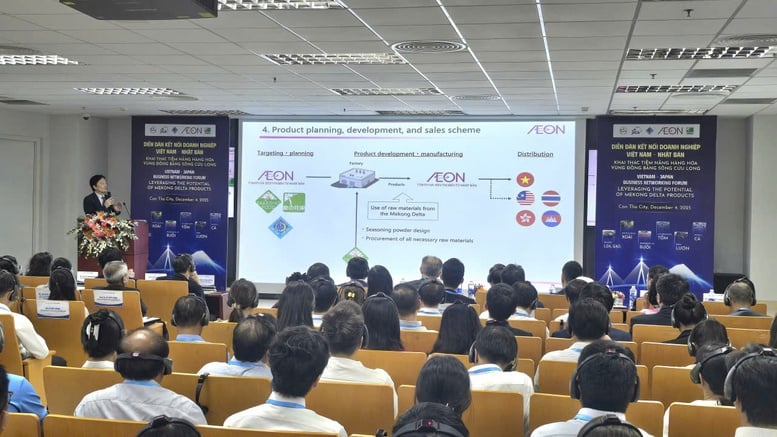
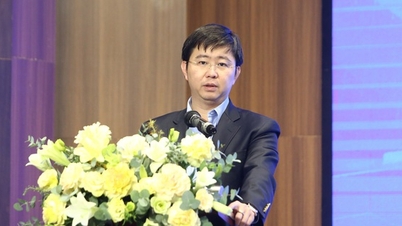
Many managers, scientists and businesses attended the Forum at Can Tho University - Photo: VGP/LS
Expectations for “Made in Mekong” products in AEON supermarket system
At the forum, experts also raised questions about the reasons why Japanese investment in the Mekong Delta has not yet made a breakthrough, despite the region’s great potential. According to analysis, it is necessary to clarify bottlenecks in access to capital, technology, logistics infrastructure, quality standards and market strategies, in order to promote deeper cooperation.
In that context, many opinions expect that “Made in Mekong” products will soon appear on Japanese supermarket shelves - something that all parties desire.
On February 14, 2025, Can Tho University leaders, together with AEON Vietnam, Takesho Food and Ingredients Company and Takesho Food Company, signed a memorandum of understanding to cooperate in developing processed products with the private label AEON TOPVALU, produced by enterprises in the Mekong Delta region.
The project aims to exploit rich raw materials, research and develop processed food products under the TOPVALU brand, contributing to strengthening the food processing industry and building the "Made in Mekong Delta" brand.
The project is also expected to promote public-private partnerships and develop high-quality human resources for the region.
In his closing remarks, Can Tho University President Tran Trung Tinh affirmed that the forum was topical and long-term strategic. Sharing from management agencies, Japanese and local enterprises helped to sketch out an overall picture of the potential and challenges of the Mekong Delta.
Mr. Tinh stated three key expectations: Building a "co-creation" ecosystem; developing a high-quality product chain "Made in Mekong"; promoting training of high-quality human resources.
Specifically, Can Tho University hopes to work with AEON, Takesho and Japanese enterprises to form research groups, joint laboratories, and R&D projects to develop new products from agriculture and aquaculture, and apply processing and standardization technology.
The school will support the development of technical standards, production-testing-evaluation processes; connect local businesses with AEON, Takesho and Japanese importers; transfer technology to improve the quality of processing and commercialization of products.
“We believe that 'Made in Mekong' is not just a brand, but will become a long-term strategy to elevate Mekong Delta products,” affirmed the President of Can Tho University.
The school is committed to designing training programs according to the needs of Japanese enterprises; expanding internships and dual training; improving foreign language proficiency and professional skills. At the same time, we hope that enterprises will accompany us in training, ordering research and recruiting students.
Can Tho University affirms to continue playing the role of focal point for coordinating cooperation, turning forum discussions into specific programs, bringing practical value to the Mekong Delta.
Le Son
Source: https://baochinhphu.vn/tang-toc-ket-noi-viet-nam-nhat-ban-de-khai-mo-suc-manh-hang-hoa-dbscl-102251204155226229.htm
![[Photo] Cat Ba - Green island paradise](/_next/image?url=https%3A%2F%2Fvphoto.vietnam.vn%2Fthumb%2F1200x675%2Fvietnam%2Fresource%2FIMAGE%2F2025%2F12%2F04%2F1764821844074_ndo_br_1-dcbthienduongxanh638-jpg.webp&w=3840&q=75)

























![[VIMC 40 days of lightning speed] Da Nang Port: Unity - Lightning speed - Breakthrough to the finish line](https://vphoto.vietnam.vn/thumb/402x226/vietnam/resource/IMAGE/2025/12/04/1764833540882_cdn_4-12-25.jpeg)































Comment (0)