

Currently, the only data Voyager 1 is transmitting back to Earth is a repeating string of binary characters, and it could take NASA engineers several weeks to fix the malfunction.
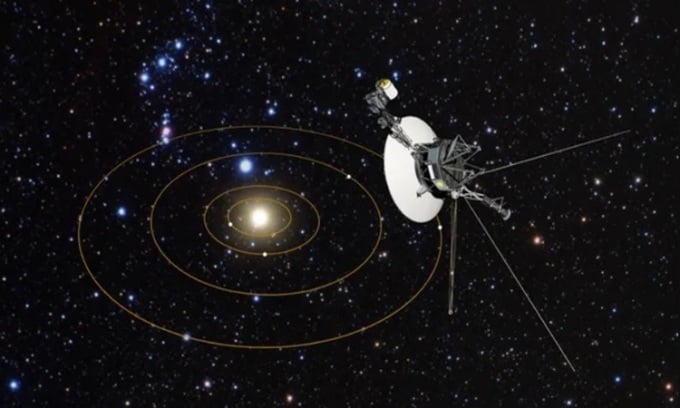
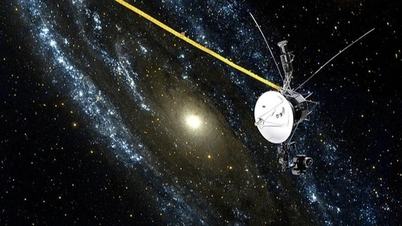
A simulation of the Voyager 1 spacecraft looking back at the solar system from a distance. Photo: NASA
NASA's Voyager 1 probe is currently unable to transmit any scientific or system data back to Earth, Space reported on December 12. The 46-year-old spacecraft can receive commands, but the problem appears to stem from the spacecraft's computer. The Voyager 1 Flight Data System (FDS), which collects technical information and data from the onboard scientific instruments, is no longer communicating as expected with the telecommunications controller, according to NASA.
Under normal operation, the FDS organizes the spacecraft's information into data packets, which it then transmits back to Earth via the TMU. Recently, the data packets have become stuck, transmitting a repeating pattern of 1s and 0s. Voyager's engineering team is tracing the problem back to the FDS, but it may take several weeks before a solution is found.
Voyager 1 and Voyager 2, launched in 1977, operated longer than any other spacecraft in history. Both were in interstellar space, traveling over 24 billion kilometers from Earth. In fact, they were so far away that it took almost a day for a signal to reach the spacecraft and another day to receive a response. Communication with Voyager 1 took 45 hours. Therefore, when NASA engineers sent a fix for the spacecraft's FDS system, they would need to wait until the next day to determine if it was effective.
The solution couldn't be as simple as just turning the system off and on again. The age and hardware of the spacecraft presented a host of challenges. NASA technicians had to work with technology available in the 1970s, sometimes having to find some creative software fixes. This wasn't the first malfunction Voyager 1 had experienced in recent years. The spacecraft had problems with its navigation and control system (AACS) in May 2022, and continuously transmitted meaningless telemetry data for several months before the issue was resolved.
NASA engineers also updated the spacecraft's software in October 2023, helping to prevent sediment buildup in the propulsion system. But updates like these can't be implemented quickly. According to NASA, finding solutions to the challenges the probe faces often involves referencing decades-old original documents written by engineers not involved in solving the problem today. As a result, the engineering team needs time to understand how a new directive will affect the spacecraft's operation to avoid unintended consequences.
An Khang (According to Space )
Source link

























































































Comment (0)