

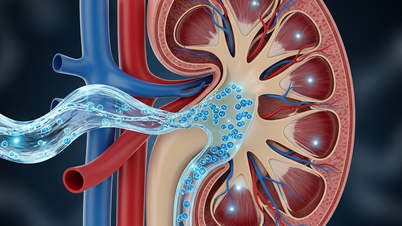
When the kidneys begin to fail, there are more than just subtle internal changes.
Many warning signs appear on the skin but are often overlooked or mistaken for common skin diseases. Experts warn that ignoring these signs can cause the disease to progress without the patient knowing.
Dry, scaly skin, constant itching or swelling around the eyes and limbs... are early signs of chronic kidney disease according to many international studies published in medical journals on nephrology and dermatology.
The rate of chronic kidney disease is increasing, in which a large number of patients only discover the disease at a late stage due to confusing symptoms.
Abnormally dry skin is the most noticeable sign.
According to India Times statistics, among patients with chronic kidney disease, up to 72% have severe dry skin. Normal kidneys help regulate sweat and oil glands. When kidney function is poor, oil glands are less active, causing the skin surface to become rough, flaky and tight.

A study published in the Journal of Clinical and Experimental Dermatology Research also noted that xerosis accounts for more than half of end-stage renal disease patients, with dryness especially evident on the face, backs of hands and lower legs.
Severe itching due to waste buildup
The American Academy of Dermatology says itching is one of the classic symptoms of kidney disease. When the kidneys don’t filter urea and waste products well, these toxins stimulate sensory nerves, causing widespread or localized itching.
Approximately 56% of patients with chronic kidney disease report moderate to severe pruritus, often associated with hyperphosphatemia.
Prolonged itching causes the patient to scratch continuously, creating scratches, dark patches or scales. Some severe cases may develop skin ulcers due to prolonged inflammation.
Uremic rash and granulomas
When urea and toxins build up in excess, the skin may develop small, dome-shaped itchy bumps, which then form rough patches.
Nearly 43 percent of chronic kidney disease patients develop rashes that are caused by fungi or bacteria, according to a report from Everyday Health. Severe rashes can turn purple, ulcerate, and are at risk of infection.
Swelling around the eyes, limbs
A typical and often early sign is edema. Swelling of the eyelids in the morning, or swelling of the ankles or hands occurs when the kidneys lose their filtering ability and fluid is retained in the tissues.
Many studies of chronic kidney disease explain this phenomenon in relation to changes in protein in the urine, causing more fluid to leak into the tissues.
Skin discoloration, pale or grayish-yellow
In advanced stages of kidney disease, toxins build up in the blood, causing the skin to turn gray, yellow, or dark.
A study of skin pigmentation in patients with chronic kidney disease showed that 21% had pale yellow pigmentation and 51% had hyperpigmentation in sun-exposed areas. Pallor occurred in 64% of patients due to anemia due to decreased renal production of the hormone erythropoietin.
Calcium deposits under the skin
When the kidneys fail to regulate minerals, high phosphorus levels lead to calcium deposits. Some studies have shown that calcium can build up in joints, elbows, or fingertips, causing severe pain as calcium deposits protrude from the skin, leaving a chalky white substance.
Source: https://dantri.com.vn/suc-khoe/than-yeu-da-co-the-xuat-hien-6-trieu-chung-la-ma-quen-nay-20251204105542325.htm


![[Photo] Cat Ba - Green island paradise](/_next/image?url=https%3A%2F%2Fvphoto.vietnam.vn%2Fthumb%2F1200x675%2Fvietnam%2Fresource%2FIMAGE%2F2025%2F12%2F04%2F1764821844074_ndo_br_1-dcbthienduongxanh638-jpg.webp&w=3840&q=75)









![[Video] Prevent disease outbreaks after floods](https://vphoto.vietnam.vn/thumb/402x226/vietnam/resource/IMAGE/2025/12/04/1764833541876_720-jpg.webp)









































![[VIMC 40 days of lightning speed] Da Nang Port: Unity - Lightning speed - Breakthrough to the finish line](https://vphoto.vietnam.vn/thumb/402x226/vietnam/resource/IMAGE/2025/12/04/1764833540882_cdn_4-12-25.jpeg)













































Comment (0)