


Professor Raphaël Mercier wants to connect with domestic scientists to put asexual rice varieties into practical testing (Photo: BTC).
At the Innovation in Agriculture and Food seminar organized by VinFuture Foundation on the afternoon of December 3, the world's leading scientists warned that global food demand will double by 2050, while land and water resources are increasingly depleted.
The event is within the framework of VinFuture 2025 Science and Technology Week.
Dual pressures on global agriculture
According to data shared by scientists, food demand is expected to increase by 100% by 2050.
However, the paradox is that key crop products tend to have reduced productivity due to climate change, while current agriculture is one of the main causes of environmental pollution.
The overuse of pesticides, fertilizers and greenhouse gas emissions from rice farming and livestock farming threaten biodiversity and degrade soils. The big question is: How can we increase food production in a sustainable and resilient way?
Breakthrough increases productivity by 30%
One of the important highlights of the discussion was the technology of asexual seed production (Apomixis) shared by Professor Raphaël Mercier (Max Planck Institute for Plant Genetics, Germany).
In nature, some plants such as dandelions can produce seeds without pollination. Based on this mechanism, Professor Mercier and his colleagues have studied converting the complex process of meiosis into a simpler process to create perfect "clone" lines of the mother plant.
This technology allows hybrid vigor to be maintained over generations without re-crossing, allowing farmers to reuse seeds without loss of yield.
Speaking to Dan Tri reporters on the sidelines of the event, Professor Mercier affirmed: "Applying asexual seeds can help increase crop yields by about 20-30% compared to purebred varieties.
This means that to produce the same output, we will need less land and fertilizer, indirectly reducing the negative impact on the environment."
For Vietnam – a leading rice exporter but heavily affected by climate change – this technology opens up huge opportunities.
Professor Mercier said the cloned hybrids were more resilient to temperature and water fluctuations. Although the technology is currently in the field testing stage, it could theoretically be applied to rice, barley and soybeans.
Re-engineering rice plants
In addition to productivity issues, reducing greenhouse gas emissions from crops is also of particular interest to Professor Pamela Christine Ronald. Rice currently contributes up to 12% of total global methane emissions due to flooded farming conditions that create an environment for bacteria to grow.
Professor Ronald introduced a solution using the PSY1 gene to help rice plants develop faster and deeper roots. Test results showed that this rice variety can reduce methane emissions by up to 40% under good growing conditions.
In another approach, Dr. Nadia Radzman proposed reducing dependence on chemical nitrogen fertilizers by taking advantage of "biological switches" from legumes.
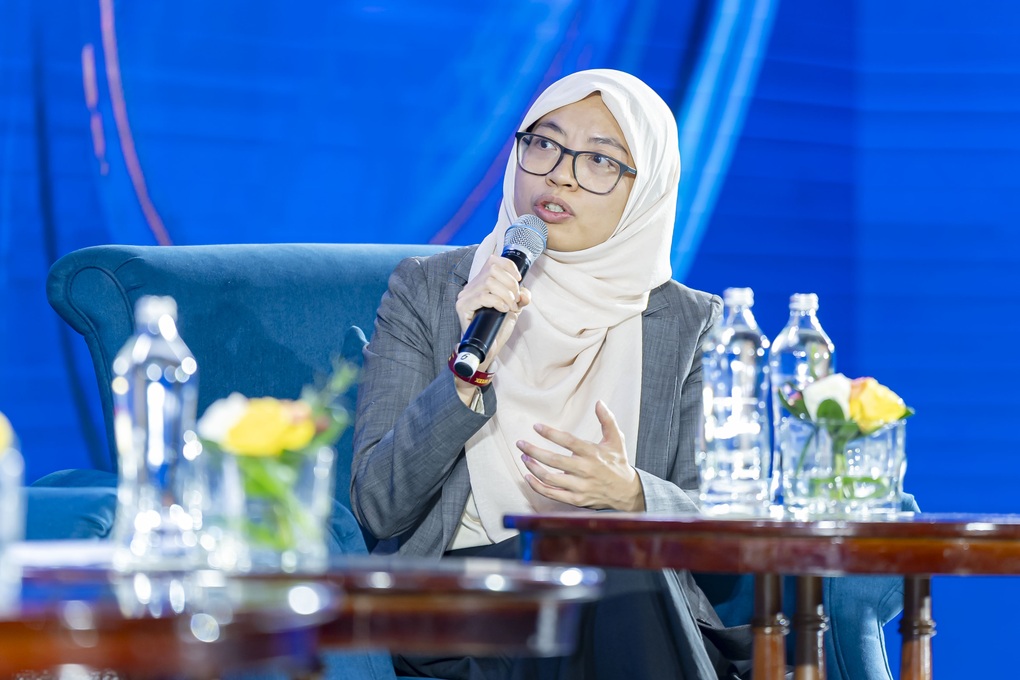
Dr. Nadia Radzman shares at the seminar (Photo: VinFuture).
Peptides like CEP are used to stimulate plant roots to form more nodules, enhancing their ability to naturally fix nitrogen from the air. At the same time, studies on peptide ENOD40 and miRNA help regulate carbon allocation, ensuring plants focus their energy on seed and fruit production most efficiently.
Turning seaweed and by-products into food
The livestock industry, which contributes 14.5% of global greenhouse gas emissions, is also on the verge of a green revolution.
Professor Ermias Kebreab has come up with a solution to use agricultural by-products and seaweed as animal feed.
Kebreab's research shows that adding small amounts of seaweed to cows' diets can reduce methane emissions by 30% to 90% without affecting milk or meat quality.
In Vietnam, available materials such as cassava leaves, cassava residue or forest tea are also proposed to be utilized to reduce both costs and emissions.
In particular, with the advantage of a long coastline and warm seas, Vietnam has the potential to develop large-scale seaweed farming to serve this green livestock industry.
Working together to achieve the 2050 goals
While individual technologies like cloned seeds or low-emission rice are effective, experts agree there is no single “magic wand.”
Professor Raphaël Mercier emphasized the need to combine a "toolkit" including: Breeding, gene editing, artificial intelligence (AI) and smart farming to achieve the goal of increasing food production by 70%.
He also expressed his impression of Vietnam's dynamism and hoped that through the VinFuture Prize, he would be able to connect with domestic scientists to put asexual rice varieties into practical testing.
The future of food security lies not only in the laboratory but also in global collaboration and local flexibility: “We need to break down barriers between sectors, promote applied research and fund basic research,” said Professor Mercier.
Source: https://dantri.com.vn/khoa-hoc/viet-nam-dung-truoc-co-hoi-lam-chu-cong-nghe-hat-giong-lua-moi-tu-duc-20251204102414385.htm


![[Photo] Cat Ba - Green island paradise](/_next/image?url=https%3A%2F%2Fvphoto.vietnam.vn%2Fthumb%2F1200x675%2Fvietnam%2Fresource%2FIMAGE%2F2025%2F12%2F04%2F1764821844074_ndo_br_1-dcbthienduongxanh638-jpg.webp&w=3840&q=75)
































![[VIMC 40 days of lightning speed] Da Nang Port: Unity - Lightning speed - Breakthrough to the finish line](https://vphoto.vietnam.vn/thumb/402x226/vietnam/resource/IMAGE/2025/12/04/1764833540882_cdn_4-12-25.jpeg)
































Comment (0)