

Need to increase public investment to build disaster-resilient schools
Discussing the investment policy of the National Target Program on modernization and improvement of education and training quality for the 2026-2035 period, delegate Tran Hoang Ngan proposed increasing public investment capital for projects to ensure facilities for kindergartens and general schools.
Mr. Ngan said that the current estimated budget of 80,000 billion VND is modest, especially in the context of increasingly severe climate change directly impacting schools.
Mr. Ngan cited the situation of floods on floods, storms on storms causing damage to the infrastructure of thousands of schools across the country. Therefore, investing in building safe educational facilities and schools that can adapt to climate change is extremely important.
“I suggest that there should be a long-term solution to the increasingly severe climate change that is happening today. Building new schools in localities that are often affected by natural disasters and floods should be both a teaching facility and a shelter when floods increase rapidly to protect people’s health and lives,” delegate Tran Hoang Ngan suggested.

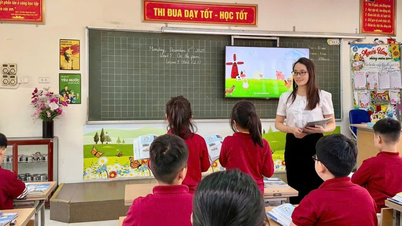
Primary school students in Ho Chi Minh City (Photo: Bao Quyen).
Sharing the same view, delegate Nguyen Thi Ngoc Xuan suggested that, in the goal by 2030, it is necessary to supplement the construction and development of a network of public and private schools, striving to basically meet the needs of students studying 2 sessions/day.
Ms. Xuan affirmed that the actual demand of people for studying 2 sessions/day in an environment with full facilities, modern and safe means is very high. Therefore, the goal is to standardize and modernize facilities not only in public schools but also to have solutions to promote the socialization of education at the general level in the period 2026-2030.
According to Ms. Xuan, it is necessary to have a plan to allocate funds and resources in 2026 and annually so that localities, including commune levels, can decide to invest and organize program implementation according to their authority without having to go through many time-consuming administrative procedures.
Workers' children also need schools like students in mountainous areas.
From the perspective of equality in education, delegate Nguyen Hoang Bao Tran is concerned about beneficiaries being disadvantaged groups.
According to her, inequality in educational opportunities is not only in mountainous areas but also in urban areas. “For many years, when talking about educational difficulties, we often mention remote areas and islands, but have not paid enough attention to another group of people who are equally difficult: children of workers in industrial and export processing zones,” said delegate Tran.
Most of the students are children of workers living in rented rooms of 10-12 square meters. Parents work overtime continuously, have unstable incomes, and do not have enough time to care for and support their children's studies. In some places, more than 70% of children in industrial zones do not have the opportunity to study special subjects, foreign languages, or extracurricular activities because their families' economic conditions do not allow it.
From this situation, Ms. Tran suggested that the national target program must clearly identify children of workers as a group of subjects that need priority support, not just a general group.
In particular, it is necessary to support the construction of public schools near industrial parks along with flexible boarding and semi-boarding school models for workers' children.
“We cannot let a large portion of the children of the core workforce of the economy suffer from educational disadvantages. Educational equity is not only a matter of the mountainous and lowland areas but also within industrial cities,” Ms. Tran emphasized.
The National Target Program on Education is expected to be divided into two phases. The 2026-2030 phase will have a total implementation budget of VND174,673 billion. The next phase, 2031-2035, will have about VND405,460 billion.
Capital allocated for public investment (construction, infrastructure upgrading, equipment purchase) accounts for 83.91% and 90.27% of total capital in the two phases, respectively.
Meanwhile, regular expenditure (investment in people) only accounts for 10.9% and 5.5% respectively.
Preschool and general education received an investment of 202,000 billion VND, accounting for 34.82% of the total capital for 10 years. This capital is used to ensure facilities and teaching equipment to meet the requirements of implementing preschool and general education programs.
Source: https://dantri.com.vn/giao-duc/de-xuat-truong-vung-lu-phai-kiem-them-chuc-nang-tru-an-khi-lu-ve-20251204120512878.htm
![[Photo] Cat Ba - Green island paradise](/_next/image?url=https%3A%2F%2Fvphoto.vietnam.vn%2Fthumb%2F1200x675%2Fvietnam%2Fresource%2FIMAGE%2F2025%2F12%2F04%2F1764821844074_ndo_br_1-dcbthienduongxanh638-jpg.webp&w=3840&q=75)





































![[VIMC 40 days of lightning speed] Da Nang Port: Unity - Lightning speed - Breakthrough to the finish line](https://vphoto.vietnam.vn/thumb/402x226/vietnam/resource/IMAGE/2025/12/04/1764833540882_cdn_4-12-25.jpeg)































Comment (0)