

"The Pro Line" and the hurried shift change
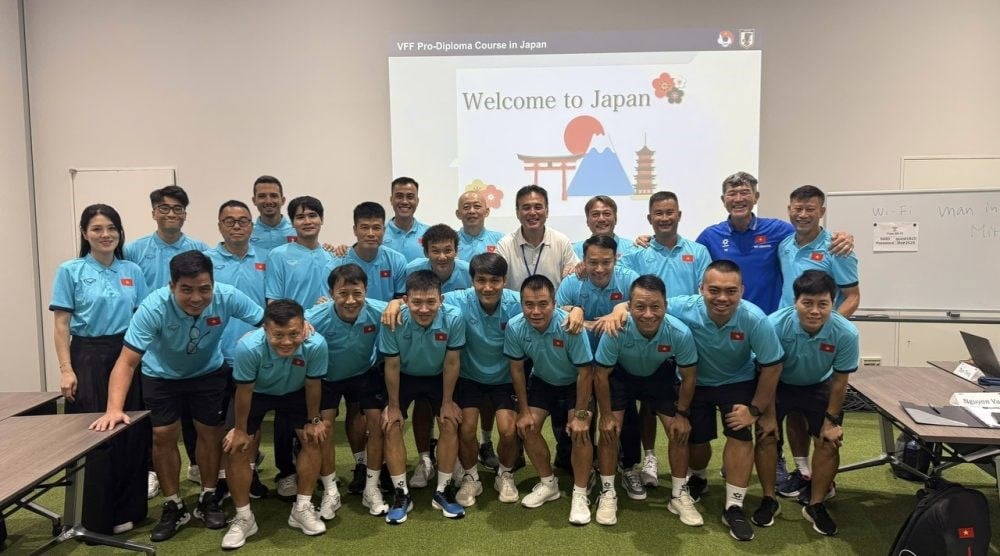
On July 1st, 18 Vietnamese coaches departed for Japan to participate in the second phase of the Professional Coaching Training Course Pro/AFC/VFF. This is not a training trip just to "improve their resumes," but a ticket to survival, because from the 2025/26 season onwards, head coaches of V.League clubs will be required to possess a Pro license or have completed at least 3/4 of the course's program.
Within just a few weeks of the 2024/25 season ending, a series of prominent Vietnamese coaches left the coaching staff simply because they lacked one... coaching certificate. Coach Phung Thanh Phuong parted ways with Ho Chi Minh City FC after two seasons of leading the team to avoid relegation. The man who was once an icon of professionalism and spirit in Saigon football was unexpectedly invited to be an assistant to a strategist from Spain.
In the ancient capital, coach Nguyen Viet Thang played a major role in helping Ninh Binh get promoted, but he also voluntarily stepped down to complete his Pro coaching course, handing over the head coach position to Gerard Albadalejo, who previously coached Barcelona B. In Ha Tinh , coach Nguyen Thanh Cong requested to withdraw due to health and professional reasons, but did not hide his desire to use the time to complete the highest level AFC coaching qualification.
In just one month, the three most successful domestic coaches in the V.League 2024/25 season simultaneously left their positions. They weren't dismissed due to professional incompetence, but rather because of qualification barriers – a new "line" that professional football is establishing.
Conversely, a number of V.League clubs are stepping up the "foreignization" of their coaching staff. Ninh Binh not only has coach Albadalejo but has also appointed a team of five assistants from the same country, including a fitness coach, goalkeeper, analyst, and rehabilitation specialist; Hanoi FC maintains faith in coach Makoto Teguramori; CAHN continues with Mano Polking; The Cong Viettel remains unchanged with the "prodigy" Velizar Popov; Thanh Hoa reunites with coach Tomislav Steinbruckner. Ho Chi Minh City FC is also in negotiations with Spanish strategist Albert Capellas, a coach who has worked at Barcelona, Dortmund, and the Philippine national team.
The appointment of a foreign coach is seen as a necessary step to innovate tactical thinking and adopt modern coaching techniques such as controlling the pace of the game, high-pressure pressing, rapid physical recovery, and player data analysis.
However, the reality of recent seasons raises a big question: are foreign coaches always successful? CAHN has changed coaches like they change clothes, yet they remain languishing in the middle of the table. The Cong Viettel has gone three consecutive years without a trophy. TP.HCM has constantly changed foreign coaches but still struggles to avoid relegation.
The old master temporarily retreated in order to advance.
Among the 18 coaches traveling to Japan this time, there are no shortage of talented and experienced names: Vu Hong Viet (led Nam Dinh to two consecutive championships), Bui Doan Quang Huy (runner-up in V.League 2023/24 with Binh Dinh), Phan Nhu Thuat, Van Sy Son, Nguyen Viet Thang... This is a generation of domestic coaches who have made a significant shift in thinking, received systematic training, and left a clear tactical mark.
In the past, coaches like Le Thuy Hai, Le Huynh Duc, and Chu Dinh Nghiem were known not only for their titles but also for their personal coaching philosophies and styles. In fact, when placed in the right environment, domestic coaches can absolutely match, or even surpass, their foreign counterparts.
The question is whether they have enough "breathing room" to make mistakes and correct them? Do they have enough patience from the club's leadership, a professional coaching staff, and a long-term development plan? Or will they be immediately replaced by a new "foreign coach" after just a few shaky opening matches?
Foreign coaches are often associated with the concept of "professionalism." But professionalism isn't just about standing on the sidelines; it's an entire ecosystem, from youth academy models and data analysis labs to nutrition and sports medicine departments, and proper investment in training domestic coaches. If a club can't even build a standard U15 team or has a GPS system to measure player speed, can it really afford to provide the "input" for a renowned foreign coach?
Conversely, domestic coaches, once they have obtained their Pro license, also need to be given the opportunities they deserve. They need a transparent selection process, long-term contracts with clear KPIs, and a scientifically-backed support team instead of a haphazard approach. Trust doesn't come from words, but from fair treatment of talent.
The AFC's tightening of coaching qualifications is an irreversible trend. Vietnamese football needs to adapt, just as the J.League has done since 2004 or the K.League since 2013. But adaptation doesn't mean sacrificing domestic coaches for foreign ones. The key lies in improving the quality of both sources simultaneously.
No one denies the impact of coaches like Calisto, Toshiya Miura, and Park Hang-seo on Vietnamese football. However, for sustainable development, a system of domestic coaches must be the foundation. The Pro coaching license is the "ladder" that forces Vietnamese coaches to learn, innovate their thinking, and approach professionalism.
Conversely, for a foreign coach to succeed, clubs must have a compatible foundation; you can't hire Mourinho to manage a pitch that's uneven and bumpy like a potato field. Whether a coach is domestic or foreign, it's ultimately just a name. What's important is how we treat their abilities fairly, have a long-term strategy, and a sufficiently robust ecosystem to develop truly professional football.
Source: https://baovanhoa.vn/the-thao/thay-noi-thay-ngoai-va-bai-kiem-tra-cho-bong-da-chuyen-nghiep-149889.html



































































Comment (0)