

When fairness becomes inadequate
In recent years, the Vietnamese education sector has made efforts to innovate the high school graduation exam with the expectation of making it both concise and aiming to achieve many goals including: Assessing the quality of general education, considering graduation recognition, and trying to let universities use university admission results in the spirit of autonomy in enrollment.
To ensure fairness in university admissions when the number of admission methods of schools is increasingly diverse with the increase of a series of capacity assessment exams, thinking assessment exams and internationally certified exams such as SAT, ACT, IELTS..., one of the notable improvements in 2025 is that the Ministry of Education and Training has applied the method of converting scores according to percentiles, in order to create a balance between the subject combinations of the high school graduation exam with each other and with capacity assessment exams, thinking assessment exams...
However, when a modern tool is applied on a non-standardized platform, especially an uneven test system, the effectiveness is unlikely to be as expected. As a result, new injustices quietly appear, destroying the goal of fairness that the reform aims for.

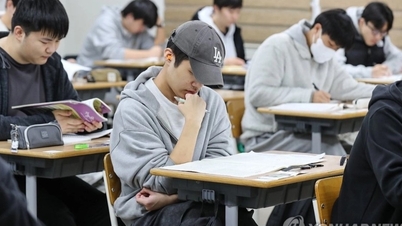
Candidates taking the 2025 high school graduation exam
"Broken" desire
Dr. Hong analyzed that with this approach, candidates lose direction and schools may lose control. The most obvious consequence is the situation of candidates registering their wishes en masse. In 2025, nearly 850,000 candidates registered for more than 7.6 million wishes - that is, an average of 9 wishes per student, far exceeding previous years, the cause of which comes from the uncertainty in score conversion.
When it is not certain which combination will be converted to a favorable result, students are forced to "spread their wishes like rain" to increase their chances of being admitted. This leads to a loss of career orientation, and universities have to face a large number of fake applications, reducing the quality of admission screening.
Non-standardized exams will deviate from the "origin"
Although percentiles are a reasonable tool, they are only effective when the input data is stable. However, currently, the 2025 high school graduation exam is mainly built using expert methods, that is, based on experience, without applying modern measurement theories such as IRT (Item Response Theory).
Therefore, the reliability and difficulty between subjects, years, and even exam codes are very different, leading to inconsistent score distribution. This leads to the consequence that students with high scores in "dense spectrum" subjects may be converted lower than those with low scores in "thin spectrum" subjects, creating a form of reverse injustice, right in the heart of an algorithm that is expected to be "fair".
According to Dr. Hong, when the test matrix is randomly generated, it will be impossible to control the difficulty level for each subject. Another underlying cause is that the test matrix is often randomly generated, drawn from a non-standardized data warehouse. When there is no question bank that is verified by technical parameters, the generated questions are difficult to ensure equivalence, especially in different test codes.
Uncontrolled "test withdrawal" also increases the risk of creating differences in difficulty levels between exam questions, making comparison and conversion meaningless, even when using modern algorithms.
Makes teaching and learning difficult
Another consequence is that the test does not clearly reflect the output competency standards. Without specific assessment criteria, the test setting is easily influenced by personal opinions or tends to test memorization and test-taking tips, instead of assessing the students' true abilities.
When the required achievement is unclear, it is difficult for students and teachers to orient teaching and learning appropriately. In the future, fundamental subjects such as Mathematics and Foreign Languages may be ignored by students if they are considered “disadvantages” in the score combination. If so, comprehensive education will be disrupted.
Currently, many universities convert scores from domestic and international standardized tests (SAT, ACT, IELTS...) for admission in addition to high school exam results. However, these international exams have a high level of standardization, while the high school graduation exam has not achieved equivalent value.
Converting scores from standardized exams into a non-standardized system, or in other words, "taking a standard measure and converting it to a non-standard measure," leads to distortions in capacity assessment, and risks distorting the comprehensiveness of the admission system, causing inequality between groups of candidates.
The exam is the starting point for all assessments and must be the starting point for fairness. To have real fairness, it is necessary to start from the exam itself. Therefore, the Ministry of Education and Training needs to implement it right from the new school year by building a standardized question bank, applying IRT theory; using software to verify and evaluate the reliability, difficulty, and validity of the exam to ensure the exam is equivalent; and publicly announcing the score distribution and score conversion process in a transparent manner. At the same time, it is necessary to clearly separate the objectives of the high school graduation exam.
"If the test is for both graduation and university admission, the test should be designed with two parts: a basic part for graduation and an advanced part for differentiation," said Dr. Hong.
Source: https://vtcnews.vn/thi-sinh-bat-an-rai-nguyen-vong-nhu-mua-can-chuan-hoa-de-thi-ar958925.html






























![[Video] The craft of making Dong Ho folk paintings has been inscribed by UNESCO on the List of Crafts in Need of Urgent Safeguarding.](https://vphoto.vietnam.vn/thumb/402x226/vietnam/resource/IMAGE/2025/12/10/1765350246533_tranh-dong-ho-734-jpg.webp)






























































Comment (0)