

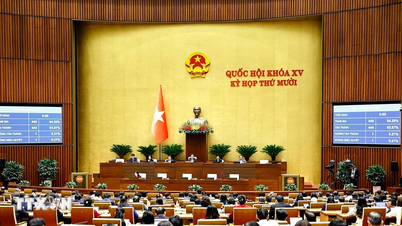
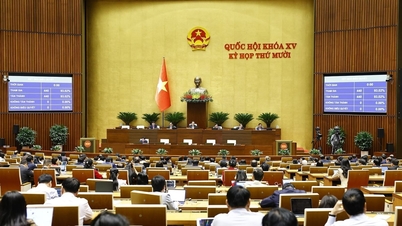
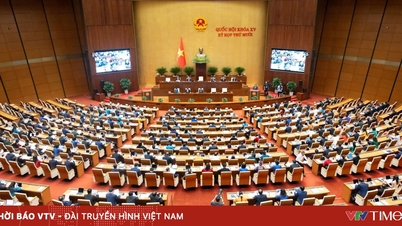
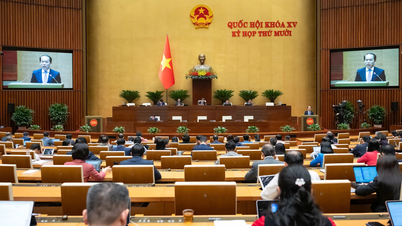
With 100% of the delegates present voting in favor, on the afternoon of December 10th, the National Assembly passed a Resolution on adjusting the National Master Plan for the period 2021-2030, with a vision to 2050.

Minister of Finance Nguyen Van Thang presented his explanatory report before the National Assembly voted.
The resolution defines the vision for 2050 as Vietnam becoming a strong, prosperous, and happy nation; a developed, high-income country with a complete, synchronized, and modern socialist-oriented market economy ; a just, democratic, and civilized society; and social governance based on a complete digital society.
The economy operates according to the principles of the digital economy, green economy, and circular economy; science and technology and innovation are the main drivers of growth.
Vietnam is among the leading industrialized countries in Asia; it is a regional and international financial center; its high-value ecological agricultural economy is among the world's leading; and it holds a solid position and plays an important role in regional and global value chains.
Furthermore, Vietnam has become a strong maritime nation, a maritime economic hub in the Asia-Pacific region; actively and responsibly participating in resolving international and regional issues concerning the sea and oceans. National defense and security are firmly ensured.
Citizens enjoy high-quality social services; a sustainable social security system; diverse and professional social assistance services that promptly support and protect vulnerable groups...
The resolution states that during the period 2031-2050, the goal is to achieve an average GDP growth rate of approximately 7-7.5% per year. By 2050, the GDP per capita at current prices is expected to reach approximately US$38,000; the urbanization rate will reach 70-75%; and the Human Development Index (HDI) will exceed 0.85.
The resolution also outlines development goals for 2030, aiming for an average annual growth rate of gross domestic product (GDP) of over 8% during the 2021-2030 period; with a growth rate of 10% or higher during the 2026-2030 period. By 2030, GDP per capita at current prices is projected to reach approximately US$8,500.
The service sector's share of GDP is over 50%, the industrial and construction sector over 40% (of which manufacturing accounts for approximately 28%), and the agriculture, forestry, and fisheries sector below 10%. The average annual growth rate of social labor productivity is expected to reach approximately 7% during the 2021-2030 period; with over 8.5% per year during the 2026-2030 period. The contribution of total factor productivity (TFP) to growth is expected to exceed 55%.
The potential and level of science, technology, and innovation have reached an advanced level in many important fields, placing Vietnam among the leading countries in the upper-middle income group. The human resources for scientific research, technological development, and innovation reach 12 people per 10,000 inhabitants; there are 40-50 science and technology organizations ranked regionally and globally.
Simultaneously, we must leverage the advantages of each socio-economic region; focusing on developing the two dynamic regions in the North and South, linked to the two growth poles of Hanoi and Ho Chi Minh City, the North-South economic corridor, the Lao Cai - Hanoi - Hai Phong - Quang Ninh economic corridor, and the Moc Bai - Ho Chi Minh City - Bien Hoa - Vung Tau economic corridor, with synchronous and modern infrastructure, high growth rates, and significant contributions to the overall development of the country.
Sustainable urban development along a network; urbanization rate exceeding 50%; striving for 3-5 cities on par with regional and international standards. Building new rural areas that are comprehensive, sustainable, and integrated with urbanization....
Disaster prevention and control is a top priority.
In his explanatory report before the National Assembly's vote, Minister of Finance Nguyen Van Thang stated that the Government has directed a thorough review of the planning targets to ensure consistency and synchronization with the targets outlined in the draft political report submitted to the 14th Party Congress and in the resolutions of the Politburo issued recently. A target regarding the proportion of manufacturing industry to approximately 28% of GDP has been added.
Regarding regional development orientations, according to the Minister, additional content should be included, such as developing the cultural industry, preserving and promoting the value of cultural spaces and heritage in the Red River Delta region, and highlighting the role and development orientation of regional centers for Da Nang and Can Tho cities.
Further emphasis should be placed on developing free trade zones in the Southeast region, and coastal economic zones in the Coastal, South Central, and Central Highlands regions.
Regarding the direction of technical infrastructure development, Mr. Nguyen Van Thang stated that the general direction has been to accelerate the investment process in important transportation infrastructure, meeting the requirements of developing economic corridors and the need for regional and inter-regional connectivity to open up new development spaces and create new impetus to promote economic growth. Additional content has been added regarding research on extending the Hanoi and Ho Chi Minh City urban railway lines and investing in key railway lines.
According to the Minister of Finance, the draft Resolution adds content on disaster prevention and control, considering it a key task with the content of managing and using resources effectively, protecting the environment, proactively adapting to climate change, building, strengthening and upgrading infrastructure for disaster prevention and control, floods, landslides, and addressing flooding, especially in large cities.
Furthermore, Resolution 81 of the National Assembly and the draft Resolution have outlined directions for disaster prevention infrastructure, emphasizing that infrastructure must meet new requirements in the context of natural disasters occurring with greater intensity and frequency.
Implement flood and landslide prevention programs in the midland and mountainous regions. Enhance the capacity for forecasting and warning of natural disasters, build an early warning system for floods, flash floods, and landslides, and proactively relocate residents from areas with high risk of natural disasters.
Source: https://vtcnews.vn/quoc-hoi-chot-den-nam-2050-viet-nam-thanh-nuoc-phat-trien-thu-nhap-cao-ar992215.html



































![[Video] The craft of making Dong Ho folk paintings has been inscribed by UNESCO on the List of Crafts in Need of Urgent Safeguarding.](https://vphoto.vietnam.vn/thumb/402x226/vietnam/resource/IMAGE/2025/12/10/1765350246533_tranh-dong-ho-734-jpg.webp)


























































Comment (0)