

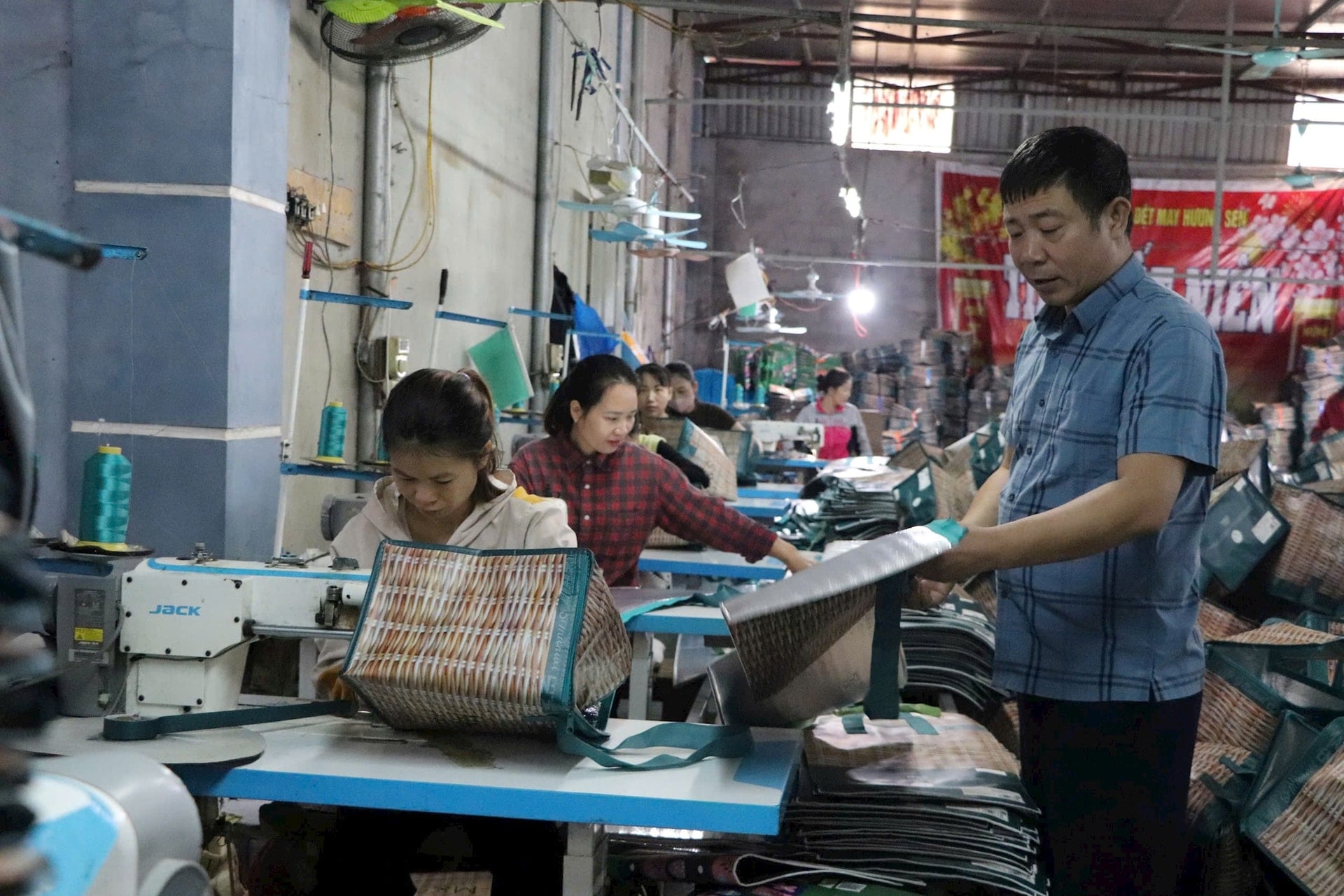
Mr. Tran Van Thinh (standing) at his family's garment factory. Photo: Xuan Tuan
Striving to rise up and become legitimately wealthy.
In the emulation movement for economic development and new rural construction in Bat Bat commune, many exemplary farmers have emerged who dare to think, dare to act, and boldly transform their economic models to rise up and achieve legitimate wealth.
A prime example is the inspiring entrepreneurial story of Mr. Tran Van Thinh (born in 1975) and Ms. Nguyen Thi Sen (born in 1983) in Hamlet 5. Starting from nothing, with unwavering determination and keen vision, they successfully built a large-scale export bag manufacturing facility, turning their dream into reality and becoming a solid source of livelihood for hundreds of local workers.
Born and raised in the rural area of Bat Bat, like many other farming families, Mr. Thinh and Ms. Sen went through years of hardship struggling to make a living, constantly worrying about how to escape poverty and improve their family's economic situation on their ancestral land.
In 2017, recognizing the growing demand for the garment market, while the local economy was still primarily based on small-scale agricultural production, the couple made a bold decision to invest in opening an industrial garment factory.
At that time, this was a risky and unprecedented choice in Bat Bat commune, because an industrial garment factory required large capital, modern machinery, experience in managing production lines, and especially a stable market – things that a farming couple lacked. However, behind this decision was a shrewd vision; they wanted to take a shortcut, embrace the trend of industrialization, and utilize the abundant local workforce. This decision was not only a desire to enrich themselves, but also a wish to create a new economic "foundation," a new direction for the entire Bat Bat commune community.
The bold decision to open a garment factory launched Mr. Thinh and Ms. Sen into a challenging entrepreneurial journey, truly making them "pioneers." Starting with a modest facility of just 200m² with a few basic sewing machines, they immediately faced countless challenges.
The first challenge was capital and equipment. To acquire enough machinery, they had to boldly borrow capital, accepting significant financial risks. The second challenge was the experience in managing and operating the production line. Industrial garment manufacturing requires precision, synchronization, and strict quality management according to export standards.
Mr. Thinh and Ms. Sen had to learn and experiment simultaneously, figuring out everything from factory layout and process organization to workforce management and product quality control. Initially, their lack of experience led to mistakes, waste, and low productivity. They adopted the philosophy of "labor for profit," working twice or three times harder than others, directly participating in every stage of production to gain valuable experience.
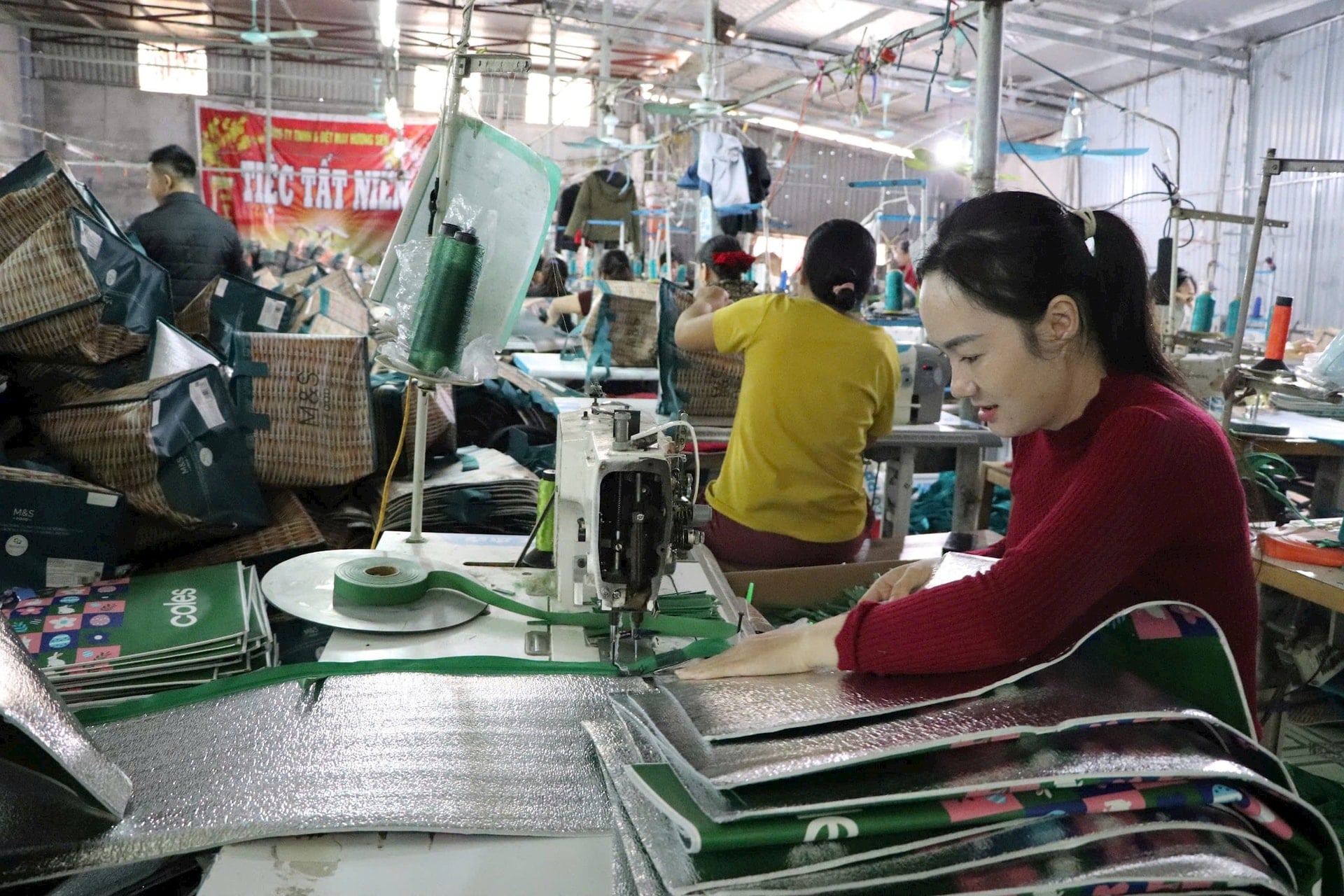
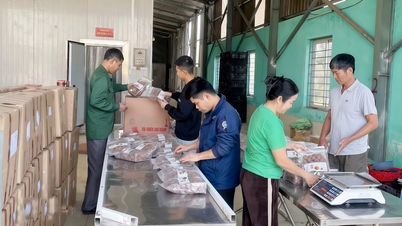
The garment factory owned by Mr. Tran Van Thinh and Ms. Nguyen Thi Sen provides employment for 120 local workers. Photo: Xuan Tuan
The third challenge, and perhaps the biggest, is securing a stable customer base and output.
Their fledgling garment factory lacked a brand and reputation in the fiercely competitive clothing market. They had to find and persuade partners themselves, accepting small, difficult, and urgent orders with low profit margins to gradually build trust. They placed absolute emphasis on product quality, ensuring on-time delivery, and steadily establishing their production capabilities.
Their sincerity, enthusiasm, and credibility have helped them gradually expand their network of partners and stabilize their order base, primarily for producing export bags through large wholesale factories.
With unwavering determination and a never-give-up spirit, Mr. Thinh and Ms. Sen transformed difficulties into motivation, constantly learning new techniques and boldly investing in upgrading machinery and continuously improving technology. They laid a solid foundation for remarkable future development, proving that with willpower and vision, farmers can completely master technology and the industrial market.
Creating stable jobs helps many families in the community.
Their perseverance and tireless efforts over nearly a decade have yielded well-deserved results, completely transforming the scale of production for Mr. Thinh and Ms. Sen's family.
From a small 200m² sewing workshop with just a few initial machines, the couple's business has expanded into a system of four spacious, sturdy sewing workshops, operating systematically and professionally according to the standards of export orders.
This success stems from the fact that they have optimized and professionalized their production process. Unlike small-scale, family-run production, the process at Mr. Thinh's workshop is organized very scientifically in a closed-loop system: Each worker is trained to specialize in a specific stage (from cutting, assembling, sewing, and finishing...).
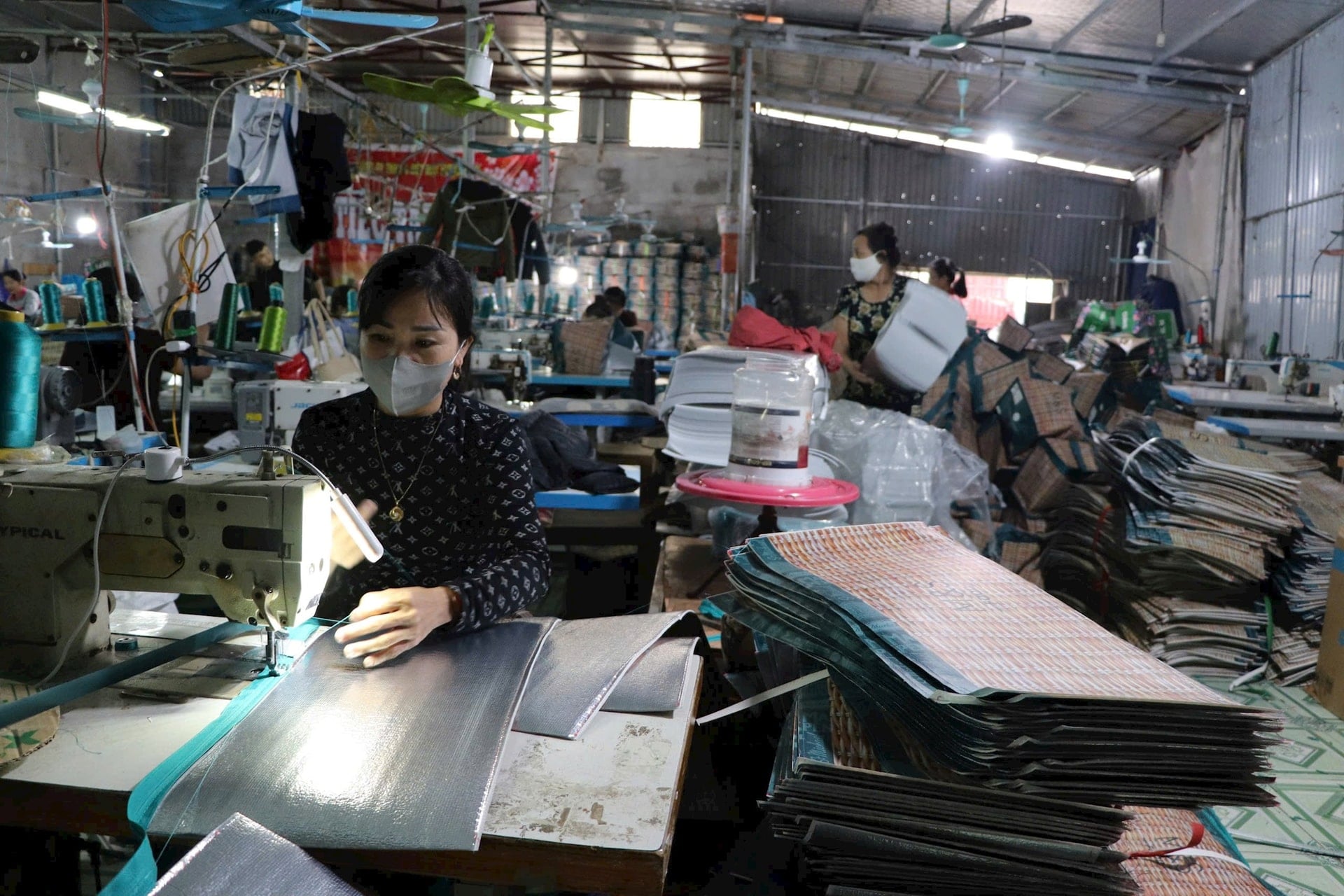
The garment factory not only creates jobs for young people but also provides opportunities for middle-aged and older workers in the area. Photo: Xuan Tuan
The production process at the factory is organized very scientifically by the owners, optimizing productivity. From raw material input, cutting, assembling to final sewing, everything is done in a closed-loop system, with each worker specializing in a specific stage.
“After completion, the products are thoroughly inspected and shipped directly to the main factory in Bac Ninh province for export to foreign markets. Thanks to professionalization, each production line in the factory can produce an average of about 12,000 products per day, meeting the large and demanding orders of international partners,” Ms. Sen said.
This specialization helps improve workers' skills, minimize errors, and optimize labor productivity. Thanks to this professional organization, the garment factory has achieved impressive productivity. On average, each production line can produce about 12,000 products (handbags, backpacks for export) per day. The large production capacity and consistent product quality have enabled the factory to fulfill large orders with stringent technical and deadline requirements from international partners. After completion, the products are thoroughly inspected and transported directly to the main factory in Bac Ninh province for export procedures.
The economic benefits are the clearest evidence of the couple's correct approach. Mr. Thinh shared: "After deducting all labor, raw material, and operating costs, the net revenue of the facility reaches 350-400 million VND/year." This is a dream figure for many households in rural areas.
Beyond enriching themselves, the most valuable aspect of Mr. Thinh and Ms. Sen's economic model is their contribution to the community. With the motto "Leaving agriculture but not leaving home," their garment factory provides regular employment for over 120 workers.
In particular, the garment factory not only attracts young people but also provides opportunities for middle-aged and older workers in the area who need light work suitable for their health. With a stable income of 5 to 7 million VND per person per month, the factory has helped many families in the commune have a good source of income, stabilizing their lives without having to go far away to work.
Besides their business activities, Mr. Thinh and Ms. Sen's family have always been exemplary in strictly adhering to the Party's guidelines and policies, and the State's laws and regulations. Their establishment consistently fulfills its tax obligations to the local authorities and ensures all benefits and policies for its employees, earning the trust and respect of the people.
The story of overcoming difficulties and rising to success of Mr. Tran Van Thinh and Ms. Nguyen Thi Sen is a vivid testament to the innovative and creative spirit of farmers in the new era. This model not only contributes to promoting the economic restructuring of Bat Bat commune but also practically contributes to the construction of advanced new rural areas, building a more prosperous, beautiful, and civilized homeland.
Source: https://hanoimoi.vn/tam-guong-sang-vuon-len-thoat-ngheo-tren-que-huong-bat-bat-726325.html






































































Comment (0)