

On December 10th, the National Assembly passed the Cybersecurity Law with 434 out of 443 participating deputies voting in favor. The law consists of 8 chapters and 45 articles, and will come into effect on July 1st, 2026.
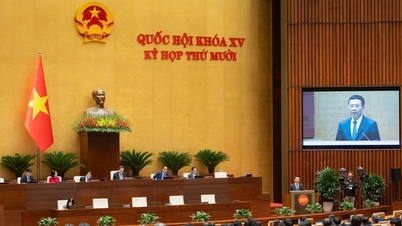
Before the National Assembly voted, on behalf of the Government and authorized by the Prime Minister, Minister of Public Security Luong Tam Quang presented a summary report on the explanation, acceptance, revision, and completion of the draft Law on Cybersecurity. The Minister stated that the law has added provisions to protect vulnerable groups in cyberspace (children, the elderly, and those with cognitive difficulties); and further clarified the basis for increasing the minimum budget allocation for cybersecurity from 10% to 15%.
Notably, Article 7, which stipulates prohibited acts regarding cybersecurity, adds a prohibition against using artificial intelligence or new technologies to falsify videos , images, or voices of others in violation of the law; and creating, posting, or disseminating information (point g, clause 2, Article 7).

Minister of Public Security Luong Tam Quang. (Photo: National Assembly)
Regarding the posting and dissemination of information on the internet (Article 7), several things are strictly prohibited, most notably: Propaganda against the Socialist Republic of Vietnam; Distorting history, denying revolutionary achievements, undermining national unity, insulting religion, discriminating on the basis of gender, and racial discrimination; Fabricating, slandering, and spreading false information that infringes upon the dignity, honor, and reputation of others or causes damage to the legitimate rights and interests of other agencies, organizations, and individuals; Fabricating, slandering, and spreading false information that causes public panic, damages socio-economic activities, hinders the normal operation of state agencies or public officials, and infringes upon the legitimate rights and interests of other agencies, organizations, and individuals.
Article 7 of the law also prohibits certain acts in cyberspace, notably including the following: Appropriating, buying, selling, seizing, or intentionally disclosing information classified as state secrets, work secrets, business secrets, personal secrets, family secrets, and private life secrets that affect the honor, reputation, dignity, rights, and legitimate interests of agencies, organizations, and individuals; intentionally eavesdropping, recording, or illegally filming conversations in cyberspace; disclosing information about civilian cryptographic products, information about customers legally using civilian cryptographic products; using or trading civilian cryptographic products of unknown origin;
Impersonating the websites of agencies, organizations, or individuals; forging, circulating, stealing, buying, selling, collecting, or illegally exchanging credit card information, bank accounts, encrypted assets, or digital assets of others; illegally issuing, providing, or using payment methods; forging documents of agencies or organizations; illegally collecting, using, disseminating, exchanging, transferring, or trading personal information and data of others...
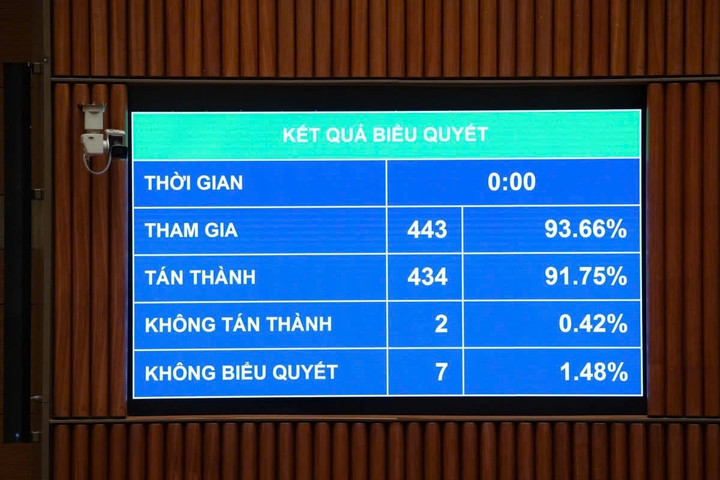
The National Assembly voted to pass the Cybersecurity Law on the morning of December 10th. (Photo: National Assembly)
The law strictly prohibits the following acts: carrying out cyberattacks, cyberterrorism, cyber espionage, cybercrime, and high-tech crimes; illegally accessing telecommunications networks, computer networks, information systems, information processing and control systems, databases, and electronic devices of others...
According to the Minister of Public Security, currently, most information systems of agencies, organizations, and businesses are interconnected and integrated to carry out management, provide services, and conduct online transactions.
Therefore, when an information system is attacked and taken over, it not only affects the information system of that agency, organization, or business, but also impacts the security and safety of the entire information system nationwide or globally.

On the morning of December 10th, the National Assembly voted to pass several laws. (Photo: National Assembly)
According to the Government's assignment, the Ministry of Public Security plays the leading role in coordinating the national cybersecurity incident response and remediation alliance, comprising agencies and businesses, ready to be mobilized to promptly respond to dangerous cybersecurity incidents and situations occurring in the information systems of ministries, departments, localities, corporations, and key economic enterprises.
The United Nations Convention against Cybercrime, signed by 72 countries in Hanoi recently, is legally binding globally and stipulates that each member state designates a 24/7 contact point to ensure the immediate provision of support for investigations, prosecutions, trials, or the collection of electronic data evidence. According to the assignment, the Ministry of Public Security is the focal point in Vietnam responsible for organizing the implementation of the Convention.
As the focal agency responsible for managing cybersecurity nationwide, the Ministry of Public Security is in charge of developing national technical standards and regulations, and guiding organizations and individuals in ensuring cybersecurity for critical national security information systems in all sectors, excluding military information systems.
Source: https://vtcnews.vn/quoc-hoi-thong-qua-luat-an-ninh-mang-bo-sung-quy-dinh-ve-su-dung-ai-ar992208.html































































































Comment (0)