With FDI attracting the second largest share, the real estate sector still has significant room for growth.
Tùng Anh•04/04/2023
In the first quarter of 2023, the real estate sector continued to maintain its second position in attracting foreign direct investment (FDI) with a total investment of nearly US$766 million, accounting for almost 14.1% of the total registered investment; following the leading sector was the manufacturing industry with a total investment of nearly US$4 billion, accounting for 73% of the total investment.
The industrial real estate segment has many bright spots and significant room for developing a wider variety of products.
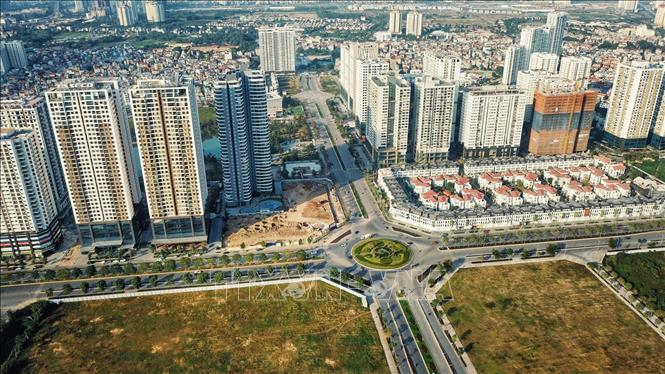
Illustrative photo: VNA
Real estate FDI maintains its second-highest position. According to the Foreign Investment Agency (Ministry of Planning and Investment), as of March 20, 2023, the total registered capital for new projects, adjustments, and capital contributions through share purchases and equity investments by foreign investors reached nearly US$5.45 billion, only 61.2% compared to the same period in 2022. Although the implemented investment capital of foreign investment projects decreased compared to the same period, it improved compared to the first two months of 2023 (down 2.2% compared to the same period and up 2.7 percentage points compared to the first two months of 2023). However, the number of new investment projects continued to increase. Specifically, the number of newly registered projects reached 522 projects, an increase of 62.1% compared to the same period. Following this trend, although still maintaining its second position in attracting FDI, capital inflow into the real estate sector decreased by 71.6% compared to the same period last year. However, experts believe that small and medium-sized foreign investors continue to show interest in and trust Vietnam's investment environment, leading to new investment decisions. Many new investment projects are still concentrated in provinces and cities with many advantages in attracting foreign investment thanks to good infrastructure, stable human resources, efforts to reform administrative procedures, and dynamism in investment promotion such as Bac Giang , Dong Nai, Bac Ninh, Ho Chi Minh City, Hai Phong, etc. Mr. Tran Khanh Quang - General Director of Viet An Hoa Real Estate Investment Joint Stock Company - assessed that the strong increase in foreign capital into the real estate sector shows that investors continue to place their trust in Vietnam's investment environment in general and the real estate sector in particular. Real estate is a preferred investment sector due to its stability and ability to attract large amounts of capital compared to other industries. Notably, within the real estate sector, the industrial real estate segment has witnessed a resurgence in Vietnam after a two-year hiatus caused by the pandemic. Immediately after borders reopened, international investors and clients quickly arranged site surveys, signed memoranda of understanding (MOUs), lease agreements, and purchase and sale agreements. The market is witnessing interest from global manufacturers with significant investment demand, especially in the fields of technology, green energy, logistics, etc. Although some believe that FDI investment in 2023 may slow down due to the economic downturn, many experts assess that the Vietnamese industrial real estate market can maintain demand from investors thanks to advantages in labor, population, infrastructure development, incentives for foreign investors, and the government's efforts to maintain macroeconomic stability. Mr. John Campbell, Deputy Director and Head of Industrial Services at Savills Vietnam, analyzed that the Vietnamese real estate market is benefiting from advantages stemming from the opening of borders, the stable Vietnamese Dong exchange rate, and attractive corporate tax rates. "Given the reality that multinational companies are still seeking to diversify their operations or relocate out of China, Vietnam's industrial real estate market is proving to be a bright spot in attracting investment. Besides experienced investors from South Korea, Japan, Taiwan (China), and China, the market needs more systematic support to attract participation from multinational corporations from the US and Europe," commented John Campbell. Industrial real estate has significant potential for attractiveness. Immediately after the borders reopened, international investors and customers quickly arranged site surveys, signed memoranda of understanding (MOUs), lease agreements, and purchase agreements. A prime example is the "giant" Foxconn's intensified strategy of diversifying its production chain in Bac Giang. With plans to continue expanding its investment scale in the provinces, Foxconn signed a Memorandum of Understanding to explore leasing 50.5 hectares of land in Quang Chau Industrial Park (Bac Giang) to expand its operations with a total investment of approximately US$300 million. Following this, Samsung also increased its total investment in Vietnam to US$20 billion, focusing on developing sectors related to artificial intelligence (AI) and big data. According to Savills' Asia- Pacific Investment Report, the market recorded several notable transactions in Q4 2022. In the South, Matsuya R&D (Japan) invested an additional US$6.7 million in its production line at Ho Nai Industrial Park, Dong Nai province. In addition, Giant Manufacturing (Taiwan - China), a renowned corporation specializing in the production and sale of bicycles and bicycle parts, has invested an additional $13 million in VSIP 2 Industrial Park (Binh Duong). In the North, a notable transaction is Taihan Precision Technology's investment of $5.3 million in Cam Giang, Hai Duong. More recently, the visit of a delegation of 52 American companies, including Boeing, Coca-Cola, Meta, SpaceX, Netflix, and Apple, to Vietnam to explore business opportunities and collaborations demonstrates the confidence of international corporations in Vietnam. This reflects Vietnam's potential to become a new global manufacturing hub in electronics, technology, and other high-value industries.
John Campbell believes that the industrial and manufacturing sectors will continue to lead in attracting foreign investment, with foreign investors showing interest in industrial land and high-quality ready-built housing. However, finding suitable industrial land is currently a challenge for businesses, as occupancy rates remain high. Specifically, in some southern provinces like Binh Duong and Dong Nai, occupancy rates consistently exceed 95%. In the northern market, provinces with developed industrial real estate markets such as Bac Giang and Bac Ninh have high demand with occupancy rates ranging from 96% to 99%. The limited occupancy rates in existing industrial parks will impact the leasing of large spaces. Meanwhile, the supply of new land is not substantial. John Campbell points out that the difficulties in land acquisition, coupled with the recent increase in land prices in Vietnam, are the reasons for this. This inadvertently creates challenges for investors wishing to establish new industrial parks or convert agricultural land to industrial use. To best support supply and meet market demand, investment procedures, legal processes, and project approval processes need to be expedited. Investors also expect faster and more efficient compensation and land clearance processes, and the provision of permits, master plans, construction certificates, and land use rights certificates as quickly as possible. Therefore, the addition of new industrial real estate supply, especially high-quality products built on "smart" and "green" principles as core foundations, such as Green Park (Vinh Phuc) and Logos VSIP Bac Ninh 1 Logistic Park (Bac Ninh), is expected to partially address the market's supply shortage. Commenting on investment potential, Mr. John Campbell stated that Vietnam's industrial real estate market still has ample room for the development of more diverse industrial real estate products such as data centers, cold storage, and logistics. Key opportunities in the logistics sector include last-mile delivery services and the implementation of Logistics 4.0 systems. Furthermore, the shortage of cold storage facilities in Vietnam is a point that investors can leverage to develop new projects. In addition, the build-to-suit factory construction service, designed to meet specific technical requirements, is also attractive to investors.





























































Comment (0)