

On the morning of August 4th, the Industry and Trade Magazine ( Ministry of Industry and Trade ) organized a seminar titled "Solutions to Promote the Participation of Industry and Trade Enterprises in the Carbon Market". At the seminar, representatives from state management agencies, businesses, and associations discussed and recommended solutions for developing and effectively operating the carbon market, encouraging the business community in general, and industry and trade enterprises in particular, to actively participate in and benefit from carbon credits.
Opportunities and challenges for Vietnam when participating in the carbon market.
According to Mr. Hoang Van Tam, from the Energy Saving and Sustainable Development Department (Ministry of Industry and Trade), Vietnam is actively preparing for the official operation of its carbon market from 2029. The period from now until 2028 will focus on building the legal framework, infrastructure, and necessary technical conditions for the implementation of the carbon market.
One of the key objectives is to develop regulations related to reducing greenhouse gas emissions and producing high-quality carbon credits. The Ministry of Industry and Trade is working to enhance the capacity of businesses, helping them understand the regulations and prepare for participation in the carbon market.
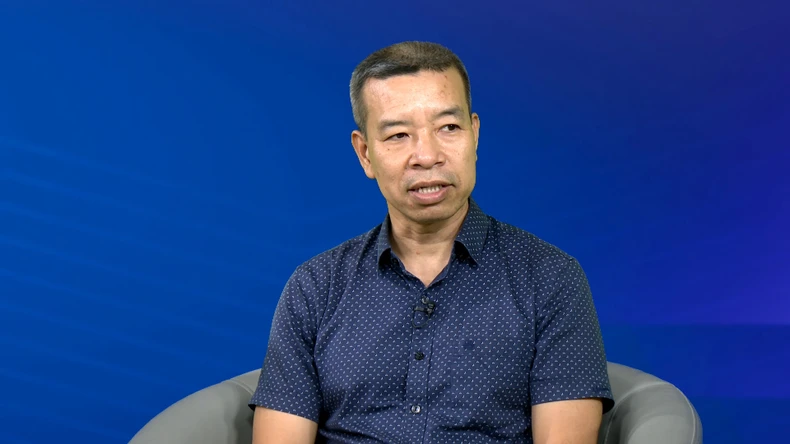 |
Mr. Hoang Van Tam, Department of Energy Saving and Sustainable Development (Ministry of Industry and Trade). |
At the seminar, Mr. Nguyen Vo Truong An, Deputy General Director of ASEAN Carbon Credit Exchange Joint Stock Company, said that the carbon credit market in Vietnam was actually launched in 2018 when the first voluntary carbon credit projects were registered with some of the world's leading assessment organizations such as the Verified Carbon Standard (VCS) or Gold Standard (GS).
However, initially, projects focused primarily on renewable energy and hydropower. The number of carbon credits was relatively small compared to the global average. It wasn't until about the last two years, especially after Vietnam successfully transferred over 10 million carbon credits in 2023, that this topic truly heated up. The community and businesses began to focus on understanding it.
Commenting on the potential of the carbon credit market in Vietnam, Mr. An stated that, regardless of whether it's a quota market, a mandatory market, or a voluntary market, businesses are lacking many elements and facing numerous challenges.
According to Mr. An, the first challenge is the lack of experts in the field of carbon credits.
"I've read some opinions, especially those from leading experts in education and universities, and one of them stated that by 2030, the fields of climate change, climate change response, and carbon credits alone will face a shortage of 150,000 personnel. Clearly, that's a realistic and alarming figure because when we implement a policy, a tool, or a project, the human factor is crucial. That's the first point," Mr. An said.
The second challenge facing businesses, including those experts, is the uncertainty surrounding how the carbon market will operate between a mandatory and a voluntary market.
Thirdly, financing is crucial for green transformation and emission reduction technologies. "How can businesses obtain financing, how can they secure financial support to invest in these technologies to contribute to the Net Zero goal, achieving their own emission reduction targets to support the national Net Zero goal? This is a question mark currently facing the Vietnamese market," Mr. An stated.
And finally, there's the investment in machinery, equipment, and technology. According to Mr. An, this factor will be achieved once countries have found solutions and the necessary finances.
Vietnam has the opportunity because we are still a new and young carbon credit market on the map of carbon credit markets worldwide, and with the current potential in terms of natural resources, forest area, forest cover density, and agricultural sectors, there is still a lot of room for growth.
 |
Mr. Nguyen Vo Truong An, Deputy General Director of ASEAN Carbon Credit Exchange Joint Stock Company. |
Vietnam is currently in the process of establishing a carbon credit market.
To develop the carbon market in Vietnam, the Ministry of Industry and Trade and related agencies are implementing various solutions. Mr. Hoang Van Tam, from the Energy Saving and Sustainable Development Department (Ministry of Industry and Trade), stated that countries around the world have gone through many lengthy stages of development to achieve results in operating such markets.
To date, Vietnam is in the transitional phase of building and gradually operating a carbon credit market, so there is still much work to be done. Vietnam already has important legal grounds such as the 2020 Environmental Protection Law and Government Decree 06/2022/ND-CP on greenhouse gas emission reduction and ozone layer protection. These decrees specifically assign tasks to relevant ministries and agencies to develop and operate a carbon market in Vietnam in the future.
Currently, the highest-level legal framework is in place, but specific regulations for the operation of the carbon market are still being implemented.
According to this expert, Vietnam currently lacks specific regulations. While awaiting guiding documents, organizations and individuals need to clearly understand two pillars: firstly, carbon emission quotas, and secondly, carbon credits. The Ministry of Finance and the Ministry of Natural Resources and Environment are the two agencies responsible for developing and operating the carbon market in the future.
Regarding regulations on inventory, verification, measurement, reporting, and appraisal (also known as MRV), Mr. Tam suggested referencing successful markets such as the EU, China, and the US. From there, adjustments should be made to suit Vietnam's conditions, allowing businesses to start with the simplest methods before gradually increasing the complexity over time.
Close collaboration between the government, businesses, and advisory and support organizations will boost the carbon market in Vietnam.
Source: https://nhandan.vn/nhieu-thach-thuc-dat-ra-voi-doanh-nghiep-khi-tham-gia-thi-truong-carbon-post828433.html
![[Photo] Prime Minister Pham Minh Chinh holds a phone call with the CEO of Russia's Rosatom Corporation.](/_next/image?url=https%3A%2F%2Fvphoto.vietnam.vn%2Fthumb%2F1200x675%2Fvietnam%2Fresource%2FIMAGE%2F2025%2F12%2F11%2F1765464552365_dsc-5295-jpg.webp&w=3840&q=75)

![[Photo] Closing Ceremony of the 10th Session of the 15th National Assembly](/_next/image?url=https%3A%2F%2Fvphoto.vietnam.vn%2Fthumb%2F1200x675%2Fvietnam%2Fresource%2FIMAGE%2F2025%2F12%2F11%2F1765448959967_image-1437-jpg.webp&w=3840&q=75)













































![[OFFICIAL] MISA GROUP ANNOUNCES ITS PIONEERING BRAND POSITIONING IN BUILDING AGENTIC AI FOR BUSINESSES, HOUSEHOLDS, AND THE GOVERNMENT](https://vphoto.vietnam.vn/thumb/402x226/vietnam/resource/IMAGE/2025/12/11/1765444754256_agentic-ai_postfb-scaled.png)














































Comment (0)