

The information was given at the workshop "Consulting on raising awareness on building internationally standardized brands for handicraft products" organized by the Vietnam Craft Village Association on the morning of December 3 in Bac Ninh .
The "soul" of handicraft products
Meritorious Artist Trinh Quoc Dat, Chairman of the Vietnam Craft Villages Association, emphasized that the relationship between brands and products in a market economy is a “parallel and mutual” relationship: brands create added value, and products are the foundation for brands to exist and express their identity. Therefore, craft village products that want to develop sustainably must have a clear brand strategy.

Workshop "Consulting to raise awareness on building internationally standardized brands for handicraft products". Photo: NH
According to Mr. Dat, in the context of the market being flooded with similar products, a strong brand helps distinguish traditional handicrafts from industrial and counterfeit goods. At the same time, a brand is a measure of quality and origin, creating trust for domestic and international consumers.
Not only does it create differentiation, branding also opens the door for products to access modern distribution channels such as supermarkets, e-commerce, and global retail chains. When there is a brand, products are priced more accurately, output is stable, workers' income increases, and rural economic development is contributed to.
Brand protection is a vital factor in preventing counterfeit goods and maintaining the reputation of craft villages. With products of profound cultural value such as wooden furniture, lacquerware, mother-of-pearl inlay, brand is also a tool to preserve identity, creating pride in the “Vietnamese soul”.
“If we consider handicrafts as the essence of national culture, then the brand is the soul that preserves that essence. Without a brand, no matter how beautiful the product is, it will be difficult to price it correctly,” Mr. Dat emphasized.
Where is the bottleneck?
As a country with the longest history of woodworking and handicrafts in Southeast Asia, Vietnam currently has more than 300 woodworking villages and 1,000 handicraft establishments , attracting hundreds of thousands of workers. In 2024, the export turnover of woodworking and handicrafts will reach more than 15 billion USD, accounting for about 7% of the country's total exports. Vietnam is in the Top 5 largest wood product exporting countries in the world , present in more than 160 markets.
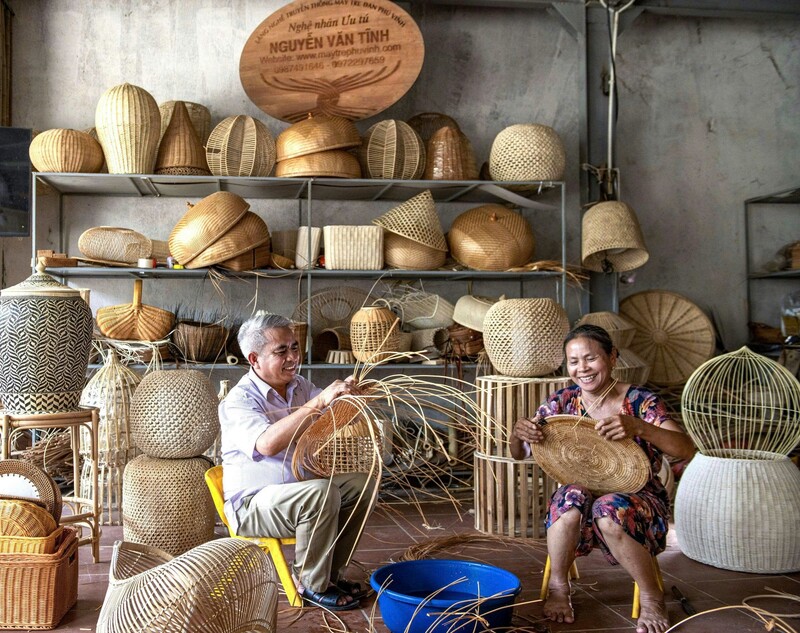
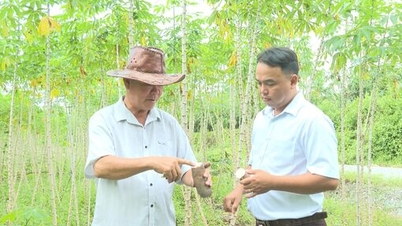
Meritorious artisan Nguyen Van Tinh (left) Phu Vinh traditional bamboo and rattan weaving village. Photo: NH
However, despite large production, Vietnamese products still mainly carry foreign brands. The added value is low, and the “Made in Vietnam” brand has not been affirmed. Many small-scale production facilities have duplicate designs and do not invest in brand recognition, packaging, or product stories.
Requirements on quality, legal wood origin, green, clean and sustainable certification have not been applied uniformly, while these are mandatory conditions of the EU, the US and Japan. Limitations in design, marketing and e-commerce make it difficult for products to reach global consumers despite good quality and competitive prices. Therefore, building a brand that meets international standards is not only a choice, but has become an inevitable trend.
Faced with the increasing demands of the market, many craft villages and businesses have proactively changed towards professionalization. Typically, Dong Ky Fine Arts Wood Craft Village (Bac Ninh) has registered the collective trademark "Dong Ky", built a showroom and promoted exports to Korea and Japan.
La Xuyen craft village (Ninh Binh) is famous for its exquisitely carved wooden products for cultural and religious works, and now has products that have achieved 4-star OCOP certification. Moc Duc Khang Enterprise (Ho Chi Minh City) and Truong Son Company (Hanoi) apply FSC standards - international legal wood sources, opening the way for exports to the EU. Some establishments have applied e-commerce, bringing products to Amazon, Etsy, Alibaba, contributing to promoting the image of Vietnamese wooden products globally.
Artisan Nguyen Thi Hoa, President of the Bac Ninh Women Entrepreneurs Association, said that a brand is not just a logo, but a cultural story told through products. She also highly appreciated the model of linking craft brands with experiential tourism, a direction that Thailand, Indonesia, and Japan have been very successful in.
In Hanoi, there are more than 1,300 craft villages, of which 300 have tourism potential, creating a special advantage for building cultural brands. Craft villages such as Son Dong, Chang Son, Van Ha, Kim Bong, Ha Thai, etc. have welcomed international visitors, creating direct experiences, helping the brand become more vibrant.
Only 20 km from the center of Hanoi, Ha Thai lacquer craft village is building a model of “One destination – many experiences”. The craft village aims to become a unique lacquer art destination by 2030, serving tourists, students and researchers. Artisan Nguyen Thi Hoi proposed that the State support the protection of the collective trademark “Ha Thai Lacquer”, invest in an international standard experience center, provide training in marketing, design, and e-commerce for craftspeople, and promote links between businesses, management agencies and craft villages.
The representative of the Department of Industry and Trade of Bac Ninh province emphasized that a brand in the integration period is no longer a name or logo, but a commitment to quality, cultural values, and competitive advantages. A strong brand can help increase the value of a product many times over and open up the global market.
To raise the level of handicraft brands to international standards, the Department of Industry and Trade proposed a group of key solutions. Accordingly, support the construction of a professional brand identity system with logo and slogan design, standardization of packaging and labels; forming a brand story based on the identity of each craft village. In addition, support businesses to achieve ISO, FSC, CE, FDA...; apply green production, transparent traceability. At the same time, support comprehensive intellectual property protection.
Accordingly, register collective trademarks, certifications, geographical indications. Protect brands in key export markets. Link brands to culture and tourism; digital transformation and cross-border e-commerce; expand international trade promotion.
Representatives of the Department of Industry and Trade of Bac Ninh also affirmed that they will continue to accompany businesses and artisans in brand development, OCOP support, model design, digital transformation and export market expansion.
Experts in the field of international standard brand building is the only way to increase competitiveness, increase value and bring Vietnamese handicraft products to the global market. When the brand becomes a "passport" in the international market, Vietnamese handicraft products not only bring economic value but also spread the national cultural identity, an extremely valuable "soft asset".
Dr. Ton Gia Hoa, Vice President of Vietnam Craft Villages Association emphasized:
Most of the brands of Vietnamese craft village products are often known by the name associated with the craft village, representing the reputation and quality of traditional handicraft products such as: Bat Trang pottery, Van Phuc silk, Chuong village hats, Phu Vinh bamboo and rattan, Hoi mats, Phong Khe do paper, Chuon Ngo mother-of-pearl inlay, Cang Son woodwork, Quat Dong embroidery, Khuon The weaving, Tay Ho hats... Standardization and systematic brand building are prerequisites for Vietnamese products to reach the world.
Nguyen Hanh
Source: https://congthuong.vn/thuong-hieu-chuan-quoc-te-don-bay-cho-hang-thu-cong-my-nghe-433087.html

![[Photo] Parade to celebrate the 50th anniversary of Laos' National Day](/_next/image?url=https%3A%2F%2Fvphoto.vietnam.vn%2Fthumb%2F1200x675%2Fvietnam%2Fresource%2FIMAGE%2F2025%2F12%2F02%2F1764691918289_ndo_br_0-jpg.webp&w=3840&q=75)

![[Photo] Worshiping the Tuyet Son statue - a nearly 400-year-old treasure at Keo Pagoda](/_next/image?url=https%3A%2F%2Fvphoto.vietnam.vn%2Fthumb%2F1200x675%2Fvietnam%2Fresource%2FIMAGE%2F2025%2F12%2F02%2F1764679323086_ndo_br_tempimageomw0hi-4884-jpg.webp&w=3840&q=75)















































































Comment (0)